


About 300,000 undocumented immigrants in Spain are set to be granted residency and work permits, Elma Saiz, the country's Migration Minister, said on Wednesday.
The policy will take effect in May and will be repeated each year for the next three years as Spain looks to expand the country’s ageing workforce. The country has remained largely open to receiving immigrants as other European nations seek to tighten their borders to block illegal crossings and asylum seekers.
Ms Saiz said on Wednesday that Spain needs about 250,000 registered foreign workers a year to maintain its welfare state. She said the legalisation policy is not aimed solely at “cultural wealth and respect for human rights, it’s also prosperity".
“Today, we can say Spain is a better country,” she told national broadcaster Radio Nacional de Espana.
Spain's Prime Minister Pedro Sanchez has often described his government's migration policies as a means to deal with the country's low birth rate.
The policy, approved on Tuesday by Mr Sanchez's leftist minority coalition government, simplifies administrative procedures for short and long-term visas and provides immigrants with more labour protection. It extends a visa previously offered to job-seekers for three months to one year.
In August, Mr Sanchez visited three West African nations to try to address irregular immigration to Spain’s Canary Islands.
The archipelago off the coast of Africa is seen by many as a step towards continental Europe, with young men from Mali, Senegal, Mauritania and elsewhere embarking on dangerous sea voyages seeking better job opportunities abroad or fleeing violence and political instability at home.
By mid-November, about 54,000 immigrants had reached Spain this year by sea or land, according to the country's Interior Ministry. The exact number of people living in Spain illegally is not clear.
Migrant arrivals in Spain - in pictures
-

A boat carrying 156 migrants arrives at La Restinga seaport on the Canary Island of El Hierro, on December 15, after their rescue by the Spanish-based Salvamar Adhara Salvamento Maritimo off the island. AFP -

A member of the Red Cross checks migrants on La Restinga dock on October 26. AFP -

Migrants arrive at La Restinga in Spain's Canary Islands on January 3. EPA -

Migrants at Arguineguin port, in Gran Canaria, Canary islands, on January 2. EPA -

Migrants are fed and wrapped in thermal blankets after arriving at La Garita beach in Arrieta, on the Canary Island of Lanzarote, on December 27. EPA -

Two migrants rest on a beach after arriving at the coast of Teguise in Lanzarote island on December 26. EPA -

Migrants covered in blankets arrive at the port in Arrecife, Canary Islands, in February 2023, after being rescued at sea by Spanish authorities. EPA -
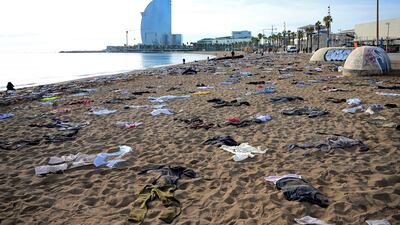
The Spanish NGO Proactiva Open Arms displays clothes at San Sebastian Beach, Barcelona, to draw attention on the migrants dying at sea, on December 11. AFP -

Members of Spanish Maritime Safety and authorities assist rescued migrants on their arrival at Arguineguin in Gran Canaria on July 10. EPA -
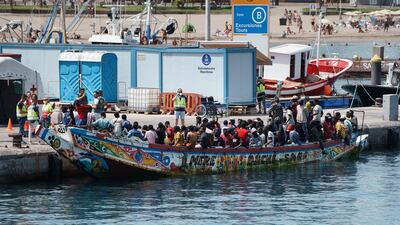
A group of 157 migrants arrives at Los Cristianos harbour, Tenerife, in the Canary Islands on July 4. EPA -

Riot police cordon off the area around the border between the Spanish enclave of Melilla and Morocco after migrants crossed the fences on June 24, 2022. AP -

Red Cross members take care of migrants rescued by Spanish Salvamento Maritimo on their arrival at Motril in Granada, Andalusia, Spain, on April 26, 2022. EPA -

Migrants arrive at the Temporary Centre for Immigrants and Asylum Seekers in Melilla after jumping the border fence from Morocco on March 2, 2022. AFP -

Another boatload of rescued migrants arrives at Arguineguin harbour, Gran Canaria, on February 11, 2022. EPA


Many such immigrants make a living in Spain's underground economy as fruit pickers, caretakers, delivery drivers, or other low-paid but essential jobs often passed over by Spaniards.
Without legal protection, they can be vulnerable to exploitation and abuse. Ms Saiz said the new policy would help to prevent abuse and "combat mafias, fraud and the violation of rights".
Spain's economy is among the fastest-growing in the EU this year, boosted in part by a strong rebound in tourism after the pandemic. In 2023, Spain issued 1.3 million visas to undocumented immigrants, the government said.

