


The powerful European Commission President Ursula von der Leyen appears to have strengthened her bid for a second term in office as her group, the centre-right European People's Party (EPP), emerged as the main winner of Sunday's European election.
With 185 of the European Parliament’s 720 seats, the EPP is projected to come first in a number of countries including Germany, Spain, Poland, the Baltic states and Greece.
"The EPP is the strongest political group in the European Parliament," said Ms von der Leyen.
"Together with others we will build the bastion against the extremes on the right and on the left.”
EPP chairman Manfred Weber said his group was "among the democratic centre parties, the only one [that] increased the number of seats" it won from the previous election.
Ms von der Leyen is viewed as a strong candidate for a second term and has been hailed by many for her management of the Covid-19 pandemic in Europe and strong response to Russia's invasion of Ukraine in 2022.
Yet the 65-year-old German politician is now faced with the difficult task of having to strike deals with groups with opposing views if she wants to keep her job.
The Socialists – Parliament's second biggest group – and the Greens have expressed hostility to her signalling she may be open to work with hard-right Italian Prime Minister Giorgia Meloni and other political parties that are members of the European Conservatives and Reformists, such as Spain's Vox and Poland's Law and Justice.
Backdoor discussions are expected at imminent high-level meetings, including a three-day G7 leaders' summit in Italy that starts on Thursday.
The high-profile event will be hosted by Ms Meloni, who has been described as one of the most influential EU leaders. On Sunday, her arch-conservative Brothers of Italy group gained 28.8 per cent of the vote, more than four times what it took in the last EU election in 2019.
Ms Meloni appears in a stronger position than the leaders of the EU's two largest countries, France and Germany, which both did poorly in the election.
Yet she remained ambiguous over her support to Ms von der Leyen on Monday, saying it was too early to give an answer regarding the possibility of a second mandate.
She said the results showed Europe needed more pragmatic policies and that Italy would play a fundamental role in implementing them.
To secure a second term, Ms von der Leyen needs a qualified majority of at least 15 out of 27 EU leaders and a majority in the European Parliament.
In 2019, she was nominated with only nine votes more than needed despite the EPP already being the largest group. Some MEPs from conservative groups that publicly backed her voted against her in the secret ballot.
The far right is hostile to green policies pushed by Ms von der Leyen and unlikely to vote for her. It remains to be seen how it decides to align itself in the European Parliament, where it was splintered into various groups in the previous legislature.
With 30 politicians from the National Rally, France's largest group of MEPs is projected to come from the far right. Germany's AfD, which came second in the election, is expected to send 15 MEPs.
It will be a delicate balancing act for Ms von der Leyen. Whatever deal she strikes, and with whom, remains to be seen.
European Parliament election results - in pictures
-

Students shout holding a sign reading "no room for fascists" during a protest against the rise of far right parties in Paris, a day after the European Parliament elections. AFP -
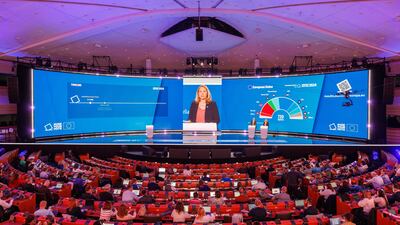
European Parliament representative Delphine Collard presents the election results in Brussels. EPA -
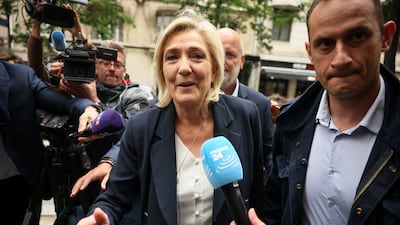
French far-right leader Marine Le Pen arrives at the National Rally party headquarters in Paris. AP -

European Commission President Ursula von der Leyen receives flowers from Christian Democratic Union party leader Friedrich Merz in Berlin. AP -
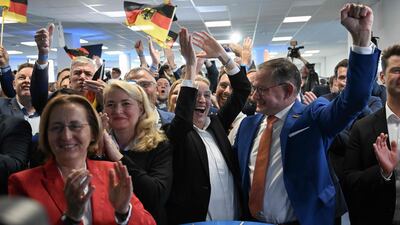
Members of the Alternative for Germany (AfD) party cheer after first exit polls in Berlin. AFP -
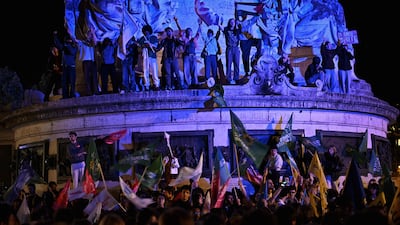
A protest on Republique square in central Paris against French far-right party Rassemblement National. AFP -

German Chancellor Olaf Scholz arrives to attend a meeting with the leadership of his social democratic SPD party in Berlin. AFP -
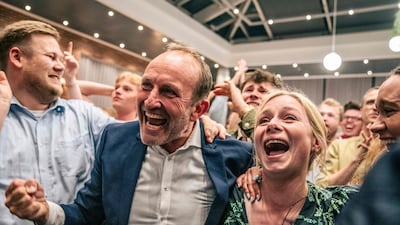
Sigrid Friis and Martin Lidegaard of the Social Liberal Party at an election party in Copenhagen, Denmark. AFP -
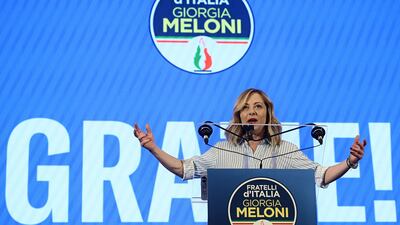
Italy's Prime Minister Giorgia Meloni, leader of the far-right party Brothers of Italy, speaks after the results in Rome. AFP -
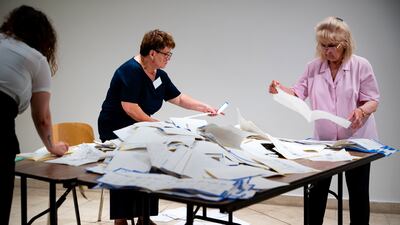
Election officials count the votes in the city of Gyor, north-western Hungary. EPA -

France's President Emmanuel Macron calls a snap general election for June 30. AFP



