


From the corner where the International Gemological Institute stands on one side and the Diamond Bourse on another, as far as the eye can see, the outlets at the heart of a historic Antwerp district have long inspired awe for the sheer concentration of a global trade in the most valuable cut stones.
Within a few minutes' walk are dozens of gems dealers braced for upheaval as the wind of change blows. The latest ban on Russian diamonds by the group of seven (G7) countries has caused what many have described as nothing less than a “revolution” in the centuries-old diamond hub.
Highly rated for the quality of her work and collaborative style, and one of a few jewellers in the world who use a rare yellow diamond from Sierra Leone, Ilana Brandwain seems unfazed, preferring to move with a shift in how customers make their choices. “I'm not afraid of change,” she tells The National, speaking in her office in Antwerp’s largest diamond bourse. Its main room was designed over a century ago with high windows so that light from the north could help traders examine diamonds under their magnifying glasses.
The ban is a consequence of the 2022 invasion of Ukraine by Russia, which produces roughly a third of the world's diamonds. It has triggered a new push for transparency in the diamond sector, which has often suffered from a perception issue due to its association with conflict in popular culture.
But it has also put pressure on the G7 to come up quickly with innovative solutions, triggering a chain of events that have impacted not only Russia and the western world, but also African producer countries and the other two main diamond hubs outside of Antwerp – Dubai and Mumbai.
Whether the G7 can sustain the level of control it hopes for is now an open question in the face of mounting complaints, particularly from African countries.
More transparency is good for Antwerp's reputation and for its customers, said Ms Brandwain, the 47-year-old chief executive of Noble Fine Jewellery and also an enthusiastic promoter of her native city – she regularly gives tours of the diamond bourse to tourists.
Massive restructuring
“The business is going through a phase of massive restructuring,” she said, observing that in past months, her clients have been increasingly asking about the origin of the diamonds she uses in her jewellery, with some explicitly expressing their rejection of Russian diamonds.
She believes that the trend “will expand in the coming years [from the West] to consumers in China and the Middle East”.
Two months into the first phase of the implementation of the G7 ban on Russian diamonds, the sector is learning to adapt to tough new rules that have left many with more questions than answers. The G7 comprises Canada, France, Germany, Italy, Japan, the UK, the US and the EU.
Its pressure led the industry to agree to the adoption of a new code of conduct last October, something that is coming in amid wider pressures from rival parts of the industry of Antwerp to cede a gatekeeper role that has held sway for decades.
The world's most valuable diamonds – in pictures
-
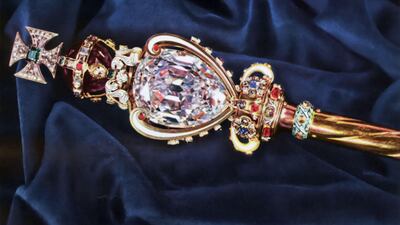
The Cullinan I diamond, or Great Star of Africa, is set in the head of the UK's Sovereign's Sceptre. It is one of nine diamonds cut from original Cullinan, the largest gem-quality rough diamond on record, discovered in South Africa in 1905. Getty Images -
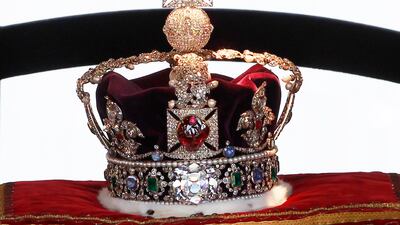
The Cullinan II diamond, or the Second Star of Africa, is also cut from the original Cullinan stone, and set in the front of the UK's Imperial State Crown. Getty Images -
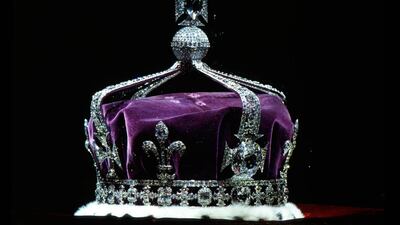
The Koh-i-Noor diamond, one of the largest cut diamonds in the world, is set in the Crown Of Queen Elizabeth, the Queen Mother. Getty Images -
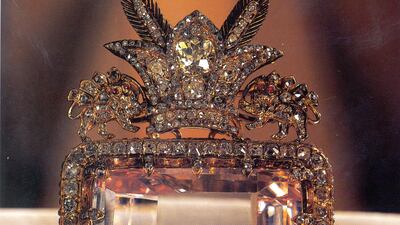
The Daria-i-Noor diamond is another of the world's largest cut diamonds, and is part of the Iranian National Jewels collection of the Central Bank of Iran. Wikimedia Commons -
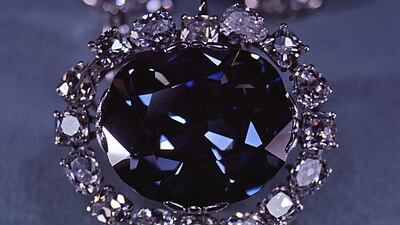
The Hope Diamond, estimated to be worth $200–350 million. It was once owned by King Louis XIV of France in the 1600s, and is now in the National Museum of Natural History in Washington, D.C. Wikimedia Commons -
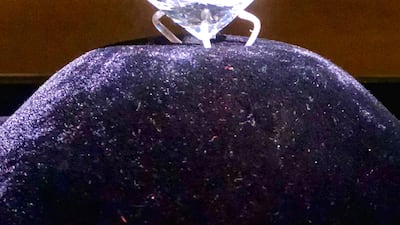
The Jacob Diamond, discovered in 1884, is estimated to be worth £100 million and is owned by the government of India. Wikimedia Commons -
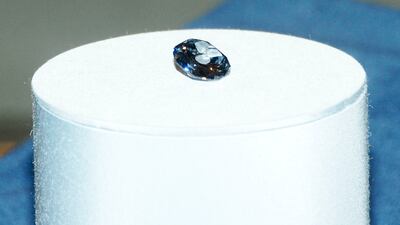
The Wittelsbach-Graff Diamond estimated worth is $80 million. It was discovered in India in the mid 1600s. Getty Images -
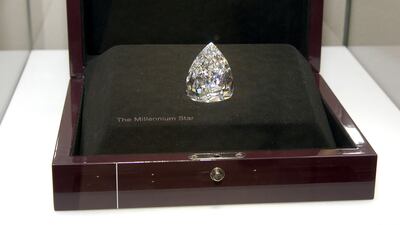
The Millennium Star is a diamond owned by De Beers, and is insured for £100,000,000. It was discovered in the Democratic Republic of Congo, at the time known as Zaire, in 1990. Getty Images -

The Centenary diamond, discovered in South Africa in 1986. Only the Cullinan I and II diamonds are larger than it. Getty Images -
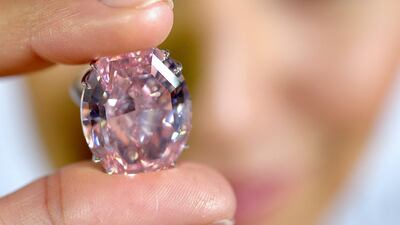
The Pink Star diamond was sold at auction for $71.2 million in Hong Kong in 2017. It was discovered in 1999 in South Africa. AP


Since March 1, importers and traders of diamonds above one carat must submit three times more paperwork than before the introduction of the ban. The extra work triggered delays and protest letters last month but many say the new procedures have now smoothed out.
The Belgian government is keen to showcase its expertise and plans to hire 30 more inspectors at its diamond office – the equivalent of a centralised inspection point. Highly trained civil servants physically check packages of diamonds and determine their origin and value in a matter of minutes.
In parallel, local authorities are developing a digital tracing platform using the blockchain technology that is expected to be implemented from September 1, when the threshold will be lowered to diamonds above half a carat.
Antwerp, the only diamond hub in the G7, would thus become the sole entry point for rough diamonds entering the G7 market – roughly 70 per cent of consumer demand. There is no scientific method of tracing diamonds once they are cut and polished.
Many say that Antwerp is walking a tightrope as it tries to implement rules that are not applied in other major diamond hubs in India and the UAE while also not pushing business away.
president, World Diamond Council
In a signal of the increasing globalisation of the industry, Indian traders now represent more than two thirds of diamond traders in Antwerp, which was historically dominated by the local Jewish population.
A number of “to let” signs in empty shop windows of the city's diamond quarter point at the receding relevance of Belgium as a diamond hub.
Such a deep transformation of the sector has only happened once before, under the so-called the Kimberley Process.
Launched in 2003 to avoid conflict diamonds entering the market, it responded to consumer demand for more transparency as awareness grew of the use of diamonds to fund anti-government insurgencies – hence the expression “blood diamond”, also the name of a 2006 Hollywood blockbuster film starring Leonardo di Caprio as a diamond smuggler.
In a similar fashion, experts say, the war in Ukraine has caused western consumers to reject Russian diamonds, a state-controlled enterprise that represents a revenue stream of €4 billion for the Kremlin.
“Some companies had already been working on increased transparency in the sector, but the G7 sanctions have accelerated this. It's a revolution,” said Ine Tassignon, spokesperson for the Antwerp World Diamond Centre, which represents 1,500 diamond companies.
Kimberley 'the backbone'
Before the war in Ukraine, the vast majority of Russian diamonds came through Antwerp. Now the aim is to bring that figure down to zero. “We are doing everything we can to get this system up and running,” Ms Tassignon told The National.
The Kimberley Process is “the backbone” of the new G7 certification process, she said, as it remains a requirement in addition to proof of the non-Russian origin of the diamond. The latter includes proof of the mining country of origin, an invoice, and an air waybill.
“The Kimberley Process only maps the flow of rough diamonds, and not the flow of polished diamonds. This is included in the G7 mechanism, which thus lays out the diamond’s entire supply chain from rough to polished,” added Ms Tassignon.
But the pushback is strong – so strong that many have been left wondering if the September 1 deadline will be honoured and if Belgium will succeed in becoming the sole entry point for rough diamonds in the G7 market.
“The challenge at this point is around having a physical audit location,” said diamond analyst Paul Zimnisky. “There’s a general agreement on stopping the flow of Russian diamonds to western markets. The trade just doesn't agree on all the nuances of how to go about that.”
The most public criticism has come from Botswana, the world’s second-largest diamond producer behind Russia. Botswana has reportedly been asking the G7 to open a second entry node on its territory and expressed disappointment at not being perceived as trustworthy enough to do so.
“If you make Belgium, Antwerp the single node for verification, gosh, what impudence,” Voice of America quoted Botswana’s President Mokgweetsi Masisi as saying last month. Botswana's state-owned Okavango Diamond Company had not answered questions from The National by the time of publication.
African countries feel that it is not fair to have a western country looking over their shoulder, said Tiffany Stevens, chief executive and general counsel of the non-profit organisation Jewelers Vigilance Committee. “There’s a lot of tension there.”
Global South
A significant segment of the diamond industry supports African countries in their pushback, including the World Diamond Council, which represents industry heavyweights such as De Beers, the world’s second-largest diamond mining company behind Russia’s Alrosa.
Speaking to The National, WDC president Feriel Zerouki said that diamond-producing countries like Botswana should be able to certify their diamonds themselves and that sending them all to Antwerp would drive up costs.
“We are fully aligned with the G7 objectives. What we are pushing back on is the idea that only Belgium can certify the origin of diamonds. There have been bottlenecks and inefficiencies that don’t help the cause. Non-Russian production is being negatively impacted,” said Ms Zerouki.

There is recognition that there has been a lack of consultations with producer countries, said Ms Zerouki. “We want to work with the G7 to create an effective mechanism because we don’t believe that this mechanism is effective in supporting the overall objective.”
The G7 technical committee that oversees the implementation of the Russian diamond ban does not have a spokesperson. The Belgian government did not provide The National with on-the-record comments for this article.
Hans Merket, researcher and policy manager at the International Peace Information Service, an Antwerp-based think tank and NGO, says there are several reasons that explain the initial lack of engagement between the G7 and African producer countries.
Following the outbreak of the war in Ukraine, the Belgian government came under intense public pressure to greenlight sanctions on Russian diamonds. “They had to come up with a solution quickly and its broader ramifications were probably underestimated,” said Mr Merket.
But there are deeper reasons that explain why the G7 decided to go solo, according to Mr Merket, and that is what he views as the failure of the Kimberley Process to reform.
He links this to the reluctance of many member states, including African countries, to move beyond the scheme’s narrow focus on stopping diamonds from funding rebel insurgencies against legitimate governments.
Share not divide
“In the past decade, we have seen instances in which state security services, private security companies or mercenaries were the ones turning diamond mining into violence and conflict, but the Kimberley Process took no responsibility due to resistance to interpret its mandate more broadly,” he said, pointing at cases in Angola, Zimbabwe and Tanzania.
Little has been done about this. Public pressure remained limited because the volume of diamonds mined in conflict areas in Africa was relatively low. But that changed with the conflict between Ukraine and Russia.
“The G7 came up with their own solution but now African countries are not happy with it and there are tensions over how to implement it,” said Mr Merket.
“There are responsibilities on both sides: the G7 should have done more to engage with African countries but most African countries also showed little openness to reform the Kimberley Process into a genuine responsible sourcing mechanism. It’s the failure of this scheme that has led us to where we are today.”
So far, the new G7 process lacks what made the Kimberley Process work: consensus.
“What made the Kimberley Process unique is that pretty much the whole industry agreed on it. It includes 85 countries,” Mr Zimnisky told The National.
“Most of the trade feels that the Kimberley Process needs an update, and to an extent, the G7 sanctions are a newer version, at least as it pertains to the western world.”
At this stage, it is hard to predict whether the ban on Russian diamonds will be fully operational in five months, as initially planned.
“The challenge for Belgium is that it's spending all its energy in keeping the G7 aligned instead of channelling that energy into negotiation with African partners. That makes everything more difficult,” said Mr Merket.


