Water Polo athlete Ioannis Fountoulis lights the cauldron. Reuters

Olympic flame handed to Paris as it prepares to leave Greece on historic sailing ship


Tariq Tahir
  • English
  • Arabic

The Olympic flame is set to begin its voyage from Greece on a historic sailing ship after the torch was handed over to the organisers of Paris 2024 in Athens.

The Belem, a French three-masted sailing ship built in 1896, will take the torch from Piraeus to Marseilles on Saturday. The torch was ignited in a cauldron during a traditional ceremony among the ancient ruins of Olympia in southern Greece, where the games were founded.

After a journey across Greece, it has been burning in a cauldron in front of the 2,500-year-old Parthenon temple, the iconic citadel that dominates the Athens skyline.

At the Panathenaic Stadium in Athens, the site where the modern Olympics were first opened in 1896, the torch was passed on to the Organising Committee of the Paris Olympics 2024.

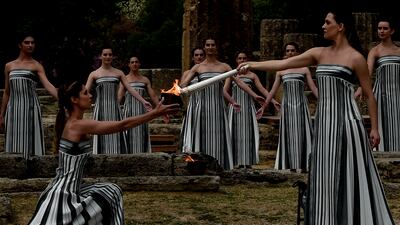
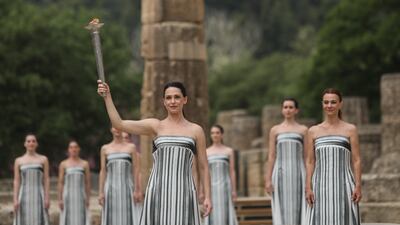
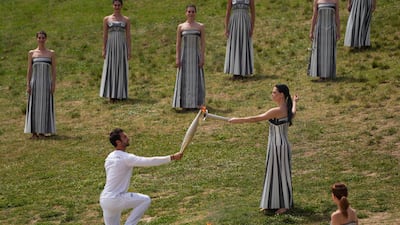
An elaborate ceremony saw the last torchbearer, Tokyo 2020 water polo silver medallist Ioannis Fountoulis, light a cauldron from which a “high priestess” lit the final torch.

The flame will now spend the night at the French embassy before being taken to the Belem for its voyage to Marseille.

After the ship arrives, it will begin a relay around France and visit overseas departments and regions of France, including New Caledonia and French Polynesia.

The handover ceremony at the Panathenaic Stadium, in Athens. Reuters

Some 6,000 police will be deployed for when the flame arrives, said Interior Minister Gerald Darmanin.

He added that the more than 1,000 boats that have signed up to sail with the Belem along the coastline before it arrives in port would all have been inspected and the area "demined" during the day.

Mr Darmanin said an elite tactical unit, bomb disposal teams, nautical police officers and an anti-drone team would be in place to secure the Old Port.

The extra officers will be mobilised on top of local firefighters and police, meaning security will be even tighter than when Pope Francis visited the city in September.

The culmination of its journey will see it light the flame in the Olympic Stadium that will burn throughout the games.

The Belem began its working life as a merchant ship after being launched in Nantes and was then converted into a pleasure boat by a British owner.

The flame will be taken by the sailing ship Belem to France. Photo: Reuters

In 1980, the Belem Foundation was set up to the preserve the vessel as part of France's maritime heritage and its operation as a training ship for young people.

The pageantry which accompanies the flame is meant to provide an ineluctable link between the modern event and the ancient Greek original on which it was initially modelled.

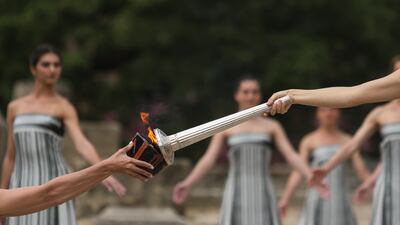
It begins when an actor, playing an ancient Greek priestess, holds a silver torch containing highly combustible materials over a concave mirror.

The sun’s rays bounce off every inch of the burnished metal half-globe and come together at one extremely hot point, which ignites the torch.

The event happens inside the archaeological site at Olympia, before the ancient temple of Hera – wife of Zeus, king of the Greek gods, whose own ruined temple lies close by.

  • Greek actress Mary Mina holds the Olympic torch during the flame lighting ceremony for the Paris 2024 Summer Olympics. Getty Images
    Greek actress Mary Mina holds the Olympic torch during the flame lighting ceremony for the Paris 2024 Summer Olympics. Getty Images
  • The ceremony was held at the Ancient Olympia archeological site, birthplace of the ancient Olympics in Olympia, Greece. EPA
    The ceremony was held at the Ancient Olympia archeological site, birthplace of the ancient Olympics in Olympia, Greece. EPA
  • The Summer Olympics Games will be held in Paris, France from 26 July to 11 August. AP
    The Summer Olympics Games will be held in Paris, France from 26 July to 11 August. AP
  • Mina gives the flame to the first torch bearer, Greek olympic gold medalist Stefanos Ntouskos. AP
    Mina gives the flame to the first torch bearer, Greek olympic gold medalist Stefanos Ntouskos. AP
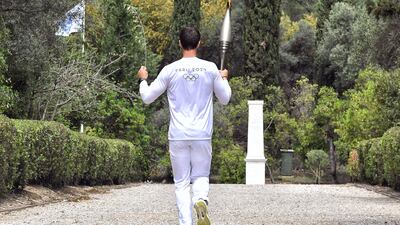
  • Ntouskos carries the Olympic torch. It will now journey across Greece before coming to France. EPA
    Ntouskos carries the Olympic torch. It will now journey across Greece before coming to France. EPA
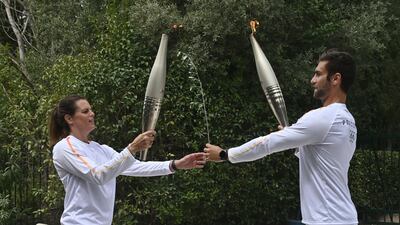
  • Ntouskos (right) lights the torch held by Second French Olympic swimmer, Laure Manaudou. AFP
    Ntouskos (right) lights the torch held by Second French Olympic swimmer, Laure Manaudou. AFP
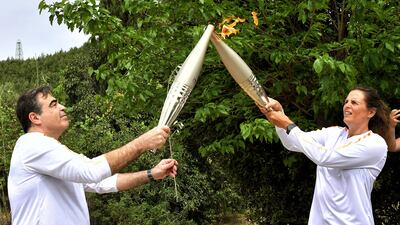
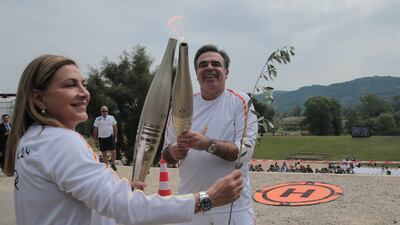
  • Manaudou lights the torch of the third torchbearer vice-president of the European Commission, Margaritis Schinas. Reuters
    Manaudou lights the torch of the third torchbearer vice-president of the European Commission, Margaritis Schinas. Reuters
  • After arriving in Marseille on 8 May, it will travel across the entire country. EPA
    After arriving in Marseille on 8 May, it will travel across the entire country. EPA
  • The Olympic torch will arrive at the Opening Ceremony in Paris on 26 July. EPA
    The Olympic torch will arrive at the Opening Ceremony in Paris on 26 July. EPA
  • The Greek Guard of Honour, Evzones, passes by the Temple of Hera during the flame lighting ceremony. Getty Images
    The Greek Guard of Honour, Evzones, passes by the Temple of Hera during the flame lighting ceremony. Getty Images

Villains
Queens of the Stone Age
Matador

Jetour T1 specs

Engine: 2-litre turbocharged

Power: 254hp

Torque: 390Nm

Price: From Dh126,000

Available: Now

Match info

Arsenal 0

Manchester City 2
Sterling (14'), Bernardo Silva (64')

Who's who in Yemen conflict

Houthis: Iran-backed rebels who occupy Sanaa and run unrecognised government

Yemeni government: Exiled government in Aden led by eight-member Presidential Leadership Council

Southern Transitional Council: Faction in Yemeni government that seeks autonomy for the south

Habrish 'rebels': Tribal-backed forces feuding with STC over control of oil in government territory

While you're here
The five pillars of Islam
UAE currency: the story behind the money in your pockets
Types of policy

Term life insurance: this is the cheapest and most-popular form of life cover. You pay a regular monthly premium for a pre-agreed period, typically anything between five and 25 years, or possibly longer. If you die within that time, the policy will pay a cash lump sum, which is typically tax-free even outside the UAE. If you die after the policy ends, you do not get anything in return. There is no cash-in value at any time. Once you stop paying premiums, cover stops.

Whole-of-life insurance: as its name suggests, this type of life cover is designed to run for the rest of your life. You pay regular monthly premiums and in return, get a guaranteed cash lump sum whenever you die. As a result, premiums are typically much higher than one term life insurance, although they do not usually increase with age. In some cases, you have to keep up premiums for as long as you live, although there may be a cut-off period, say, at age 80 but it can go as high as 95. There are penalties if you don’t last the course and you may get a lot less than you paid in.

Critical illness cover: this pays a cash lump sum if you suffer from a serious illness such as cancer, heart disease or stroke. Some policies cover as many as 50 different illnesses, although cancer triggers by far the most claims. The payout is designed to cover major financial responsibilities such as a mortgage or children’s education fees if you fall ill and are unable to work. It is cost effective to combine it with life insurance, with the policy paying out once if you either die or suffer a serious illness.

Income protection: this pays a replacement income if you fall ill and are unable to continue working. On the best policies, this will continue either until you recover, or reach retirement age. Unlike critical illness cover, policies will typically pay out for stress and musculoskeletal problems such as back trouble.

THE BIG THREE

NOVAK DJOKOVIC
19 grand slam singles titles
Wimbledon: 5 (2011, 14, 15, 18, 19)
French Open: 2 (2016, 21)
US Open: 3 (2011, 15, 18)
Australian Open: 9 (2008, 11, 12, 13, 15, 16, 19, 20, 21)
Prize money: $150m

ROGER FEDERER
20 grand slam singles titles
Wimbledon: 8 (2003, 04, 05, 06, 07, 09, 12, 17)
French Open: 1 (2009)
US Open: 5 (2004, 05, 06, 07, 08)
Australian Open: 6 (2004, 06, 07, 10, 17, 18)
Prize money: $130m

RAFAEL NADAL
20 grand slam singles titles
Wimbledon: 2 (2008, 10)
French Open: 13 (2005, 06, 07, 08, 10, 11, 12, 13, 14, 17, 18, 19, 20)
US Open: 4 (2010, 13, 17, 19)
Australian Open: 1 (2009)
Prize money: $125m

%20Ramez%20Gab%20Min%20El%20Akher
%3Cp%3E%3Cstrong%3ECreator%3A%3C%2Fstrong%3E%20Ramez%20Galal%3C%2Fp%3E%0A%3Cp%3E%3Cstrong%3EStarring%3A%3C%2Fstrong%3E%20Ramez%20Galal%3C%2Fp%3E%0A%3Cp%3E%3Cstrong%3EStreaming%20on%3A%20%3C%2Fstrong%3EMBC%20Shahid%3C%2Fp%3E%0A%3Cp%3E%3Cstrong%3ERating%3A%20%3C%2Fstrong%3E2.5%2F5%3C%2Fp%3E%0A
Updated: May 02, 2024, 8:12 AM