

India sent military helicopters and special forces scoured densely forested mountains in Indian-administered Kashmir on Wednesday for gunmen who killed at least 26 people at a tourist spot.
The attack took place at Baisaran in Pahalgam, a Himalayan summer resort, on Tuesday afternoon, when the attackers emerged from the forest and raked the crowds of visitors with automatic gunfire.
There were about 200 tourists and locals, including women and children, at the spot, which is surrounded by pine trees and a glacial lake and is accessible only on foot or by pony.
Those killed were all men, and included a citizen of Nepal, a former Indian government official, a former naval officer, and an air force employee. Another 17 people were injured.
The attack was the deadliest in more than two decades in India’s restive Kashmir region, where militants have waged an insurgency seeking independence or accession to Pakistan.
-
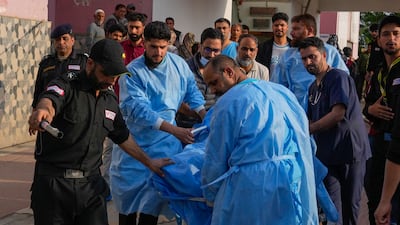
Paramedics at a hospital in Anantnag after gunmen attacked Indian tourists visiting Pahalgam, Kashmir, on April 22. AP -
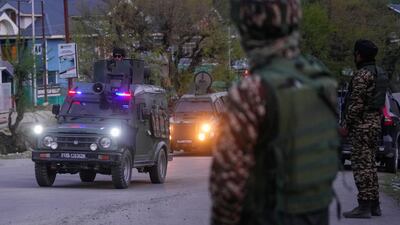
Indian security officers patrol the streets of Pahalgam following the attack. AP -
At least five tourists were killed and several others injured. Getty images -
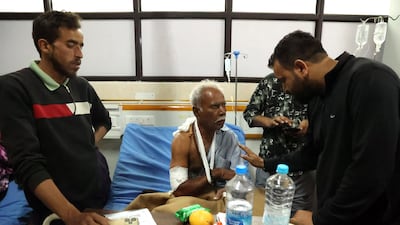
Authorities have condemned the attack as the most severe targeting civilians in the region in recent years. Reuters -
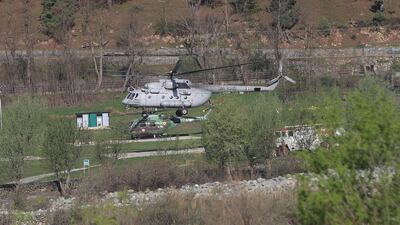
Prime Minister Narendra Modi has cut short his trip to Saudi Arabia and returned to India. EPA -
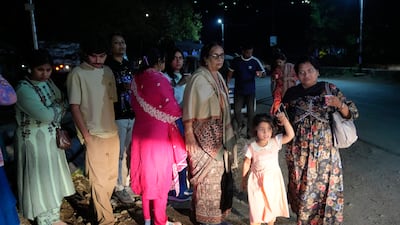
Indian tourists were stuck on the road heading to Pahalgam after the attack. AP -
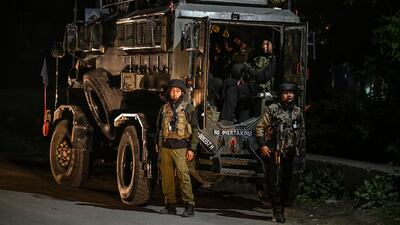
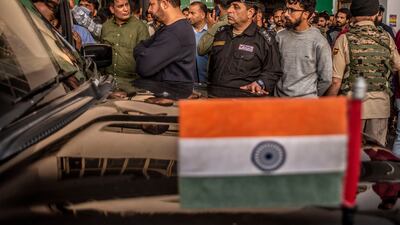
Indian army personnel stand guard near Pahalgam, south of Srinagar. AFP


Prime Minister Narendra Modi cut short his trip to Saudi Arabia and returned to New Delhi on Wednesday, where he held a meeting with National Security Adviser Ajit Doval and External Affairs Minister Subrahmanyam Jaishankar.
Home Minister Amit Shah, who supervises India’s internal security, visited Baisaran and laid wreaths on the bodies of the victims. He also met with the families of the dead and survivors and assured them that the “culprits of the dastardly attacks will not be spared”.
A group calling itself the Resistance Front claimed the attack, saying it was targeted at people from outside the region who "arrive posing as tourists, obtain domiciles, and then begin to act as if they own the land", local media reported.

Indian authorities released sketches of the attackers and gave the names of three as Asif Fuji, Suleman Shah and Abu Talha.
Indian authorities have hinted at Pakistan’s role in the attack, which coincided with a fierce gun battle along the Line of Control – the de facto border dividing the Kashmir region between India and Pakistan.
The Indian army said it shot two alleged infiltrators trying to enter the Kashmir valley in Uri region, north of the capital Srinagar.
Tuesday’s attack was the largest since March 2000, when militants shot dead 35 people from the Sikh community in the Chittisinghpura area of the valley. The attack coincided with the visit of then-US president Bill Clinton to New Delhi.
Tuesday's attack came during a visit by US Vice President JD Vance, whose wife is of Indian origin.
"Usha and I extend our condolences to the victims of the devastating terrorist attack in Pahalgam, India. Over the past few days, we have been overcome with the beauty of this country and its people. Our thoughts and prayers are with them as they mourn this horrific attack," Mr Vance wrote on X.
Control of the Kashmir region is divided between India and Pakistan but both claim it in its entirety since British occupiers left the subcontinent in 1947.
Kashmir valley has been in the grip of a decades-long armed rebellion against New Delhi’s rule that has left tens of thousands of people dead. The region has an estimated 500,000 soldiers permanently stationed in the territory, with overall armed militancy witnessing a sharp decline in recent years.
Mr Modi’s government revoked the region's semi-autonomous status in 2019, months after 40 paramilitary troops were killed in Kashmir’s Pulwama district.
The government claimed that “peace and normality” had returned to the valley and promoted tourism to the region, known for its glacial lakes, snow-capped mountains, alpine meadows and pine forests. Tourism had dipped at the peak of insurgency in the 1990s, but has surged in recent years.
“This is a crime against humanity, it is not about tourism or the economy. Our head hangs in shame,” Asif Burza, owner of the Ahad Hotel in Pahalgam, told The National.
“We are trying to make the tourists comfortable and trying to comfort them,” he said.
Pahalgam, located east of Srinagar, is a heavily fortified region used as a base camp for the Amarnath pilgrimage to a cave shrine dedicated to the Hindu god Shiva, which draws nearly half a million people every summer. This year’s pilgrimage is expected to begin in July.
Tuesday’s attack has shaken the nation and sparked fears among residents of Kashmir that it will disrupt tourism, a major contributor to the local economy.

