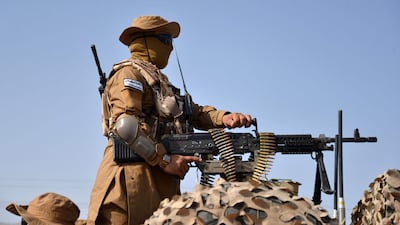
Afghan women say they fear worse is to come after the Taliban introduced a morality law this week that formalises and expands on the increasingly severe restrictions imposed on them since the hardline group seized power three years ago.
The law introduced on Wednesday by the Taliban’s Ministry of Justice is based on a decree by its supreme leader, Haibatullah Akhundzada, and will be enforced by its Ministry of Preventing Vice and Promoting Virtue.
Many of its 35 articles mandate more rigorous adherence to rules already in force, such as the requirement for women to cover their bodies and faces.
“Women were already adhering to strict dress codes, including wearing hijabs, long clothing, and even masks,” said Sara Wahedi, chief executive of Afghan tech company Ehtesab, and a vocal critic of Taliban policies. “The fact that the supreme leader felt the need to codify this further reveals that the Taliban’s ultimate goal is the systematic erasure of women.”
The law also introduces new restrictions. For instance, women are not allowed to speak loudly, or to sing, recite or read aloud in public, since the sound of their voices is considered too intimate. Some provisions apply to men, such as Article 22 that forbids them from wearing a tie or shaving their beards, which are required to be of “fist length”.
The Taliban began imposing bans on women’s rights and movement soon after seizing power in August 2021. Young women and girls have been banned from attending universities and secondary schools; women were forbidden from many jobs in the public and private sector, and allowed to travel only in the company of a male guardian.
“They do not want to see women in the public, and I think they have caught wind of the fact that women have been protesting by manoeuvring through all these restrictions, and that infuriates them even more,” said Ms Wahedi, who lives outside the country.
An activist from Kabul who asked to be identified only as Amina said the Taliban were seeking to close off any way of working around their rules.
“Women have been consistently facing challenges from the Taliban since they took over. But we have also been finding new and unique ways to resist and fight these problems, to protest, to work or study,” she said.
“We look for new ways to simply survive, but they find ways to limit women further.”
Systemic oppression
Ms Wahedi fears the new law has opened the door for women to be exploited. Although it lists offences, these are not clearly defined and the punishments for each are not specified.
“Now that this decree is codified, the Taliban has given the morality police the authority to interpret and enforce it as they see fit,” she said.
“This means the law is now at the discretion of individual men who can decide how to execute it – whether that results in imprisonment or physical punishment is unclear.”
The result, she says, is an “unpredictable and deeply disturbing” environment for women in the country. “The complete lack of protection for women is terrifying.”
The Taliban this week barred entry to Richard Bennett, the UN’s special rapporteur on Afghanistan, who issued a scathing report last month on the hardline group's treatment of women, calling it a “crime against humanity”.
Ms Wahedi said Mr Bennett being barred from the country felt like a significant blow.
“I didn’t think things could worsen after such a clear message to the international community. Yet, less than a day later, the new decrees were announced, and I felt sick to my stomach, similar to the education ban announcement,” she said.
New law, same old Taliban
The new laws are reminiscent of the Taliban's first time in power in the 1990s, when women were forbidden from participating in public, political and economic life. The group promised a new approach to women’s rights when manoeuvring for a return to power, before they seized control by force in August 2021.
The reality is very different, says Sahar Fetrat, researcher with the Women’s Rights Division at Human Rights Watch.
“We have repeatedly witnessed how deeply rooted the Taliban’s misogyny is, stripping women of their personhood at every turn,” said Ms Fetrat. “The Taliban are consistently unlocking new levels of hatred toward women.”
She said the new rules “persistently sexualise and objectify women” and were a pretext to confine them to their homes. “They strive to dehumanise women to the point of complete suffocation – all while the world watches,” she said.
The burden is heavier for women such as Amina who are the providers for their households. “I was a university student when the Taliban took over in 2021. I didn’t get to finish my degree because of the education ban,” she said. “Now I can’t work to support my family of eight people.”
With no male members for her family to fall back on, her inability to provide for them is causing her severe mental trauma, she said. In a different life, Amina had wanted to pursue a career in politics.
“But women in Afghanistan have no choices left; either become beggars on the streets to support their families or end their lives,” she said, choking back tears.

Classification of skills
A worker is categorised as skilled by the MOHRE based on nine levels given in the International Standard Classification of Occupations (ISCO) issued by the International Labour Organisation.
A skilled worker would be someone at a professional level (levels 1 – 5) which includes managers, professionals, technicians and associate professionals, clerical support workers, and service and sales workers.
The worker must also have an attested educational certificate higher than secondary or an equivalent certification, and earn a monthly salary of at least Dh4,000.
Stree
Producer: Maddock Films, Jio Movies
Director: Amar Kaushik
Cast: Rajkummar Rao, Shraddha Kapoor, Pankaj Tripathi, Aparshakti Khurana, Abhishek Banerjee
Rating: 3.5
Benefits of first-time home buyers' scheme
- Priority access to new homes from participating developers
- Discounts on sales price of off-plan units
- Flexible payment plans from developers
- Mortgages with better interest rates, faster approval times and reduced fees
- DLD registration fee can be paid through banks or credit cards at zero interest rates
Company%20Profile
%3Cp%3E%3Cstrong%3EName%3A%3C%2Fstrong%3E%20HyveGeo%3Cbr%3E%3Cstrong%3EStarted%3A%3C%2Fstrong%3E%202023%3Cbr%3E%3Cstrong%3EFounders%3A%3C%2Fstrong%3E%20Abdulaziz%20bin%20Redha%2C%20Dr%20Samsurin%20Welch%2C%20Eva%20Morales%20and%20Dr%20Harjit%20Singh%3Cbr%3E%3Cstrong%3EBased%3A%20%3C%2Fstrong%3ECambridge%20and%20Dubai%3Cbr%3E%3Cstrong%3ENumber%20of%20employees%3A%3C%2Fstrong%3E%208%3Cbr%3E%3Cstrong%3EIndustry%3A%20%3C%2Fstrong%3ESustainability%20%26amp%3B%20Environment%3Cbr%3E%3Cstrong%3EFunding%3A%20%3C%2Fstrong%3E%24200%2C000%20plus%20undisclosed%20grant%3Cbr%3E%3Cstrong%3EInvestors%3A%20%3C%2Fstrong%3EVenture%20capital%20and%20government%3C%2Fp%3E%0A
WWE TLC results
Asuka won the SmackDown Women's title in a TLC triple threat with Becky Lynch and Charlotte Flair
Dean Ambrose won the Intercontinental title against Seth Rollins
Daniel Bryan retained the WWE World Heavyweight Championship against AJ Styles
Ronda Rousey retained the Raw Women's Championship against Nia Jax
Rey Mysterio beat Randy Orton in a chairs match
Finn Balor defeated Drew McIntyre
Natalya beat Ruby Riott in a tables match
Braun Strowman beat Baron Corbin in a TLC match
Sheamus and Cesaro retained the SmackDown Tag Titles against The Usos and New Day
R-Truth and Carmella won the Mixed Match Challenge by beating Jinder Mahal and Alicia Fox
Ten tax points to be aware of in 2026
1. Domestic VAT refund amendments: request your refund within five years
If a business does not apply for the refund on time, they lose their credit.
2. E-invoicing in the UAE
Businesses should continue preparing for the implementation of e-invoicing in the UAE, with 2026 a preparation and transition period ahead of phased mandatory adoption.
3. More tax audits
Tax authorities are increasingly using data already available across multiple filings to identify audit risks.
4. More beneficial VAT and excise tax penalty regime
Tax disputes are expected to become more frequent and more structured, with clearer administrative objection and appeal processes. The UAE has adopted a new penalty regime for VAT and excise disputes, which now mirrors the penalty regime for corporate tax.
5. Greater emphasis on statutory audit
There is a greater need for the accuracy of financial statements. The International Financial Reporting Standards standards need to be strictly adhered to and, as a result, the quality of the audits will need to increase.
6. Further transfer pricing enforcement
Transfer pricing enforcement, which refers to the practice of establishing prices for internal transactions between related entities, is expected to broaden in scope. The UAE will shortly open the possibility to negotiate advance pricing agreements, or essentially rulings for transfer pricing purposes.
7. Limited time periods for audits
Recent amendments also introduce a default five-year limitation period for tax audits and assessments, subject to specific statutory exceptions. While the standard audit and assessment period is five years, this may be extended to up to 15 years in cases involving fraud or tax evasion.
8. Pillar 2 implementation
Many multinational groups will begin to feel the practical effect of the Domestic Minimum Top-Up Tax (DMTT), the UAE's implementation of the OECD’s global minimum tax under Pillar 2. While the rules apply for financial years starting on or after January 1, 2025, it is 2026 that marks the transition to an operational phase.
9. Reduced compliance obligations for imported goods and services
Businesses that apply the reverse-charge mechanism for VAT purposes in the UAE may benefit from reduced compliance obligations.
10. Substance and CbC reporting focus
Tax authorities are expected to continue strengthening the enforcement of economic substance and Country-by-Country (CbC) reporting frameworks. In the UAE, these regimes are increasingly being used as risk-assessment tools, providing tax authorities with a comprehensive view of multinational groups’ global footprints and enabling them to assess whether profits are aligned with real economic activity.
Contributed by Thomas Vanhee and Hend Rashwan, Aurifer
Abu Dhabi GP starting grid
1 Lewis Hamilton (Mercedes)
2 Valtteri Bottas (Mercedes)
3 Sebastian Vettel (Ferrari)
4 Kimi Raikkonen (Ferrari)
5 Daniel Ricciardo (Red Bull)
6 Max Verstappen (Red Bull)
7 Romain Grosjean (Haas)
8 Charles Leclerc (Sauber)
9 Esteban Ocon (Force India)
10 Nico Hulkenberg (Renault)
11 Carlos Sainz (Renault)
12 Marcus Ericsson (Sauber)
13 Kevin Magnussen (Haas)
14 Sergio Perez (Force India)
15 Fernando Alonso (McLaren)
16 Brendon Hartley (Toro Rosso)
17 Pierre Gasly (Toro Rosso)
18 Stoffe Vandoorne (McLaren)
19 Sergey Sirotkin (Williams)
20 Lance Stroll (Williams)
How to avoid crypto fraud
- Use unique usernames and passwords while enabling multi-factor authentication.
- Use an offline private key, a physical device that requires manual activation, whenever you access your wallet.
- Avoid suspicious social media ads promoting fraudulent schemes.
- Only invest in crypto projects that you fully understand.
- Critically assess whether a project’s promises or returns seem too good to be true.
- Only use reputable platforms that have a track record of strong regulatory compliance.
- Store funds in hardware wallets as opposed to online exchanges.
The BIO:
He became the first Emirati to climb Mount Everest in 2011, from the south section in Nepal
He ascended Mount Everest the next year from the more treacherous north Tibetan side
By 2015, he had completed the Explorers Grand Slam
Last year, he conquered K2, the world’s second-highest mountain located on the Pakistan-Chinese border
He carries dried camel meat, dried dates and a wheat mixture for the final summit push
His new goal is to climb 14 peaks that are more than 8,000 metres above sea level
The Kingfisher Secret
Anonymous, Penguin Books