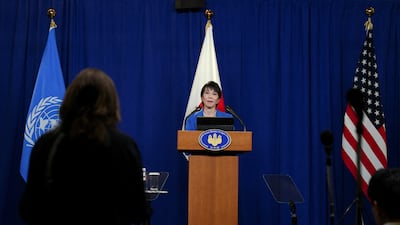

Japanese Prime Minister Sanae Takaichi said on Wednesday that talks on ending restrictions in the Strait of Hormuz should include regional countries as well as nations that depend on it and the International Maritime Organisation.
Ms Takaichi called for free and safe navigation to be restored without additional charges – a position that is of particular importance to Japan. In normal times, tankers passing through the strait carry about 93 per cent of the crude oil the country imports, according to its Economy Ministry.
“The situation in the Middle East has been growing increasingly tense, and free and safe navigation is increasingly under challenge in the Strait of Hormuz, which is an international public good,” Ms Takaichi said in response to a question from The National at an event on the sidelines of the UN General Assembly.
“Japan, in co-operation with the international community, has been continuing to engage in diplomatic efforts with a view to achieving an early de-escalation of the situation across the Middle East.”
The US and Iran are under renewed pressure to find a diplomatic way out of the crisis.
Iran’s President Masoud Pezeshkian told member states that Tehran was “ready for dialogue, diplomacy, and negotiations without accepting the language of force”.
US Secretary of State Marco Rubio told reporters in New York that President Donald Trump “has a number of options available, including military options”.
Middle East sources told The National on Wednesday that Iran had presented the US with a road map to end the conflict that includes a regionwide ceasefire, the gradual reopening of the Strait of Hormuz and an end to the US blockade of Iranian ports.
They spoke a day after US and Iranian officials held talks on the sidelines of the UN General Assembly in New York, in the latest bid to break the deadlock over efforts to end their conflict.
The strait, which connects the Gulf to the open sea, is one of the world’s most important routes for energy shipments.
About 20 million barrels of crude oil and petroleum products passed through it each day before the conflict, according to the International Energy Agency. Disruption to that traffic has strained global energy supplies.
Ms Takaichi described Hormuz as a important centre for global trade, where free and safe passage should be restored as soon as possible “without any additional expenses incurred” by ships using the route.
Japan has sought to keep diplomatic channels open while securing alternative oil supplies.
This year, Tokyo backed international talks on freedom of navigation and said it had proposed safe maritime corridors at the IMO for vessels and crews caught in the Arabian Gulf.
Its Economy Ministry said in June that alternative purchases were expected to replace oil imports disrupted by the blockade for the following month.
Ms Takaichi said Japan would continue speaking with Iran and other countries directly, including through telephone calls and meetings between leaders.

