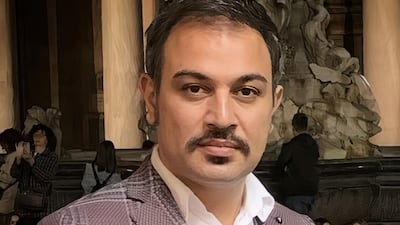

The EU Council on Friday issued sanctions against Nima Salehi, an Iranian hacker who has been behind cyber attacks on regime opponents.
The EU continues to target Iranians, including judges, involved in state repression, its foreign affairs chief Kaja Kallas said on X.
“As Tehran intensifies its domestic crackdown, the EU will continue to hold those responsible to account,” Ms Kallas said.

Executions and mass arrests have intensified in Iran in parallel with the war launched by the US at the end of February. About 40 Iranians, including 18 linked to January's nationwide protests, have been executed since the start of the year, a senior UN official said in June.
Thousands died in the January protests in what has been described as Iran's deadliest crackdown since the 1979 revolution.

The EU listed five judges who have imposed death sentences and long prison terms on protesters and political dissidents, including Abolfazl Ameri Shahrabi, a Tehran judge who sentenced the 2023 Nobel Prize winner Narges Mohammadi to imprisonment.
Ms Mohammadi has been jailed several times in past decades for her fight against the death penalty and female dress codes. She was most recently arrested in December for criticising authorities and was released in May for medical treatment after suffering a heart attack.
Listed alongside the judges was Mr Salehi, described as the 42-year-old founder of a cyber group named Ashiyane. The EU Council said the group co-operates closely with the EU-sanctioned Cyber Police and the Islamic Revolutionary Guard Corps.

Cyber attacks
Ashiyane is “responsible for intensive cyber attacks on both domestic opponents and reformists and foreign institutions”, the EU Council said. “Ashiyane has assisted the regime’s crackdown on the opposition, which has involved numerous serious human rights violations.”
Iranian rights group Spreading Justice discovered in late 2025 that Mr Salehi had been travelling across continents, including Europe, in previous years. It called for him to be sanctioned.
The head of Ashiyane, 43-year old Behrouz Kamalian, was listed by the EU in 2011 for similar reasons to Mr Salehi: intensive cyber attacks against opponents and foreign institutions. Mr Salehi is described as appearing in Iranian state media alongside Mr Kamalian but as having evaded the same level of scrutiny and sanctions.
Mr Kamalian founded Ashiyane, which means “nest” in Persian, in 2002, Spreading Justice said. It “gained prominence through widespread website defacements, including attacks on foreign government sites, and by identifying vulnerabilities in Iranian websites,” it said. Over time, it “built a broader cyber ecosystem, including a training centre, a security company, and hosting services”.
EU sanctions consist of an asset freeze, a travel ban and a prohibition against making funds available to those listed.