

Five more people, including the prime suspect, have been arrested over the theft of priceless jewellery from the Louvre museum, the Paris prosecutor said on Thursday.
Authorities linked one of the new arrests to DNA found at the museum, Laure Beccuau revealed.
“We had him in our sights,” Ms Beccuau said of the main suspect. None of the stolen items, valued at about $102 million, have been recovered, she added.
Four hooded thieves stole imperial jewels after breaking into the Louvre on the morning of October 19, exposing security lapses at the world's most-visited museum.
The latest arrests follow the detention at the weekend of two men in their thirties, who are suspected of breaking into the museum through an upstairs window to steal the precious pieces.
The pair had “partially admitted” their involvement in the heist under interrogation, Ms Beccuau told a media conference on Wednesday. They are suspected of being the pair who forced their way into the museum's Gallery of Apollo and used cutters to open the display cases, she said.
Four thieves arrived at the museum on a lorry equipped with a freight lift that two of them used to climb up to a window. They took less than eight minutes to steal the jewels, before leaving on two motor scooters, travelling beside the Seine River towards eastern Paris, where they had other vehicles parked, Ms Beccuau said.
-
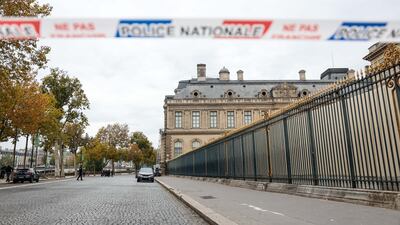
The Louvre in Paris has been robbed by several criminals who smashed windows and stole jewellery. EPA -
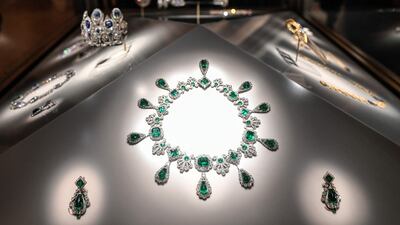
This emerald-and-diamond necklace that Napoleon gave to his wife, Empress Marie Louise, was taken. AFP -

An extendable ladder used by the thieves to access one of the upper floors of the museum. EPA -
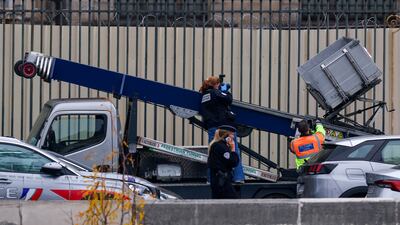
Police officers work by the crane believed to have been used in the robbery. Reuters -
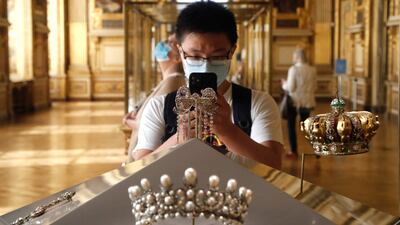
Empress Eugenie's crown being pictured. It was recovered after the thieves dropped it as they made their escape. AFP -

Police officers seal off the entrance to the museum. Getty Images -

The Louvre is sealed off after the robbery. Getty Images -
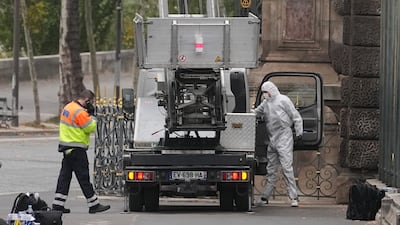
Police officers look for clues by a basket lift used by the thieves. AP -
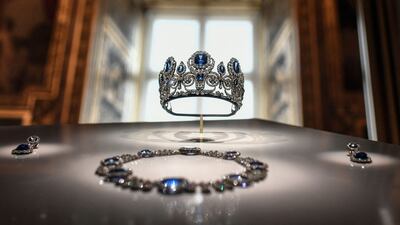
A tiara, necklace and single earring from the sapphire set that belonged to Queen Marie-Amelie and Queen Hortense was among the items stolen. AFP -

Police at the scene. Getty Images


The suspects face preliminary charges of theft committed by an organised gang and criminal conspiracy. They face up to 15 years in prison if convicted.
Ms Beccuau said DNA evidence on a scooter and on the smashed glass cases at the museum helped police find the suspects. One of those charged is a 34-year-old Algerian who has been living in France since 2010, she added.
He was arrested at Charles de Gaulle airport as he waited to fly to Algeria with no return ticket. The suspect was living in Aubervilliers, a suburb north of Paris, and was known to police mostly for road traffic offences. His DNA was found on a scooter, she said.
Another suspect, 39, was arrested at his home in Aubervilliers. He was known to police for several thefts and his DNA was found on one of the glass cases, as well as on items left behind by the thieves, she added.
Ms Beccuau also said on Wednesday that she had not ruled out more people being involved in the crime. She said nothing suggested that the thieves had accomplices within the museum’s staff.
She appealed for the thieves to return the artefacts. “These jewels are now, of course, unsellable … anyone who buys them would be guilty of concealment of stolen goods,” she said. “There’s still time to give them back.”
French police on Wednesday acknowledged major gaps in the Louvre’s security. Paris police chief Patrice Faure told the country's Senate that ageing systems and slow-moving fixes had left weak points.
“A technological step has not been taken,” he said. Parts of the video network were still analogue, producing lower-quality images that are slow to share in real time, he added.
A long-promised revamp – a $93 million project requiring about 60km of new cabling – “will not be finished before 2029–2030”, he said.

