


On a December evening in the Cuban city of Trinidad, near the country's south coast, the temperature – warm, but not too hot or muggy – is about perfect.
After a busy day seeing the sights or visiting a nearby national park area, many tourists will enjoy relaxing in a chair and gazing towards the beach a few miles away. However, if staying in a casa particular, a private house that rents out rooms, they may have to spend the evening in the dark, because Cuba experiences repeated power cuts, often lasting for hours.
While the town’s evening quiet is broken by the buzz of generators switched on by restaurants or hotels to keep things functioning, casa owners will pass guests camping lamps to use in place of non-functioning ceiling lights.
It is far from ideal for a tourism-dependent nation already facing a squeeze on visitor numbers because of the effects of a long-standing US embargo. This was brought in when communists deposed the American-backed dictator Fulgencio Batista in 1959 and was tightened under Donald Trump’s first US presidential administration.
Power shortages exist across the nation, including in other key tourist cities such as Vinales in the far west, Cienfuegos in the south, Santa Clara (celebrated for guerrilla leader Che Guevera’s decisive role there in the revolution) and the capital, Havana. Sometimes, power may be on only for a few hours per day.
One hostel owner in Old Havana, the capital’s partly-restored tourist hotspot, said that there used to be “a lot of tourists” but the situation now was “very, very difficult”.
“In Havana you have around five hours of broken electricity. In Trinidad, in Vinales it’s more complicated,” the hostel owner, who asked for anonymity due to political sensitivities, told The National. His central location means that there are guests in his hostel “all the time”, but owners of other premises are, he said, finding it harder to attract holidaymakers.

Downturn
Indeed, Cuba is the Caribbean country where tourism has most struggled to bounce back from the Covid-19 downturn, according to Dr Emily Morris, honorary senior research fellow at University College London’s Institute of the Americas.
“The depressed tourism numbers – currently around half the pre-Covid level thanks to US sanctions – and foreign exchange shortages affect the quality of the hotels and facilities in general, with missing repairs,” she said. “And the fall in the value of real Cuban salaries since 2021 has had a serious effect on staff levels and morale, and therefore on behaviour. All this is reflected in reviews.”
Power struggles
Whether it is in national parks visited on day trips from Trinidad, or casas in Vinales, there are some holidaymakers present, but tour guides and property owners say fewer than they would have expected for what is peak season in Cuba.
Dr Helen Yaffe, senior lecturer in political and international studies at the University of Glasgow in the UK and the author of We Are Cuba!: How a Revolutionary People Have Survived in a Post-Soviet World, said that "a confluence of different issues" were behind the power shortages, which saw a nationwide blackout in October that lasted several days.
She said that US sanctions were key, as they, for example, limit Cuba’s ability to access credit from international banks, restrict the sale to Cuba of equipment with US components and make it difficult for Cuba to source fuel (some deliveries have been cancelled because suppliers fear US sanctions). Fuel shortages affect power generation, since most electricity is generated from oil. Cuba, Dr Yaffe said, “has no lender of last resort”.
Dr Morris said, however, that in recent months the country appeared to have reduced its vulnerability to national power cut, as shown by a rapid recovery from a power cut at the end of November.
At the end of his first term as US president, Donald Trump designated Cuba a state sponsor of terrorism, which further discouraged visitors from travelling to the Caribbean nation, as doing so renders them ineligible to subsequently visit the US on the country’s visa-waiver scheme.
The hostile relationship between Washington DC and Havana is a far cry from the situation in pre-revolutionary Cuba when, to quote a 1929 travel book, Terry’s Guide to Cuba, “the present-day Cuban is rapidly becoming Americanised”.

“Thousands act, think, talk and look like Americans; wear American clothes, ride in American autos; use American furniture and machinery; oftentimes send their children to American colleges; live for a time in the States themselves or expect to, and eat much American food,” the book stated.
American cars are still seen on Cuban roads, but these are supersized early 1950s Chevrolets, Buicks, Pontiacs and Oldsmobiles imported before the embargo.
Falling numbers
Today, the country has shortages of even basic medicines, and faces an continuing exodus of citizens exhausted by its economic crisis and lack of prospects. According to forecasts published by the World Health Organisation, the population, currently around 11 million, could fall to 9.4 million by 2050. To the casual visitor, the economic challenges and lack of development are obvious, from the severely dilapidated apartment blocks, including in Havana, to the way that many shops consist simply of residents selling a small selection of items from their front room.
In towns, people often travel on horse-drawn carts rather than in motor vehicles, while in the countryside, ploughs pulled by pairs of oxen instead of tractors are a common sight. Motorways connecting major cities are eerily quiet. But the country, under the presidency of Miguel Díaz-Canel, who took over in 2019 from Raúl Castro (who had succeeded his brother Fidel) is aiming to strengthen its energy independence, which would significantly help with the power situation.
Cuba plans to ramp up its solar power capacity, often through Chinese suppliers, which should stabilise its electricity supply and help the country meet climate goals. The aim is that by 2030 almost a quarter of the nation’s energy will come from renewable sources.
“They’ve really accelerated it now,” Dr Morris said. “It was 95 per cent run on fossil fuels, their electricity grid. It’s already coming down to 90 per cent. They’ve got ambitious targets which people looked at and thought, ‘They’re never going to make it.’ Now that it’s such a priority I think they will.”
This greater priority given to the energy transition could, Dr Morris said, lead to a strengthening of ties between Cuba and countries, such as China, that the US is antagonistic towards.

The deep freeze in relations between the US and Cuba has previously improved, notably during the administration of Barack Obama, but the coming years seem likely to be particularly difficult. Mr Trump has nominated as secretary of state Marco Rubio, a Cuban-American senator (his parents immigrated to the US from Cuba) who is a fierce opponent of the regime in Havana.
"They're bracing themselves for the next Trump administration, which looks particularly ominous because of the nomination of Marco Rubio, who's built his career on attacking the Cuban government and being its worst nightmare," said Dr Yaffe.
The Trump administration may increase the enforcement of measures to block the flow of remittances and travel from the US and Cuba, while using Washington DC’s diplomatic and economic weight to pressure third countries to cut ties.
The US is, Dr Yaffe said, “attempting to create the circumstances where the Cuban people will turn on their own government”. But while younger Cubans – plugged into social media and with greater access to information about life in capitalist nations – may lack the revolutionary fervour of previous generations, there is “no sign the government is close to collapse”.
“The biggest critics internally have left the country,” Dr Yaffe said. “It’s not like Venezuela, where you have millions of opposition activists in the country.”
So, while Cuba may be grappling with power cuts and fuel shortages, and struggling to attract visitors, it seems that there is no sign of another revolution brewing among the dogged population of this Caribbean nation.
-
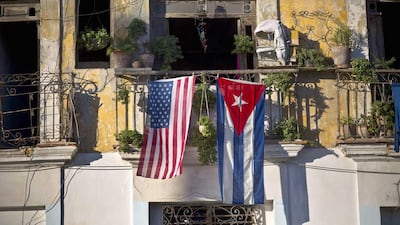
-

A man sells beans inside a state-run market in Havana. Many Cubans expressed hope the restoration of diplomatic ties between Cuba and the US will mean greater access to jobs and the comforts taken for granted elsewhere. Desmond Boylan / AP Photo -
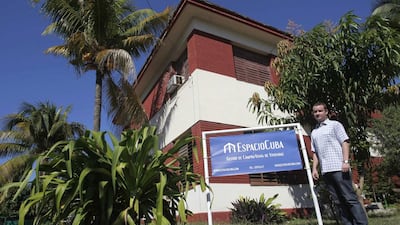
Yosuan Crespo, a private real estate agent, poses in front of his office in Havana. Many Cubans are already imagining a more prosperous future after the US said it will put an end to 50 years of conflict with the communist-run island. Reuters -
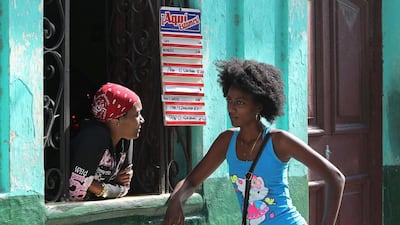
Two women chat at a window of a cafe in Havana. The Cuban private sector is confident that US measures to begin normalising relations with the communist island would improve business activity. Alejandro Ernesto / EPA -
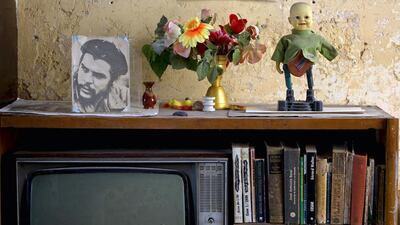
A photo of revolutionary icon Che Guevara is displayed on top of a TV in Havana. The restoration of diplomatic ties between Cuba and the United States has unleashed expectations of even more momentous changes in Cuba. Ramon Espinosa / AP Photo -
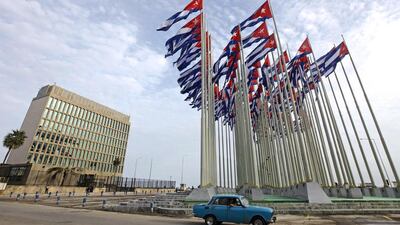
A car drives past the building of the the US diplomatic mission in Cuba. Desmond Boylan / AP Photo -
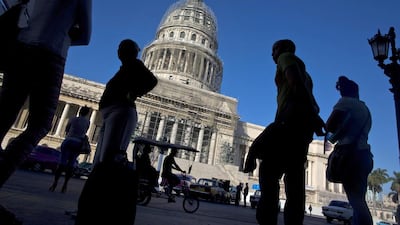
People line up to take the bus outside the Capitolio in Havana, Cuba. Ramon Espinosa / AP Photo -

A man sells tomatoes on a street of Old Havana in Havana. Ramon Espinosa / AP Photo -
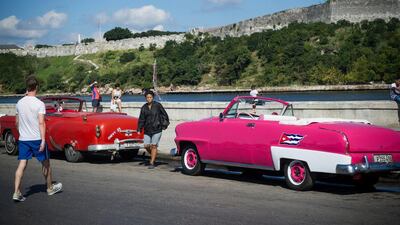
Old American cars in a street of Havana. Fidel Castro imposed a law after assuming power in 1959 that prevented anyone without government permission from importing foreign automobiles. Yamil Lage / AFP -

A street entertainer waits for tourists in Old Havana. The normalisation of ties between the US and Cuba could be a boon to the poor and isolated country. Desmond Boylan / AP Photo -
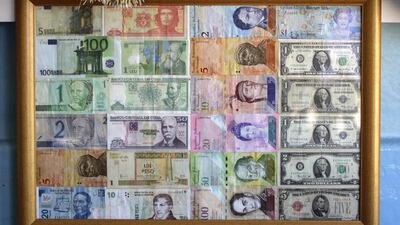
Bank notes from various countries are displayed on the wall of a beverage shop Havana. Desmond Boylan / AP Photo -
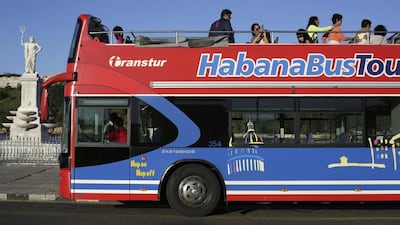
A double-decker bus waits for tourists to board in Old Havana. Enrique De La Osa / Reuters -
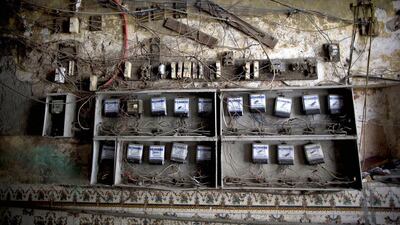
US president Barack Obama's policy shift towards Cuba would allow American businesses to export goods such as building materials, farming equipment and communications infrastructure to the island. Above, A tangle of old and new electrical circuits sit on a wall in a building in Havana. Ramon Espinosa / AP Photo -

A woman stands on the street in downtown Havana. Many Cubans are already imagining a more prosperous future after the US said it will put an end to 50 years of conflict with the communist-run island. Alexandre Meneghini / Reuters



