


Live updates: Follow the latest news on Israel-Gaza
Spain, Ireland and possibly a number of other European countries are preparing to recognise Palestinian statehood next week in a bid to increase pressure on Israel, as awareness grows of the EU's failure to find a common position on the Gaza war.
Before the Hamas-led October 7 attacks on Israel, most EU countries, including some of those expected to take action next week, had said they were open to recognising Palestinian statehood but only as part of peace talks.
That has changed for some over recent months as the number of dead in Gaza soared beyond 35,000 and as Israel appeared unwilling to outline any postwar governance scenario in the embattled enclave.
It has vowed instead to destroy Hamas for leading the incursions that killed 1,200 Israelis.
Now recognition of a Palestinian state is increasingly viewed as a political tool to pressure Israel into accepting a two-state solution despite the government's hostility to the idea. Those in favour argue it is good for Israel's own safety.
“We have found ourselves in a situation where we feel the need to move forward unilaterally because the European response has been so weak,” a European diplomat from one of the countries that is working on Palestinian statehood recognition told The National.
Calls for a ceasefire or for increased access for humanitarian aid to Gaza have caused tense diplomatic discussions that often failed to find consensus. The latest example was EU foreign policy chief Josep Borrell issuing a statement this week warning against an Israeli military incursion in Rafah in his name alone due to Hungarian opposition.
“Of course it would be better if the EU could come to a proper agreement on our approach to Israel and Palestine,” said the diplomat. “But we have been unable to do that, which has massively weakened our influence in the region.”
A number of countries including Belgium, Slovenia, Malta and Portugal have said they would be interested in joint recognition of the state of Palestine in an attempt to give it more weight.
Clingendael Institute
But they have appeared unwilling to lead talks, unlike Spain and Ireland. Norway has also expressed interest as a close EU partner. Many still remember the diplomatic spat with Israel caused by Sweden's unilateral recognition of Palestinian statehood in 2014.
Kelly Petillo, programme manager for the Middle East and North Africa at the European Council on Foreign Relations think tank, said recognition of a state of Palestine is unlikely to have much impact without EU heavyweights France and Germany joining.
Who else will follow?
“We know recognition will start with Spain and Ireland. The question is: who else will follow?” Ms Petillo told The National.
May 21 has been put forward as a date for recognition by Mr Borrell, but senior European politicians from countries involved in the talks have been reluctant to endorse it.
Speaking on Wednesday, Irish Foreign Affairs minister Micheal Martin said recognition of Palestinian statehood would happen “before the end of the month” but that the specific date was “fluid” and would be finalised in the coming days.
A number of European diplomats were also hesitant to give a firm date to The National, saying that discussions were restricted to high-level officials.
Recognition of a Palestinian state by a number of EU countries would increase pressure on Israel to accept a two-state solution, though realistically the short-term impact is likely to be limited.
“It's a step forward,” said the diplomat. “We feel others should follow suit. But we're not under the idea that it will have an immediate impact or that a two-state solution is easy to pursue.”

Israeli Prime Minister Benjamin Netanyahu's apparent lack of vision for a postwar Gaza has triggered criticism from Defence Minister Yoav Gallant. This can only lead to two “negative options”, said Mr Gallant on Wednesday: Gaza being ruled by either Hamas or by the Israeli military.
Speaking to The National, a retired Egyptian ambassador said that recognition of Palestinian statehood, even if done by smaller EU states, is important in increasing pressure at UN level.
A vote at its General Assembly last week showed overwhelming backing to recognise a Palestinian state. Currently 50 out of the 193 UN members do not recognise a Palestinian state.
However, state membership can only be decided by the UN Security Council.
“Recognition is very important because it can make up for what Palestine is missing in terms of international support,” said the former diplomat, who declined to be named due to the sensitivity of the topic.
“It's important even to resolve the war in Gaza. What happened on October 7 proved to Israel that its security is not dependent on military superiority. It's dependent on the peace arrangements and treaties it has with Egypt and Jordan,” he said.
Recognition of a Palestinian state by western states is hugely symbolic for historic reasons, said Erwin van Veen, senior research fellow at Dutch think tank Clingendael.
“The holdouts are in Western Europe,” said Mr van Veen. “It is to some extent because many early Israeli settlers at the time of its foundation originated from Europe. Israeli society today feels part of the community of western liberal democracies.
“It may create a cascade effect and increase pressure on France, Germany and the UK to follow suit,” he added, highlighting a shift in public opinion in the West with the Gaza war in favour of Palestinian rights.
“The smaller the crowd of non-recognisers becomes, the clearer it is that it's not the acceptable position.”
Negotiation chip
The EU's hesitancy is widely viewed to be linked to staunch German support for Israel for historical reasons. Germany is also the second largest weapons exporter to Israel after the US.
A number of other EU countries including the Czech Republic, Slovakia and Hungary have also pushed back on language that may appear critical of Israel.
France has attempted to strike a middle ground, with president Emmanuel Macron saying that recognition of a Palestinian state was “not a taboo”, but he has not publicly said it would follow Spain and Ireland should they decide to move ahead with statehood recognition.
“The recognition of a Palestinian state is a tool in the peace process, which must be used at the right time,” sources at the French Foreign Affairs Ministry told The National.
“The aspirations of the Palestinian people to have a state are legitimate. The Palestinian state must be a viable state, based on contiguous territory and with a revitalised Palestinian Authority.”
The short-term impact of statehood recognition for Palestine remains unclear.
Ms Petillo said the recognition of a Palestinian state may increase pressure on the EU Commission, the bloc's executive arm, to review an association agreement with Israel over human right violations concerns – a request made by Ireland and Spain in February.
“There is an ocean between a review taking place and it having an impact on the ground in Israel,” said Ms Petillo. “Europe is not stepping up as a geopolitical power and is thus undermining its own principles.”
The call to review the association agreement has so far not been supported by all 27 member states. Instead, the EU council decided to invite Israeli Foreign Minister Israel Katz to a meeting of the bloc's foreign affairs ministers for more discussions on possible human rights violations. Mr Katz's attendance at the next meeting, scheduled for May 27, has yet to be confirmed.
Many believe that the EU has been sidelined as Israeli, Arab and US officials struggle to agree on a ceasefire and what a postwar Gaza would look like.
“Palestinian statehood is being used as a negotiation chip that could lead to further normalisation with Arab states. But what's interesting to note is that Europe barely fits in any of these talks,” said Ms Petillo.
Two hundred days of Israel Gaza war – in pictures
-
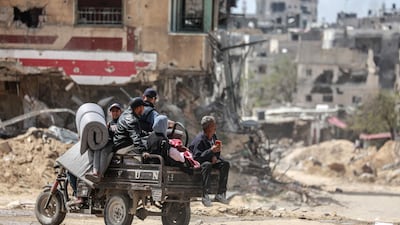
Palestinians move with their belongings on a road lined with destroyed buildings, in Khan Younis, in the south of the Gaza Strip, on April 22. AFP -

An infant saved from the womb of her mother Sabreen Al Sheikh, who was killed in an Israeli strike along with her husband Shokri and her daughter Malak, lies in an incubator at Al Emirati hospital in Rafah, on April 21. Reuters -

A man rides a bicycle, on April 2, past a damaged vehicle where employees from the World Central Kitchen non-profit, including foreigners, were killed in an Israeli air strike. Reuters -

A woman at the damaged Al Shifa Hospital, on April 1, after Israeli forces withdrew from the medical complex following a two-week siege. Reuters -
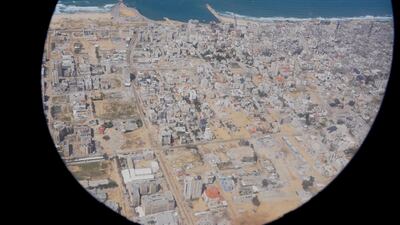
The view from a Jordanian flight dropping vital aid by parachute into Gaza, in March. Matthew Kynaston / The National -

Nozha Awad flees Al Shifa hospital with her triplet children, after an Israeli raid siege began at the medical complex, in March. Reuters -

Palestinians gather to receive aid outside a UNRWA warehouse, in March. Reuters -

A family end their fast amid the rubble of their destroyed home, during Ramadan in Rafah, in March. Reuters -

Wafaa Tabasi with her twin malnourished daughters, at Al Awda health centre in Rafah, in March. Reuters -

Palestinians carry bags of flour taken from an aid lorry near an Israeli checkpoint in Gaza City, in February. Reuters -

Fernando Simon Marman and Louis Hare, two Israeli hostages who, according to the Israeli military, were freed in a special forces operation in Rafah, reunite with loved ones at Sheba Medical Centre, in Ramat Gan, Israel, in February. Reuters -
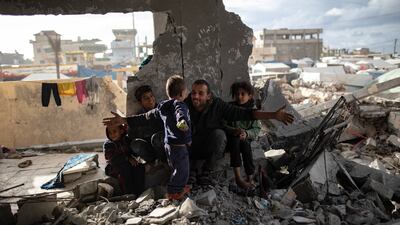
Palestinian Muhammad Al Durra with his children in the ruins of a house in Rafah where they sheltered on January 11, 2024. EPA -
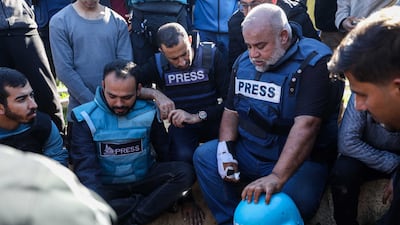
Family and friends at the funerals of journalists Hamza Al Dahdouh and Mustafa Thuraya on January 7, 2024 in Rafah, Gaza. Getty Images -
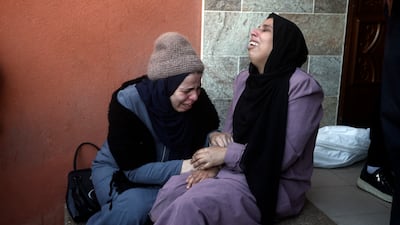
Palestinians mourn relatives killed by Israeli bombardment of the Gaza Strip outside a mortuary in Khan Younis January 4, 2024. AP Photo -
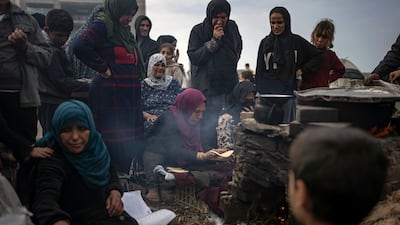
Displaced Palestinians queue to bake bread at a camp in the Muwasi area of Rafah, Gaza Strip, on December 23, 2023. AP Photo -
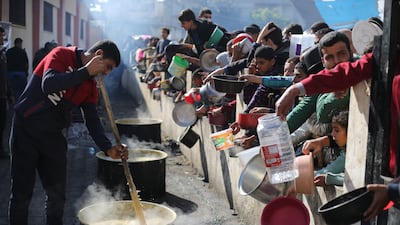
Palestinians queue for food in Rafah, the Gaza Strip, on December 20, 2023. AP Photo -

The ruins of Rafah on December 14, 2023. AFP -
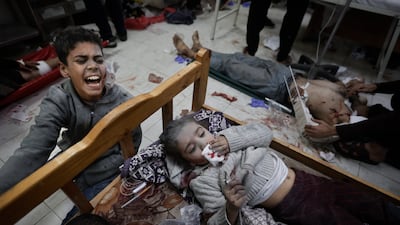
Palestinians wounded in the Israeli bombardment of the Gaza Strip arrive at a hospital in Khan Younis on December 8, 2023. AP Photo -
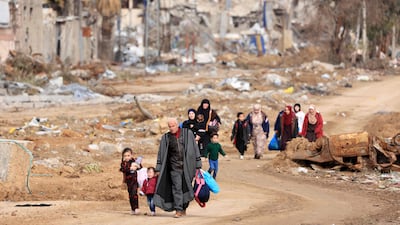
Palestinians flee Israeli bombing along the Salaheddine Road in the Zeitoun district of Gaza city on November 28, 2023. AFP -

A Red Cross vehicle takes Israeli hostages from the Gaza Strip into Egypt in Rafah on November 25, 2023. AP -
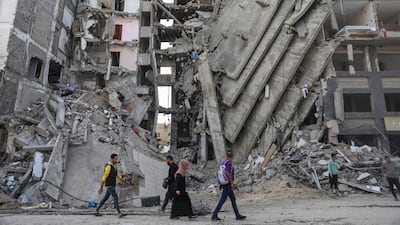
The ruins of buildings in Gaza city on November 24, 2023, as a temporary truce between Israel and Hamas took effect. AP Photo -
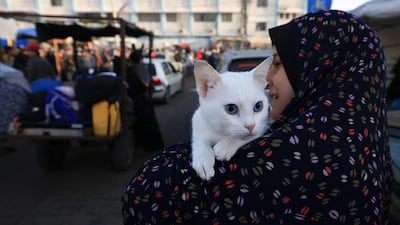
A woman and her cat return home to eastern Khan Younis in the southern Gaza Strip during the first hours of a four-day truce between Israel and Hamas forces on November 24, 2023. AFP -
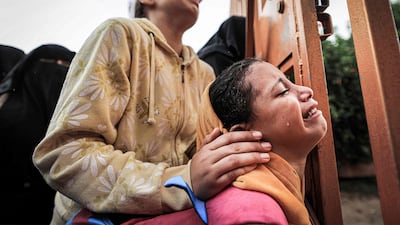
Mourning the dead of Israeli bombardment outside the mortuary at Nasser Hospital in Khan Younis on November 14, 2023. AFP -
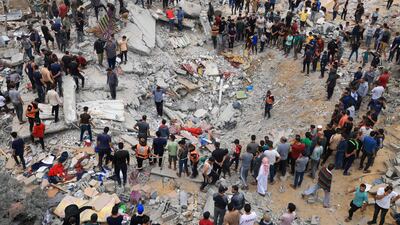
Civilians and rescuers look for survivors in the rubble of a building after Israeli bombing of Khan Younis in the southern Gaza Strip on November 12, 2023. AFP -

November 7, 2023, a month to the day after Hamas attacked Israel, a victim of an Israeli bombardment in Rafah is moved from the rubble. AFP -
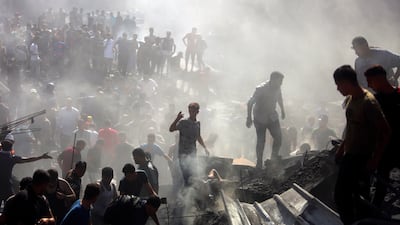
Searching the rubble after Israeli air strikes on the town of Khan Younis, southern Gaza Strip, on October 26, 2023. AP Photo -
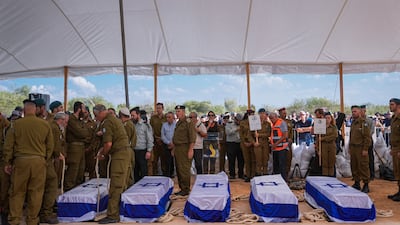
Mourning the Kotz family at their funeral in Gan Yavne, Israel, on October 17, 2023. AP Photo -
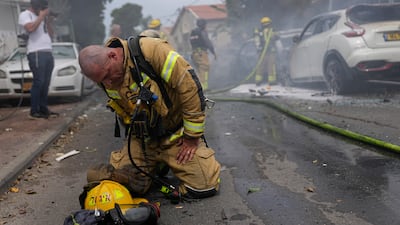
An Israeli firefighter composes himself after he and his colleagues extinguished cars set on fire by a rocket fired from the Gaza Strip in Ashkelon, Israel, on October 9, 2023. AP Photo -
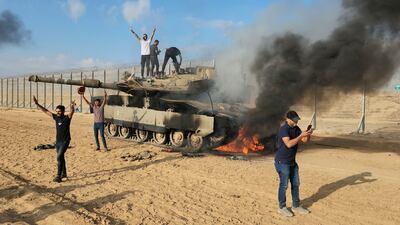
Palestinians with the wreckage of an Israeli tank at the Gaza Strip fence east of the city of Khan Younis on October 7, 2023, the day Hamas forces swept unopposed into Israel. AP Photo -
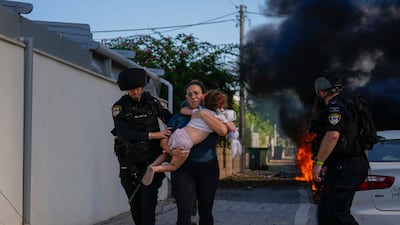
Israeli police officers evacuate a woman and a child from a site hit by a rocket fired from the Gaza Strip, in Ashkelon, southern Israel, on October 7, 2023. AP Photo


“We like to think that recognition of Palestinian statehood is an important step but it's in reality a small set of states that seem most likely to do it.”
As a result, the EU's response to the Gaza war has generally been a watered-down and delayed version of policies adopted by the US administration. In February, the US was first to sanction extremist settlers in the occupied West Bank for violence against Palestinians – a move that multiple reports have described as lacking impact.
The EU followed suit on April 19 with sanctions against four individuals. Killings of Palestinians in the West Bank, both at the hands of Israeli settlers and the military, have soared since October 7.
Court action
One place where pressure is increasing on Israel is in European courts as NGOs increasingly sue their own states to stop weapons exports. Some politicians, including in Belgium, have been vocal in echoing such calls, though not always with the full backing of their governments.
US President Joe Biden recently paused a shipment of bombs to Israel over concerns over civilian deaths among Palestinians. He has nevertheless maintained strong support for Israel and has recently agreed on an arms deal worth more than $1 billion.
In a signal that legal action may be contributing to policy decisions in Europe, a regional government in Belgium cancelled gunpowder exports to Israel in February in the wake of provisional measures issued by the International Court of Justice after South Africa accused Israel of genocide in the Gaza strip.
NGO Peace Action found that in 2021, Belgium accounted for more than half of the world's gunpowder exports to Israel.
A group of NGOs have said they would sue Israeli shipping company ZIM for allegedly transferring 246 tonnes of munitions from the port of Hamburg to Israel and via the Belgian port of Antwerp without transit licences. The National has contacted ZIM for comment.
Belgium is also a member of the UN's Human Rights Council, which in April backed a call to cease weapons sales to Israel. Germany criticised the draft resolution's “prejudged” allegations “that Israel engages in apartheid, and it accuses Israel of collective punishment.” Israel also rejected the draft resolution.
Willem Staes, policy and partnership adviser on the Middle East at 11.11.11, a coalition of Belgian NGOs, said that the lawsuit is “about letting ZIM know they are under scrutiny but also about sending a strong political signal and pushing various governments in Belgium, both federal and regional, to get their act together and close all existing loopholes”.
“In addition to stopping the illegal transit of weapons through Belgian territory, this lawsuit is also a way of putting the issue of arms exports and transfers to Israel higher on the political agenda,” Mr Staes told The National.
“It's wishful thinking to expect an EU-wide arms embargo in the short term. But individual countries mustn't shy away from taking responsibility by hiding behind a lack of consensus.”

