


Yathreb Hajri knows where every dinar of her modest government salary goes.
There’s the cost of trainers for her son, 12, who won’t stop growing, extra internet for her daughter, 14, to do schoolwork while in-person classes are suspended in Tunisia and petrol for her husband’s car.
But one thing sucks up more of her earnings than anything else: food.
“Even as a government employee,” said Ms Hajri, 41, who works for the Higher Education Ministry, “we are living paycheck to paycheck. My salary is barely enough for the family to eat.”
Ms Hajri and her family are part of Tunisia’s vanishing middle class that is feeling the strain of decades of economic downturn. They’re now facing a new crisis as Tunisia weighs austerity measures that would see subsidies on essentials like food and fuel eliminated in favour of direct cash payments to the poor.
Last week, a delegation that included Tunisian Prime Minister Hichem Mechichi and the governor of the central bank, Marouane El Abassi, met with the International Monetary Fund in Washington DC to discuss a loan package of up to $4 billion.
To secure that loan, the delegation proposed a raft of reforms and austerity measures aimed at shoring up the economy, which has slumped in the years since the revolution of 2011.
The proposal included reforms long-promised by Tunisia in similar aid deals, including improving tax collecting, cutting the public sector wage bill and overhauling subsidies.
But a leaked document revealing that apparent plan to completely eliminate food subsidies on a tight timeline sent shock waves through a country already suffering under the current economic crisis.
Under the plan, cuts would begin in June and subsidies on essentials like flour, sugar and oil would be phased out entirely within three years.
“This is tantamount to medieval bloodletting, hoping it will heal the more serious infection that's underlying this problem,” said Fadhel Kaboub, an associate professor of economics at Denison University in Ohio who closely follows the Tunisian economy. “It's going to cause pain for the most vulnerable people in Tunisia, and it will not address the roots of the problem.”

Decades of poor economic policy focused on low value-added exports and outsourced labour have left Tunisia in a bind, Mr Kaboub said. A massive trade deficit developed over years, leaving Tunisia “without food security or energy security, and with massive holes in our trade balance”.
That deficit has weakened Tunisia’s currency and forced the government to subsidise staples that are imported to keep the poorest afloat. But the government now argues that subsidies unfairly benefit the wealthy as well as the poor, and that direct cash payments to the poorest families would better serve the economy.
Critics have questions about the effectiveness and the implementation of these cash payments.
“The proposal needs clear benchmarks for eligibility and a large database that is transparent from the local to the national level,” said Aram Belhadj, professor of economics at Tunisia's Economics and Management University of Nabeul.
“But whether you like it or not, subsidisation is a tool to protect the purchasing capacity of people, and cannot be substituted with cash transfers.”
Tunisians protest against economic crisis – in pictures
-

Protesters face police officers during a demonstration in Tunis. AP -
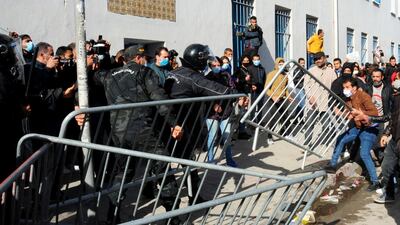
Protesters clash with police officers during demonstration in Tunis. AP -
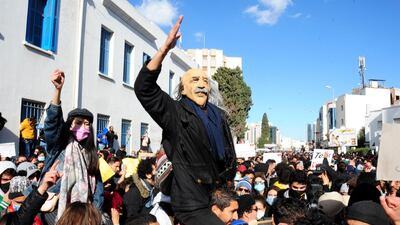
Demonstrators, one wearing a carnival mask, demonstrate in Tunis. AP -
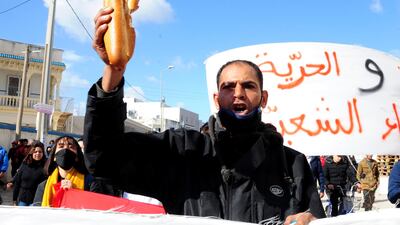
A protester shouts and holds bread during demonstration in Tunis. AP -
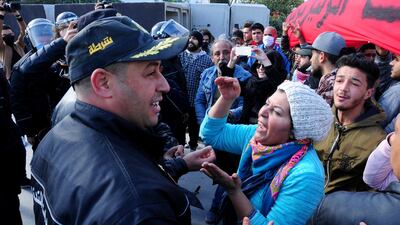
A demonstrator argues with a police officer in Tunis. AP -

Protesters shout slogans during a demonstration next to the Tunisian parliament in Tunis, Tunisia. EPA -

Protesters shout slogans during a demonstration next to the Tunisian parliament in Tunis, Tunisia. EPA -

Security forces confront protesters from the Ettadhamen city suburb on the northwestwern outskirts of Tunisia's capital Tunis as they prevent them from passage onwards to reach an anti-government demonstration outside the Tunisian Assembly (parliament) headquarters. AFP -
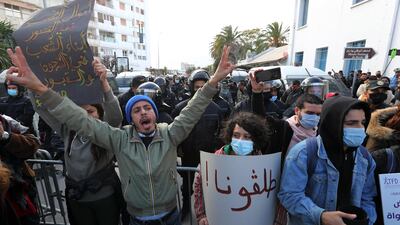
Protesters shout slogans during a demonstration next to the Tunisian parliament in Tunis. EPA -
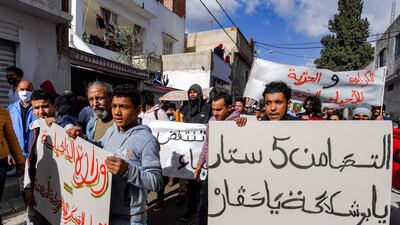
Protesters from the Ettadhamen city suburb on the northwestwern outskirts of Tunisia's capital Tunis march in a bid to pass onwards to reach an anti-government demonstration outside the Tunisian Assembly (parliament) headquarters. AFP -
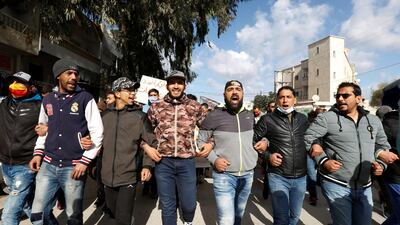
Demonstrators walk together as they take part in an anti-government protest in Tunis. Reuters -

A demonstrator gestures near a policeman during an anti-government protest in Tunis. Reuters -
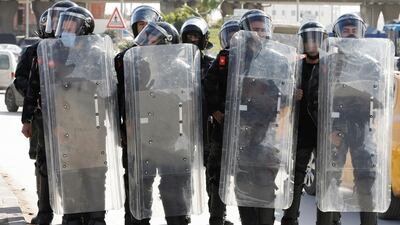
Members of the police stand guard during an anti-government protest in Tunis. Reuters -

Security forces confront protesters from the Ettadhamen city suburb on the northwestwern outskirts of Tunisia's capital Tunis as they prevent them from passage onwards to reach an anti-government demonstration outside the Tunisian Assembly headquarters. AFP -
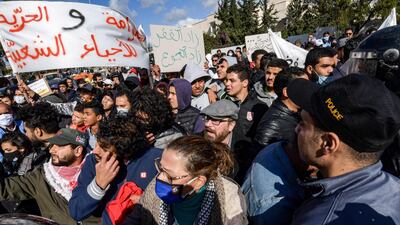
Security forces confront protesters from the Ettadhamen city suburb on the northwestwern outskirts of Tunisia's capital Tunis as they prevent them from passage onwards to reach an anti-government demonstration outside the Tunisian Assembly headquarters. AFP -
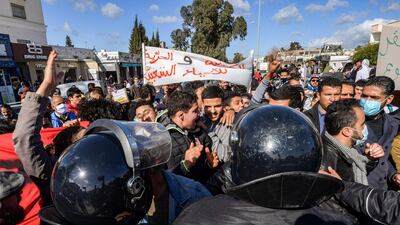
Security forces confront protesters from the Ettadhamen city suburb on the northwestwern outskirts of Tunisia's capital Tunis as they prevent them from passage onwards to reach an anti-government demonstration outside the Tunisian Assembly headquarters. AFP -

Demonstrators carry signs during an anti-government protest in Tunis. Reuters -
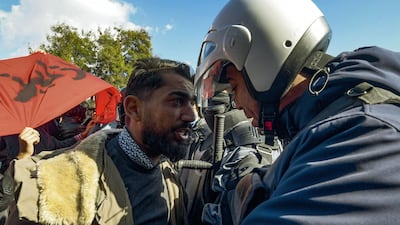
Security forces confront protesters from the Ettadhamen city suburb on the northwestwern outskirts of Tunisia's capital Tunis as they prevent them from passage onwards to reach an anti-government demonstration outside the Tunisian Assembly headquarters. AFP -
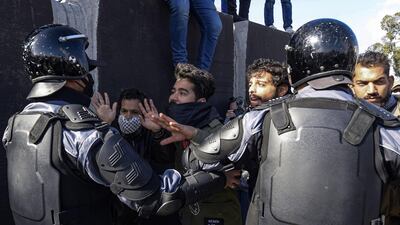
Security forces confront protesters from the Ettadhamen city suburb on the northwestwern outskirts of Tunisia's capital Tunis as they prevent them from passage onwards to reach an anti-government demonstration outside the Tunisian Assembly headquarters. AFP


Payments would be allotted through a yet-to-be-built electronic registration system, and, in a move to counter the rife tax evasion that has long plagued the country, only those who paid their taxes on time and in full would receive their distributions.
Though eligibility benchmarks have not been established, many middle-class Tunisians – those on a salary of between 500 ($180) and 1,500 Tunisian dinar ($550) per month – fear they would not make the cut, but would still feel the squeeze.
Law student Intissar Gassara, 28, and her partner Mohamed Sallemi, who works in fiscal consulting, say their budget barely stretches to meet the cost of food, utilities, transportation and medication for Ms Gassara’s brother who lives with them.
“There’s no security – financially or socially,” said Ms Gassara. “It’s the ambiguity that gets you. What if one of us had a medical emergency? How would we come up with the money to cover it?”
She and Mr Sallemi, both college-educated, both working in white-collar jobs, even if part-time, are considered middle class. But the rising cost of food puts pressure on them daily.
“I was shocked at the price of a litre of milk yesterday,” Ms Gassara said. “It used to be 1,120 millimes [$0.40] and now it’s 1,350 millimes [$0.42]. If they cut the subsidies, everyone will be living in poverty.”
The most recent study by the Tunisian Institute for Strategic Studies (ITES), which is affiliated with the Tunisian presidency, showed that Tunisia’s middle class shrunk from more than 70 per cent of the population in 2010 to 55 per cent in 2018. The pandemic has only accelerated that trend.
In January, thousands of young people took to the streets in protests over economic marginalisation and joblessness with a verve not seen since the 2011 revolution. With the proposed cuts, many are worried those protests will only increase.
Ms Harji’s husband, Makrem, 49, remembers the Bread Riots, a spate of violent protests that broke out after subsidies on semolina were slashed in 1984.
More than 100 people were killed and hundreds more maimed. President Habib Bourguiba was forced to reinstate subsidies.
“People needed something to bring them together, and it happened to be bread,” Mr Harji said of the ‘84 protests. “The same thing is happening now, but instead of bread the youth are thinking more about standards of living.”
Mr Harji said if the subsidy cuts went through, he was certain people would take to the streets.
“This time,” he warned, “it is going to be more intense.”
Ghaya ben Mbarek contributed reporting

