

Tunisian opposition party Ennahda plans to defy new Covid-19 rules and stage a rally against the president on Friday to mark a day some regard as the 11th anniversary of the country's revolution.
President Kais Saied's government has brought in more Covid-19 rules after the seven-day average number of new cases rose from about 300 two weeks ago to a weekly average of more than 2,600 on Wednesday.
These measures include a night-time curfew, a ban on all gatherings for two weeks and discouraging people from travelling abroad.
However, Ennahda and other parties accused the government of using the pandemic to try to block protests against the president six months after he sacked the government, suspended parliament and assumed broad powers.
"In principle, Ennahda will go ahead with the Friday protest," party official Mohamed Goumani told Reuters on Wednesday.
"The decision [to ban gatherings] is a political one, not a scientific one, especially given that hundreds of thousands of students will be going to school," Mr Goumani said.
-

Tunisians shout slogans as they protest against President Kais Saied in the capital Tunis on the 10th anniversary of the start of the 2011 uprising. AFP -
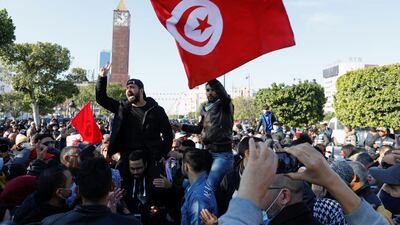
Demonstrators in Tunisian capital Tunis protest against President Kais Saied seizing governing power. Reuters -
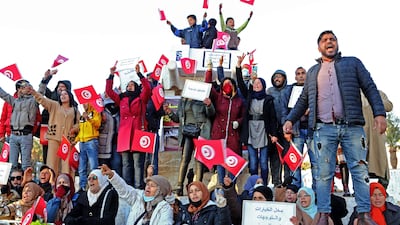
Unemployed Tunisian graduates during a demonstration to mark the 10th anniversary of the start of the 2011 uprising in central city Sidi Bouzid. AFP -
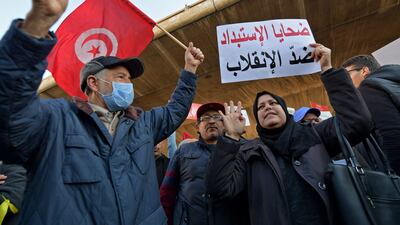
Opponents of Tunisian President Kais Saied slam his decision to extend the suspension of parliament. AFP -

Protesters against Tunisian President Kais Saied. AFP -

People protest in Tunis. Reuters -
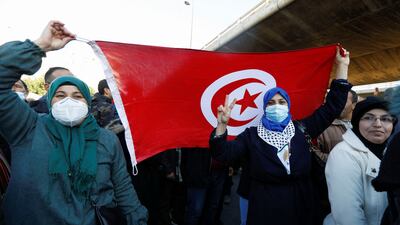
Protestors hold the Tunisian flag in Tunis. Reuters -
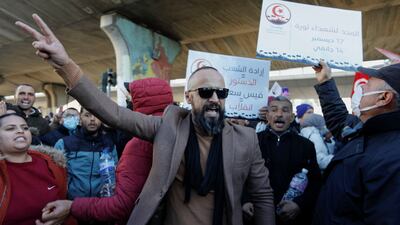
People march and hold signs in Tunis. Reuters -

Tunisian police block the entrances to the city centre at a protest against President Kais Saied in Tunis. AFP


Ennahda is the largest party in the now-suspended parliament, with around a quarter of the seats. It has played a role in successive coalition governments since the 2011 revolution that introduced democracy. Friday marks 11 years since former autocrat Zine El Abidine Ben Ali dissolved his government, declared a state of emergency and fled the country.
Mr Saied insists his actions in July to dismiss the government were necessary to save the state and denies harbouring dictatorial ambitions. He has started rewriting the country's constitution and says he will put it to a referendum this summer before a new parliament is elected.
The previous government's perceived poor response to the pandemic, including a botched vaccination drive, raised the political pressure before Mr Saied's intervention.
Leaders of two other parties that had joined the call for protests on Friday also accused the government of restoring the health restrictions for political reasons.
"We will be on Revolution Street to protest whatever the cost," said Ghazi Chaouachi, the head of Attayar – which had 22 MPs – using a nickname to describe the capital's Avenue Habib Bourguiba.
The measures were intended "to prevent a wave of popular anger that they can only confront by citing health conditions", said the leader of the smaller Joumhouri Party, Issam Chebbi.

