

Tunisian politicians have questioned President Kais Saied’s assurance to US Secretary of State Antony Blinken that he was preparing to move the country forward from its “exceptional situation” almost four months after a shock power grab.
Mr Saied froze Tunisia's Parliament, sacked the government and assumed total executive power on July 25, when he said the country was under “imminent threat” a decade after mass protests toppled autocrat Zine El Abidine Ben Ali and ushered in political reform and democracy.
On September 22, Mr Saied issued a presidential decree consolidating all executive, legislative and judicial powers in his hands, only to later install a government in October, lead by Tunisia’s first female Prime Minister, Najla Bouden, albeit with restricted powers.
The president’s office said Mr Saied told Mr Blinken during a phone call at the weekend of his intention to lead the country out of the “exceptional situation into a normal situation” and also denied having suspended the 2014 Constitution.
Mr Blinken reportedly said he hoped to introduce the proposed reforms soon and later tweeted that he "encouraged a transparent and inclusive reform process to address Tunisia's significant political, economic, and social challenges”.
-
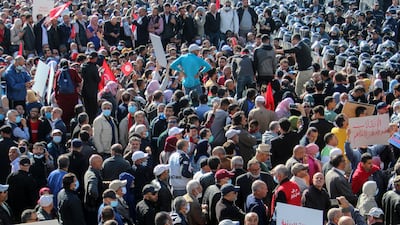
Demonstrators gather at a rally against Tunisian President Kais Saied in Tunis. AP -

Demonstrators with flags and placards at the protest. Reuters -

Thousands of Tunisians rally against a presidential power grab in the only democracy to have emerged from the Arab uprisings a decade ago. AP -
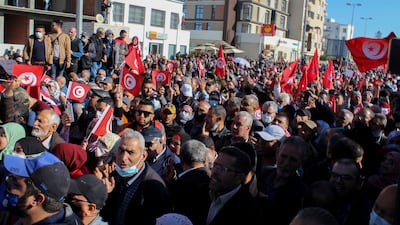
The streets of Tunis are filled with people and flags. AP -

Tunisian President Kais Saied suspended the country's Parliament and dismissed Hichem Mechichi as prime minister on July 25. EPA -
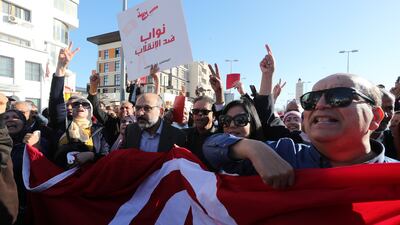
Protesters shout slogans during the demonstration. EPA -

Tunisian protesters rally against the president's seizure of governing powers. EPA -
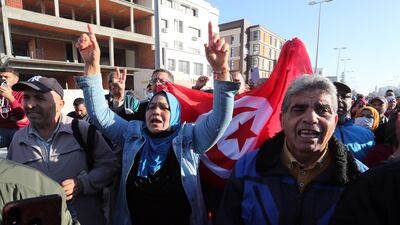
Men and women at the protest. EPA -

Thousands of people joined the protest. EPA -
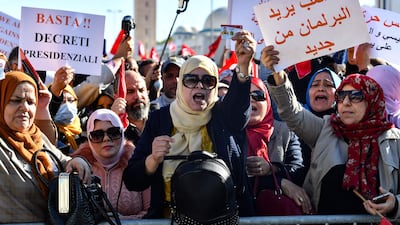
Mr Saied granted himself judicial powers in his power grab that opponents have called a coup. AFP -

Tunisian demonstrators remove metal barriers during scuffles with security forces. AFP -
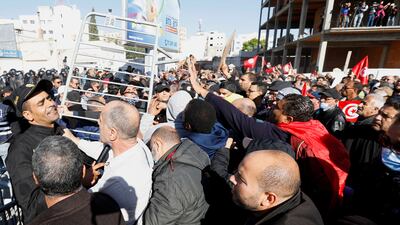
Crowds clash with security forces. Reuters -
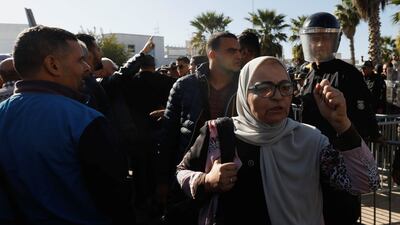
Security forces try to control the crowds. Reuters


However, Tunisian politicians are convinced that Mr Saied’s idea of “normal” will not result in the elections that many political parties and civil society have been calling for.
“Saied has refused to give us a road map, which most political parties have demanded, [so] how can we return to a normal functioning when nobody understands what is going on?” Hichem Ajbouni, an MP and co-founder of the Democratic Current party, told The National.
“He has never described exactly what the ‘imminent danger’ was and nobody has any idea,” he said.
“We should return to the constitution after a debate between the economic, political and social stakeholders and partners.”
He said Tunisia’s request to the IMF for a new package of financial aid was a non-starter in the current situation because “reforms can’t be done with a provisional government”.
During a sit-in at the Kasbah by the Free Destourian Party (PDL) on Sunday, leader Abir Moussi accused Mr Saied of inflicting a “double hell” on Tunisians after a decade of political turmoil.
Ms Moussi, who had initially supported Mr Saied’s actions, accused him of having “no plan or strategy” and not caring that Tunisians were sinking deeper into poverty.
Amine Snoussi, Tunisian political commentator and author, also voiced doubts about whether Mr Saied would act on his promises.
“Saied says he will announce the exceptional measures this coming weekend,” he told The National, but pointed out that the president “said he would run a national dialogue but then didn’t do anything”.
Mr Saied’s popularity was on the decline, he said. “He is starting to lose people and that has not really happened before and now the pressure is really on him.”
Mr Snoussi said he was not convinced that Mr Saied was capable of decisive rule or transparency and that although he still holds a hardcore of supporters, his lack of action and clarity is losing him the trust of the Tunisian people.
“I don’t think that the situation is well understood by the whole Tunisian public, there’s still an idea that he will fight corruption and corrupt parties,” he said.
“I think he is still planning on his original idea of a democracy without political parties – and without political parties everything will just revolve around Saied.”

