

There’s a video that resurfaced just after Kais Saied won Tunisia's presidential election that shows the then little-known constitutional law professor subjected to a hidden camera prank.
Mr Saied is sat in a small studio during a radio interview, when suddenly the entire room is rocked by a series of violent tremors. The presenter panics, a look of sheer terror on his face as he darts from one side of the studio to the other. People can be heard screaming in the corridor outside as heavy equipment and furniture supposedly start to crash and fall.
But as the camera zooms in on Mr Saied, he is utterly still, his expression blank, seemingly unmoved by the chaos around him. He checks his watch, waiting for the earthquake to pass.
It is with much the same coolness that Mr Saied has appeared to approach the political crisis Tunisia now finds itself in, following his abrupt decision on July 25 to dismiss the government, freeze parliament and take over all executive powers.
Mr Saied took these decisions after the government's mishandling of the Covid-19 crisis and widespread concerns about corruption and ineffective governance. Critics have called his move an unlawful “coup” and pressure from Tunisia’s allies is mounting for a clear roadmap ahead.
Mr Saied’s consolidation has largely been met with popular support, but has left some sceptical about the future of a country whose revolution ignited the Arab uprising.
Days after US senators and international democratic watchdogs decried the political turmoil facing Tunisia, however, the president seemed unconcerned - strolling along Tunis’s main thoroughfare, chatting with supporters and passers-by.
Convivial bootstrapping
Mr Saied, 63, was never expected to win the election. But he did, in October 2019, by a landslide.
An independent candidate without the backing of a party or an expensive campaign, he shunned the limelight, running a makeshift campaign with minimal advertising or media outreach, and instead favouring grassroots campaigning, door to door.
Campaigners The National spoke to painted a picture of convivial bootstrapping: with no money to set up a campaign headquarters, volunteers brought necessities from home – tables, chairs, even an air-conditioner unit.
“He didn’t make a structure," said Khayreddine Debaya, who worked on Mr Saied's campaign in the southern city of Gabbes. "He said that if he made a structure it would be like a political party. It will be a party like the others in Tunisia and then we will have achieved nothing."
Mr Saied ran on a message of integrity and anti-corruption that was especially popular among young voters. Leading up to the runoff, Mr Saied excelled in the TV debates as he faced down Nabil Karoui, a Tunisian media magnate who was arrested on suspicion of money laundering a few weeks before the election.
During his campaign, Mr Saied’s formal, slightly aloof, matter-of-factness and laser focus on law and order earned him the nickname “RoboCop”- like the cyborg in the eponymous 1987 film – a moniker used with affection by supporters and derision by critics.
Mr Saied became a familiar face to Tunisians in the years after the revolution: he was among the principal legal experts who consulted with lawmakers to formulate the 2014 constitution. Supporters today praise his intelligence, his knowledge of the law, and aggressive “ordinariness” – a far cry from other slick, media-savvy Tunisian politicians.
"We had been trying to get Saied to run for office since 2015 or 2016," said Aymen Gharbi, who worked on Mr Saied's campaign in the interior city of Sidi Bouzid, "but the man is stubborn. He wanted to do it his way — make government work his way."
Tired of out-of-touch officials perceived as using power for their own personal gains, many Tunisians see Mr Saied as “clean” and “uncorrupted”; the kind of man who still visits his favourite local café flanked by his presidential security detail; the kind who initially refused to live in Carthage Palace after taking office – preferring to stay in his family home with his wife Ishraf, who is also a judge, and their three children, in one of Tunis’s working-class neighbourhoods.
Although Mr Saied is not slick, he is a far cry from folksy. Prone to speechifying and lectures, Mr Saied only speaks in rigid, impeccable classical Arabic, far removed from the fast, French-infused local dialect spoken by his constituents.
'Very grounded'
Islem Said, one of Mr Saied’s students, said despite his strange formalities and reputation as the "best" constitutional law professor at their university, he was also kind and approachable, a teacher who paid attention to his students. “He always was very grounded,” she said.
Not everyone is persuaded by his persona, however. Tunis-based activist Yasmine Sakher, 25, feels it puts distance between Mr Saied and the people he claims to represent.
"I can’t stomach him. I've never felt comfortable around him," she said. "Once I ran into him on the street, just walking around downtown, and he addressed me in formal Arabic. I just never felt like I could connect with him."
She'd often hear him speaking with students and leftists in the Elysees café in downtown Tunis in the years after the revolution and felt like he was holding court rather than mixing with ordinary people.
"Sometimes he says a word in formal Arabic, and three days later I'm still trying to figure out what he meant."
-
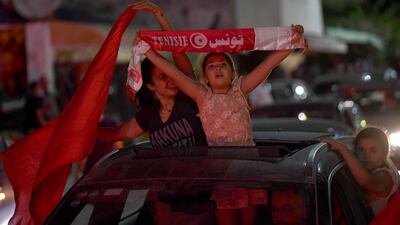
People celebrate on the streets after Tunisian President Kais Saied announced the dissolution of parliament and Prime Minister Hichem Mechichi's government in Tunis on July 25, 2021. -
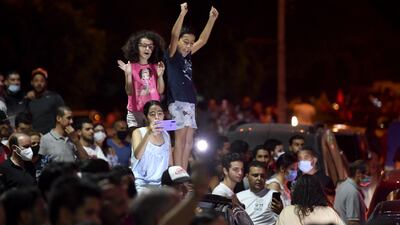
The president announced the suspension of Tunisia's parliament following a day of protests against the ruling party. -

Thousands of Tunisians waved flags and honked horns in cities and towns across the country. -
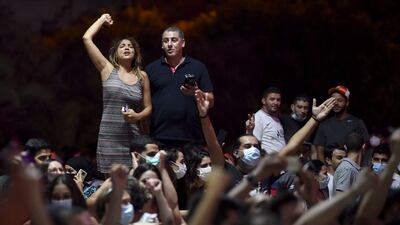
Crowds sang the national anthem. -
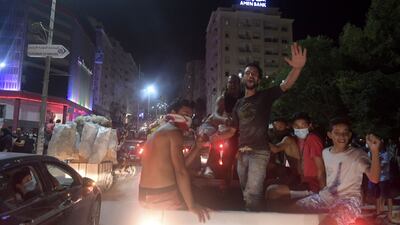
Tunisia has been in a political crisis for months, as the country tackles an economic crunch and the pandemic. -
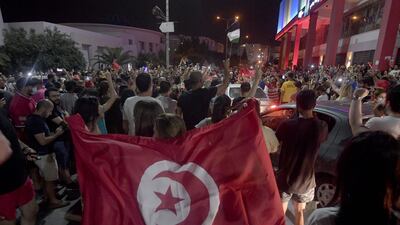
The street celebrations were held under the watch of military personnel, reports said. -

A woman raises the Tunisian flag. -
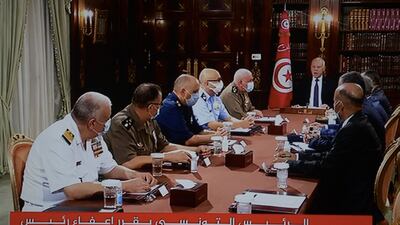
President Kais Saied, flanked by military officials, announces the dissolution of parliament and Prime Minister Mechichi's government. -

Mr Saied said he would assume executive authority with the assistance of a new prime minister.


Others say they are drawn to Mr Saied’s principles. Although Ms Said does not remember the president having strong political opinions while a professor, she says his ideas on social justice – specifically his stance on corruption – have been “consistent”. One of Mr Saied’s first pledges since July 25 was to tackle corrupt businessmen and retrieve what he estimates to be 13.5 billion Tunisian dinars ($4.86 billion) that he says was stolen from the country.
Farhat Zaghbani, 29, first encountered Mr Saied in the heady days just after Tunisia’s revolution in 2011 during the massive wave of demonstrations known as the Kasbah 1 protests. Thousands of Tunisians from across the country descended on the seat of government to demand a change to the political system.
During the sit-in, he spent time listening to different thinkers and leaders who were positing their visions of Tunisia's future. He was particularly enamoured with a group called Forces for a Free Tunisia, to which Mr Saied belonged. "Their vision of a decentralized Tunisia really struck me," he said. "The man himself wasn't what appealed to me, but the ideas."
Mr Zaghbani says as Tunisia was writing its new constitution, he'd often see Mr Saied on TV as an expert guest on state-run Wataniya explaining what was happening during the process. "We came to see him as an expert on these kinds of things, and to trust him."
On the question of trust, Ms Said is more sceptical: “As a person, as in the portrait we had of him at university - it seems that he didn't change over time. I would say that I trust him but I do not trust power. I don't think politics should be ruled by trust, because you have so many good presidents who start their first mandate doing an amazing job, but then because of the overall trust and power, they deviate with time.”
She says that while she liked Mr Saied, she thought his campaign was based on “dreamy populism.” With no political track record to show otherwise, Mr Saied was a kind of blank canvas for people to project their hopes onto. Ms Said ultimately didn’t vote for him in the second round because of his conservatism.
A certain opacity
Indeed Mr Saied does hold conservative views that have caused concerns in the past with many in the more secular, liberal parts of the country. He is in favour of restoring the death penalty, which has been suspended since 1994 in Tunisia, and opposes equal inheritance right for men and women. Despite his young support base, Mr Saied has also shown no signs of willingness to tackle Tunisia’s enduring problems with police brutality and powerful police unions.
Due to Mr Saied’s reticence to giving interviews, he is surrounded by a certain level of opacity. Most communication is through the presidency’s official Facebook posts and little is known about the minutiae of his core beliefs or policy objectives.
Throughout his presidency, Mr Saied has increasingly advocated for greater presidential powers. In April, he made waves when during a speech he said that the president is the supreme commander of the military and civilian armed forces – despite the constitution’s careful separation of powers within the executive. Some of his rhetoric can appear contradictory: he also advocates for radical decentralization, wanting to place more power in local councils.
For now, many supporters are watching and waiting to see what Mr Saied does next, and hoping he lives up to the ambitions many have placed in his hands.
"He is right in the thick of it so he won’t get everything right," said Mr Debaya, his former campaigner.
"But he is sincere, he wants to leave a trace in our history. We need to have people like that – who are courageous, stubborn, who want to make their mark."

