• A farmer picks peaches from trees in a farm in the village of Rahbet Khattab in the northwestern countryside of Hama province in central Syria. Seven years into Syria's civil war, some 6.5 million people in the country are unable to meet their food needs, the United Nations says. AFP
    A farmer picks peaches from trees in a farm in the village of Rahbet Khattab in the northwestern countryside of Hama province in central Syria. Seven years into Syria's civil war, some 6.5 million people in the country are unable to meet their food needs, the United Nations says. AFP
  • This aerial view shows Syrian potato farmers using a tractor to plant the root vegetables near the town of Binnish in Syria's northwestern Idlib province. AFP
    This aerial view shows Syrian potato farmers using a tractor to plant the root vegetables near the town of Binnish in Syria's northwestern Idlib province. AFP
  • Workers in Rateb Hosrom's greenhouse prepare bunches of freshely-picked carnations at his greenhouse in Syria's northwestern Idlib province, to be sold in flower shops around the rebel-held region. AFP
    Workers in Rateb Hosrom's greenhouse prepare bunches of freshely-picked carnations at his greenhouse in Syria's northwestern Idlib province, to be sold in flower shops around the rebel-held region. AFP
  • Syrian farmer Ayman Ibrahim harvesting Azolla aquatic ferns used as livestock feed in the town of Kafr Takharim in Syria's northwestern Idlib province. - To dodge skyrocketing prices for animal fodder in Syria's last major rebel bastion, farmer Ayman Ibrahim has turned to an aquatic fern used as a fertiliser in Asian rice paddies. Azolla is highly productive with the ability to double its weight in seven days, according to the UN Food and Agriculture Organisation. The plant is rich in proteins and has been used as a feed for cattle, fish and poultry in Vietnam; and for pigs in Singapore and Taiwan. AFP
    Syrian farmer Ayman Ibrahim harvesting Azolla aquatic ferns used as livestock feed in the town of Kafr Takharim in Syria's northwestern Idlib province. - To dodge skyrocketing prices for animal fodder in Syria's last major rebel bastion, farmer Ayman Ibrahim has turned to an aquatic fern used as a fertiliser in Asian rice paddies. Azolla is highly productive with the ability to double its weight in seven days, according to the UN Food and Agriculture Organisation. The plant is rich in proteins and has been used as a feed for cattle, fish and poultry in Vietnam; and for pigs in Singapore and Taiwan. AFP
  • Syrian potato farmers use a tractor to plant the root vegetables near the town of Binnish in Syria's northwestern Idlib province. AFP
    Syrian potato farmers use a tractor to plant the root vegetables near the town of Binnish in Syria's northwestern Idlib province. AFP
  • A view of pistachio trees growing at a pistachio orchard in the village of Maan, north of Hama in west-central Syria. - Pistachio farmers in central Syria are hoping that reduced violence will help revive the cultivation of what was once one of the country's top exports. Maan, famed for its pistachio production, was controlled for years by jihadists and their rebel allies but it fell to the government at the start of the year following a months-long offensive. And as the violence subsided, many formerly displaced farmers have returned, hoping this season will mark the revival of what was once a leading industry. AFP
    A view of pistachio trees growing at a pistachio orchard in the village of Maan, north of Hama in west-central Syria. - Pistachio farmers in central Syria are hoping that reduced violence will help revive the cultivation of what was once one of the country's top exports. Maan, famed for its pistachio production, was controlled for years by jihadists and their rebel allies but it fell to the government at the start of the year following a months-long offensive. And as the violence subsided, many formerly displaced farmers have returned, hoping this season will mark the revival of what was once a leading industry. AFP

Syrian regime abets illegal auctions to invest in displaced farmers' lands


Nada AlTaher
  • English
  • Arabic

With just a month to go until wheat-harvesting season, Hussam and his 25 relatives had to flee their tiny village in Syria's central Hama governorate, leaving behind the 2.5 hectares of lush farmland that had sustained them for decades.

Three years later, the 43 year-old went from living comfortably to struggling just to feed his five kids in a refugee camp on the border with Turkey in the northern opposition-controlled city of Haram. From farming vegetables, wheat and cotton for wholesale, Hussam now survives on handouts.

"Here I knew hunger," Hussam, who asked to go by his first name for security reasons, told The National. "Sometimes we eat, sometimes we don't. Most of our homes were destroyed after years of almost daily bombardment.''

Since the landowners escaped airstrikes and a regime-led campaign of attacks on Sahl Al Ghab, the fertile grounds have become a source of revenue for supporters of Syrian President Bashar Al Assad’s regime.

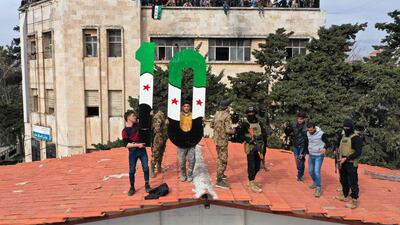
  • An aerial picture shows Syrians gathering on the roofs of buildings in the rebel-held city of Idlib, as they mark ten years since the nationwide anti-government protests that sparked the country's devastating civil war. AFP
    An aerial picture shows Syrians gathering on the roofs of buildings in the rebel-held city of Idlib, as they mark ten years since the nationwide anti-government protests that sparked the country's devastating civil war. AFP
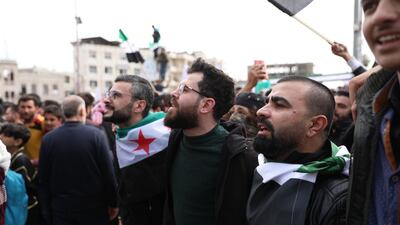
  • Syrians gather to commemorate the ten years anniversary of the uprising against the Syrian government, in Idlib. EPA
    Syrians gather to commemorate the ten years anniversary of the uprising against the Syrian government, in Idlib. EPA
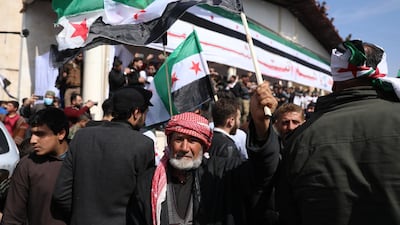
  • Syrians gather to commemorate the ten years anniversary of the uprising against the Syrian government, in Idlib. EPA
    Syrians gather to commemorate the ten years anniversary of the uprising against the Syrian government, in Idlib. EPA
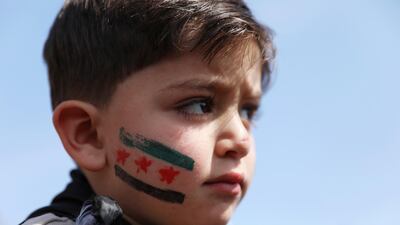
  • A Syrian boy takes part in a gathering to commemorate the ten years anniversary of the uprising against the Syrian government, in Idlib. EPA
    A Syrian boy takes part in a gathering to commemorate the ten years anniversary of the uprising against the Syrian government, in Idlib. EPA
  • A woman draws a flag on a boy's head as they are gathered to commemorate the ten years anniversary of the uprising against the Syrian government, Idlib. EPA
    A woman draws a flag on a boy's head as they are gathered to commemorate the ten years anniversary of the uprising against the Syrian government, Idlib. EPA
  • Protesters wave flags of the Syrian opposition during a demonstration in Syria's rebel-held city of Idlib. AFP
    Protesters wave flags of the Syrian opposition during a demonstration in Syria's rebel-held city of Idlib. AFP
  • A man holds a girl on his shoulder as she holds a flag of the Syrian opposition during a demonstration in the village of Atme in Syria's rebel-held northwestern province of Idlib close to the border with Turkey. AFP
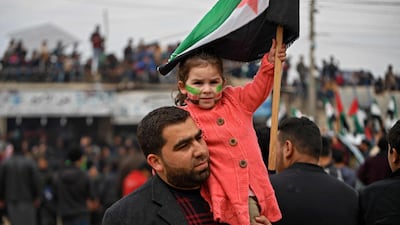
    A man holds a girl on his shoulder as she holds a flag of the Syrian opposition during a demonstration in the village of Atme in Syria's rebel-held northwestern province of Idlib close to the border with Turkey. AFP
  • An aerial picture shows Syrians waving the national flag during a gathering in the rebel-held city of Idlib. AFP
    An aerial picture shows Syrians waving the national flag during a gathering in the rebel-held city of Idlib. AFP
  • An aerial picture shows Syrians gathering in the rebel-held city of Idlib. AFP
    An aerial picture shows Syrians gathering in the rebel-held city of Idlib. AFP

Unauthorised civil unions and government-appointed security committees in Hama are colluding in the illegal “investment” of plots whose owners – like Hussam - have fled bombing, shelling and daily attacks.

Through rigged auctions, the rights to cultivate and benefit from these abandoned spaces are granted to a small circle of bidders handpicked by pro-government loyalists.

"It's not ours anymore," landowner and a lawyer-turned-activist Abdulnasser Hoshan, 52, told The National.

For over 70 years, Mr Hoshan’s family also built their lives on Hama’s fertile soil – in the heart of Syria’s pistachio-farming industry. No longer a family heirloom, his land is going to the highest regime-backed bidder.

“Once it has fallen into the hands of the regime, documents proving ownership are worthless in the face of the sweeping seizures,” he said. “Only a handful of merchants are allowed to bid on the land. They back pro-regime militia fighting on behalf of the government.”

He and 30,000 others from the now-decimated town of Kafr Zita fled for safety after multiple offensives, including a 2014 chlorine gas attack, ended with the regime's successful takeover in 2019.

“Ancestors from whom we had inherited our land are all publicly listed as owners of lands to be invested through auctions,” he said.

Announcements of auctions of farmland belonging to farmers who fled the shelling in various towns in Syria.

Mr Hoshan left 10 hectares behind.

Government-issued legislative decrees “legitimising” these measures, even though they contravene with constitutional property protection laws prohibiting the stripping of ownership if it fails to serve “greater good” without just compensation to the original owner.

  • Announcements of auctions of farmland belonging to farmers who fled the shelling in various towns in Syria.
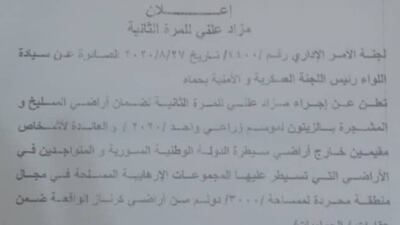
    Announcements of auctions of farmland belonging to farmers who fled the shelling in various towns in Syria.
  • Announcements of auctions of farmland belonging to farmers who fled the shelling in various towns in Syria.
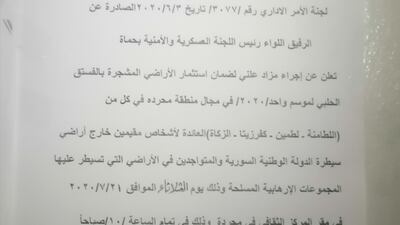
    Announcements of auctions of farmland belonging to farmers who fled the shelling in various towns in Syria.

“While ownership is not being ‘stripped’ in a formal sense – the act of cultivating someone else’s land, especially when there’s a threat over reclaiming it, is equivalent to looting,” Mr Hoshan said.

Although the property deed itself is not impacted, rights associated with ownership like cultivation of land by their true owners and leasing it are severely limited.

Rights groups say the measures are tantamount to property seizure.

"The regime effectively takes these lands and distributes them to security forces and militia members to compensate them for the work they're doing on the regime's behalf because the money paid to them is not enough," Syrian Network for Human Rights head Fadel Abdul Ghany told The National.

This includes 44,000 hectares of agricultural land in regime-held Hama and parts of Idlib, the Syrian network said in a report.

Forcibly displaced people living in opposition territories also face grave risks if they choose to return, including, but not limited to, imprisonment, according to international rights agencies.

Human Rights Watch (HRW) has warned other NGOs against offering support to farmers on this “stolen land”.

“This is not the first time that Syrian authorities have used laws and policies to punish people they perceive to be opposing their brutal rule,” HRW Syria researcher Sara Kayyali said.

"We have never seen justification for this in writing," she told The National.

Mr Hoshan says that is because there isn’t a legal backing to these measures or the mechanism through which the bidding takes place.

“The unofficial, informal, and non-governmental Peasants’ Union says the auctions are held on behalf of the state-owned Agricultural Cooperative Bank,” he said.

The Peasants’ Union and the Syrian Agricultural Cooperative Bank couldn't be reached for comment.

Some of the de-facto expropriation is labelled “asset seizure” without providing evidence of farmers’ debts outstanding.

“The union cannot confiscate anyone’s assets, nor can the bank authorise them to do so," said Mr Hoshan, the lawyer. "Those who have their assets held also need to be notified before that happens – which is not being done here.”

In the northern fringes of Idlib, journalist Iyad Abd Al Jawad, 37, and his family also live in a refugee camp. They fled their home in 2015.

Iyad Abd Al Jawad took an extra-wideshot of his family’s farm in Qaber Fidda showing clearly that it is being cultivated and used years after he and his family left the village. The vantage point from where he stood two years ago has since been taken over by the regime. Courtesy: Iyad Abd Al Jawad

Two years ago, Mr Jawad climbed a hill close to his old 2.4-hectare farmland in his village of Qaber Fidda. He shot a photo that clearly showed his land is now being farmed and cultivated by unknown hands.

“We grew wheat, barley and beans in the winter and cotton, beets and vegetables in the summer," he said. "We lost everything.”


Banned items
Dubai Police has also issued a list of banned items at the ground on Sunday. These include:
  • Drones
  • Animals
  • Fireworks/ flares
  • Radios or power banks
  • Laser pointers
  • Glass
  • Selfie sticks/ umbrellas
  • Sharp objects
  • Political flags or banners
  • Bikes, skateboards or scooters
UAE and Russia in numbers

UAE-Russia ties stretch back 48 years

Trade between the UAE and Russia reached Dh12.5 bn in 2018

More than 3,000 Russian companies are registered in the UAE

Around 40,000 Russians live in the UAE

The number of Russian tourists travelling to the UAE will increase to 12 percent to reach 1.6 million in 2023