

Under a desert sunset almost 13 years ago, a group of Bedouin rebels fighting against President Bashar Al Assad hid at the side of a remote road in central Syria, waiting to ambush a bus.
Shepherds told them the bus left a local army base every day and headed to the city of Homs, where military tank forces were shelling residential areas to crush the uprising against the Assad regime.
Posters of Mr Al Assad and his ally, Hezbollah leader Hassan Nasrallah, were plastered on the bus's windows. The weather was cold and the bearded rebels wore jackets over their grey tunics. They intercepted the bus near Furqlus, 35km south-west of Homs. A gunfight ensued, resulting in the deaths of 11 men, including six pilots and four other officers, as well as the commander of the rebel force.
The operation in late November 2011 was the most high-level attack in the nascent Syrian civil war, due to the number of senior personnel involved. The Syrian army, which rarely disclosed its casualties, announced it at the time.
The army said it would “cut every evil hand that targets Syrian blood”.
-

Syrians demonstrate in Binnish, in Idlib province, on the 13th anniversary of the country's revolution as they demand the departure of President Bashar Al Assad and Abu Muhammad Al Jolani, the leader of Hayat Tahrir Al Sham. All photos: Moawia Atrash for the National -
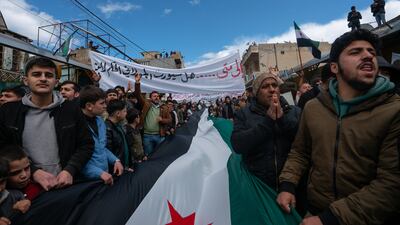
The demonstrators have also called for a change in the policies of Hayat Tahrir, a rebel formation set up by Al Nusra Front in 2017 after the group formally broke off from Al Qaeda -
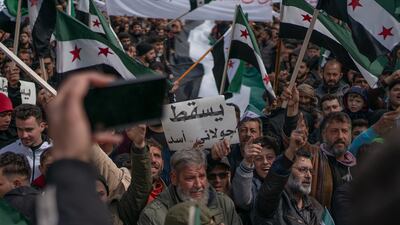
Syria remains fragmented 13 years after the start of the revolution, with the regime controlling about 70 per cent of the country -
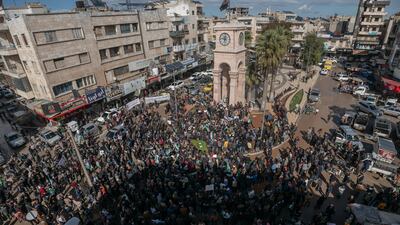
Hundreds of Syrians gather near Clock Square in Idlib. Outright fighting between the government and opposition groups has dropped in intensity, the conflict is far from over -
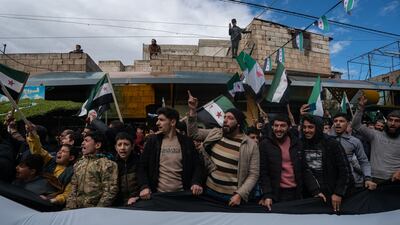
An entrenched war economy, deep societal rifts, amalgamations of militias, as well as zones belonging to Iran, Russia, Turkey and the US compound any effort at stabilisation -
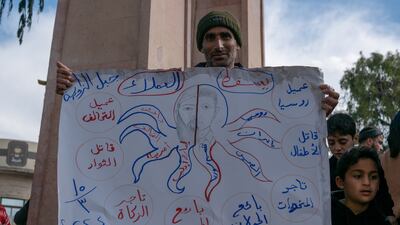
Rebel brigades, including Hayat Tahrir, control large parts of Idlib -

Ahmed Al Ali, left, said 'today, we came to the squares to renew our pledge once again and to affirm the overthrow of the Syrian regime and that the oppressors cannot rule us' -

Shada Barakat told The National that one of her children was detained by the Assad regime while her husband had 'died due to oppression, and I am demonstrating here until I feel that I can do something to take revenge on this regime' -
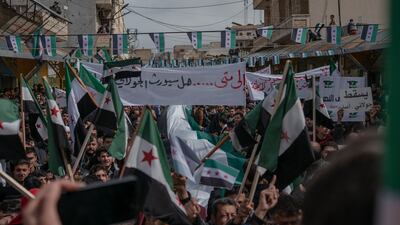
Millions of people have fled the country due to the conflict, and a war economy based on narcotics and other illicit trade has taken hold -
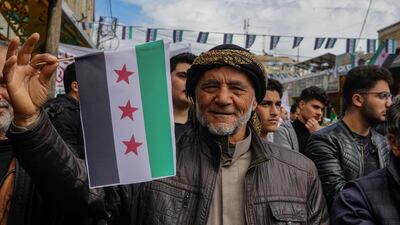
The Syrian National Army, a Turkish proxy, controls territory in Aleppo, while the SDF, backed by the US, controls much of north-eastern and eastern Syria -
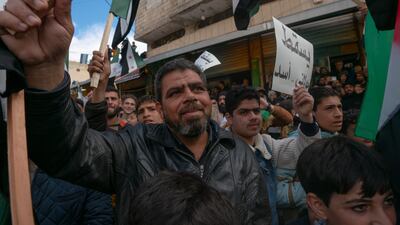
For the past seven months, peaceful demonstrations demanding the removal of the president have been occurring in Suweida province, where Druze militias have kept pro-regime forces in check


The attack helped to rally Mr Al Assad's supporters as the regime promoted its official narrative that “terrorists” were bent on destroying Syria. Opponents of the pro-democracy uprising that started in March of that year said that the pilots had been trained to fight Israel, Syria's neighbour and enemy.
The account of the attack was based on an interview with Abu Yazan, who was second-in-command of the rebel group, in Hatay, southern Turkey, about a year later.
Abu Yazan was wounded in the eye during the operation. He visited southern Turkey briefly in 2012 for treatment and died in mysterious circumstances in Syria in 2015.
Abu Yazan's journey is illustrative of how an initial peaceful revolt morphed into a civil war that has left the country radicalised and fragmented today.

'It's your turn, doctor'
The protests against Mr Al Assad began in Deraa, on the country's southern border with Jordan, in early 2011 after school pupils painted anti-regime graffiti inspired by the uprisings in Tunisia, Egypt, Libya and Yemen.
“It is your turn, doctor,” they wrote, referring to Mr Al Assad's studies as an eye doctor in London in the 1990s before he become president in 2000.
Secret police responded to the graffiti by imprisoning and torturing the children, sparking calls for protests including a “day of rage” on March 15.
On March 18, after Friday prayers in Deraa, security forces used live ammunition to disperse a large demonstration, killing three people.
For many, this date is considered the starting point of the Syrian civil war.

Sectarian violence
The peaceful protest movement quickly spread to other parts of the country and was met with repression from security forces.
It began to take on a sectarian nature as the regime deployed militias from Mr Al Assad's Alawite sect, an offshoot of Shiite Islam, to suppress the revolt in Sunni-majority urban areas.
Most of the civilians killed in the crackdown were Sunni.
Mr Al Assad also allowed the Iran-backed Shiite Lebanese group Hezbollah to deploy its fighters against the opposition, including in Homs and near Shiite shrines in Damascus.
Their presence contributed to the development of a violent Sunni backlash in the second half of 2011, as the peaceful revolt became an armed conflict fought increasingly along sectarian lines.
The militarisation of the opposition was led by Sunni soldiers, who had begun defecting from the military, in which the most of the officers were Alawite. The defectors formed rebel brigades who organised under a loose grouping known as the Free Syrian Army.
Abu Yazan's group was one of the many groups that fought under the umbrella of the FSA.
Most of Abu Yazan's group were blue-collar workers from Khalidiya in Homs, where he grew up, who originally belonged to Sunni Bedouin clans from the desert outside the city. The group became defunct after forces loyal to the president captured Khalidiya and other rebel areas of Homs in 2013.
He said that his group had been expecting to find civilians on the bus they attacked, who they had planned to take captive to negotiate a swap for civilians who had been arrested for taking part in anti-regime demonstrations.
As groups like Abu Yazan's took up arms against the regime, their conflict quickly became an international one.
His group received funding from expatriates from Khalidiya who lived and worked in the Gulf.
The FSA more broadly received the backing of Turkey, the US and other Arab states as it took on the Alawite-dominated regime and the army units that had stayed loyal to it.
These backers had deep differences, such as on the Kurdish issue in Syria and the role of religious leaders opposing Mr Al Assad.
On the other side, Iran backed the regime in Damascus. The Iranians set up a network of united militias, supervised by Hezbollah, particularly around Damascus, and in northern and eastern Syria.
Friction and fragmentation
Abu Yazan continued to lead hit-and-run raid after the bus attack, but quit the FSA after the regime regained control of Homs in 2013. He then joined Al Nusra Front, Al Qaeda's Syrian affiliate, which had displaced many of the moderate rebel factions as their outside backing waned.
Al Nusra was better organised than its rivals and appeared to have acquired tacit support from Turkey and other outside brokers, factors that helped it to take either take over moderate factions through violence or by attracting fighters disillusioned with the FSA.
Abu Yazan fought for Al Nusra Front in areas around Aleppo and other parts of north-western Syria before defecting to ISIS in 2014 as the two factions engaged in a power struggle for control of the armed opposition.
Al Nusra Front lost territory to ISIS in eastern Syria, but it remained a formidable player in the north-west, where it led an offensive that dislodged the regime from the province of Idlib. The loss of Idlib exposed the Alawite heartland in the coastal mountains to attack, and was a main reason for Russia's military intervention in 2015, which reversed the tide of the war.

Foreign forces
Many of the gains made by the opposition were reversed as Russian air strikes pounded rebel positions. Under Russian air cover, the army and its pro-Iranian militia allies recaptured many areas of the country.
A year later, Turkey intervened in northern Syria in support of anti-regime rebels.
Meanwhile, in Syria's north-east, the US deployed troops to support the Kurdish-led Syrian Democratic Forces, who had taken territory from the regime and from Arab Sunni rebels, in fighting against ISIS.
Today, Syria remains fragmented, with the regime controlling about 70 per cent of the country.
Rebel brigades, including Hayat Tahrir Al Sham, a rebel formation that was set up by Al Nusra Front in 2017 after the group formally broke off from Al Qaeda in 2016, control large parts of Idlib.
The Syrian National Army, a Turkish proxy, controls territory in Aleppo, while the SDF, backed by the US, controls much of north-eastern and eastern Syria.
Steady economic decline also contributed to the regime's weakening grip in the mostly Druze governorate of Suweida, near the border with Jordan.
For the past seven months, peaceful demonstrations demanding the removal of the president have been occurring in the province, where Druze militias have kept pro-regime forces in check.
Millions of people have fled the country, and a war economy based on narcotics and other illicit trade has taken hold, often run by gangs with links to militias on both sides of the conflict, although the drug trade is seen as dominated by the regime's allies, especially in southern Syria.

No end in sight
While outright fighting between the government and opposition groups has dropped in intensity, the conflict is far from over.
Waiel Olwan, senior fellow at the Turkey-based Jusoor Centre for Studies, said that Syria is “at a stage of lessened conflict, but not at its end”.
An entrenched war economy, deep societal rifts, amalgamations of militias, and zones belonging to Iran, Russia, Turkey and the US compound any effort at stabilisation.
“The scenarios for the future of the country remain disparate,” he said.
Any solution, he said, would need to address the militia infestation. Some, too extreme to be integrated into the regular army, or eager “to continue fighting for the sake of fighting”, will need to be disbanded and dismantled, “and that could involve confrontation”.
Including others in a new postwar state could be done “relatively easily” by offering them a share of reconstruction funds or a seat on the table in any final settlement negotiations, or because of pressure from their sponsors to agree to give up their arms.
Mr Olwan said this was the case in Lebanon after the 1975-1990 civil war, when all the militias, except Hezbollah, agreed to demilitarise. Western financial support, as well access to international borrowing markets made billions of dollars available for reconstruction.
In Iraq, Mr Olwan pointed out, new security structures in the last decade designed to curb the power of the mostly Iran-backed militias have mainly not worked because the militias were haphazardly integrated into them, and Iran wanted its armed allies to remain dominant.
In Syria, he said, it is not yet clear “how much outside powers could contribute to stability and how much reconstruction funding there could be”.

