
Three people, including a child, were killed on Monday when rocket fire from Syria hit a Turkish border town, Ankara has said.
"Three of our citizens lost their lives. One of them is a child, another a teacher," Turkish Interior Minister Suleyman Soylu said on live TV, promising a "strong response".
Education Minister Mahmut Ozer said 10 people were wounded in the strike.
Turkey's official Anadolu news agency said the strikes hit a high school and two houses as well as a lorry near the border crossing that links Karkamis to the Syrian town of Jarablus.
A soldier and seven Turkish police officers were wounded overnight in separate shelling by suspected Kurdish militants that targeted a border area in nearby Kilis, Mr Soylu said.
The US embassy in Turkey said in a tweet it strongly condemned the "violent and unjustified attack".
The incident came as President Recep Tayyip Erdogan warned that he is mulling sending ground forces into north-east Syria saying the operation would not be “limited to an air campaign.”
Turkey’s Defence Ministry and military will talk about the number of ground troops that would be required, he added.
“We will hold our consultations and then we will take steps accordingly,” Turkish media quoted Mr Erdogan saying.
The attack in Karkamis, on the western bank of the Euphrates, followed a wave of nearly 90 Turkish air strikes on Kurdish militia targets in northern Syria and the mountains of Iraq at the weekend.
An undisclosed number of Syrian soldiers were also killed in the air strikes, Syrian state media said, while the death toll from the weekend's violence surged past 40, according to the Syrian Observatory for Human Rights, a war monitor.
The offensive, called Operation Claw-Sword, was launched in response to a bombing in Istanbul that killed six people and wounded 81 that Turkey has blamed on Kurdish militants.
The Observatory reported that Turkish warplanes resumed air strikes on Monday, hitting several areas including near the border town of Kobani. It said Turkish artillery also retaliated to the rocket attacks by firing at areas in Syria near the town of Tel Rifaat as well as the outskirts of the village of Ein Issa.
Turkish officials did not immediately confirm reports of new air strikes by Turkish jets. Turkey’s defence ministry, however, confirmed retaliatory strikes by Turkish artillery units.
“The traitors who continue with their attacks against innocent civilians … and go as low as to target schools, were held accountable for their actions,” the ministry said on Twitter.
-

A group of PKK soldiers walk near their base camp high in the mountains of northern Iraq on June 1, 2004. Reuters -
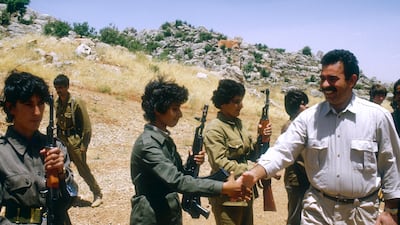
Kurdistan Workers' Party (PKK) leader Abdullah Ocalan greets women soldiers at the Mahsun Korkmaz Academy military training camp in Lebanon on June, 18, 1988. Getty Images -

Peshmerga and Turkish soldiers prepare to storm a hill on October 23, 1992, near a stronghold held by the PKK in Hakurk Valley. AFP -

Abdullah Ocalan was abducted in Nairobi in 1999 by the Turkish National Intelligence Agency (MIT), with assistance from the US, and taken to Turkey. Reuters -

Turkish riot police detain a Kurdish protester following a demonstration in central Istanbul on April 2, 2006. Reuters -
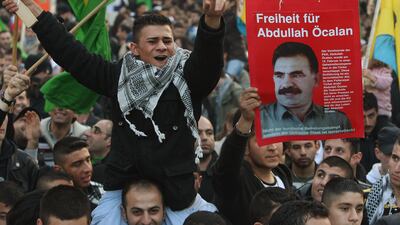
A man holds a sign demanding freedom for imprisoned Kurdish leader Abdullah Ocalan at a protest of mostly Kurdish demonstrators on November 4, 2007, in Berlin, Germany. Getty Images -
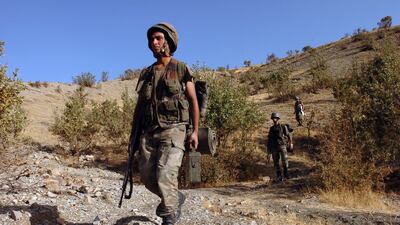
Turkish army commandos on patrol near the Iraq border on October 27, 2007, in the Uludere district of Sirnak province, south-eastern Turkey. Getty Images -
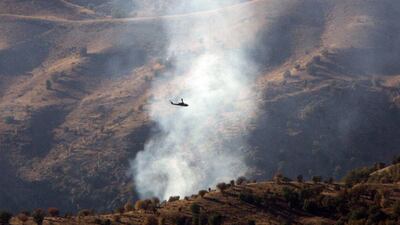
A Turkish helicopter flies over the Cudi Mountains during an attack on an outlawed PKK camp October 30, 2007, in Sirnak province, near the Iraq border. AFP -
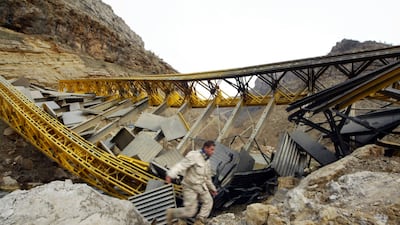
A ruined bridge lies in northern Iraq's Kurdistan region during fighting between Turkish forces and PKK fighters on February 24, 2008. AFP -
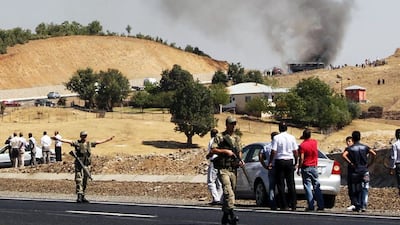
Turkish soldiers stand guard as smokes rises from a bus that was attacked by members of the PKK on September 18, 2012, in Bingol. AFP -
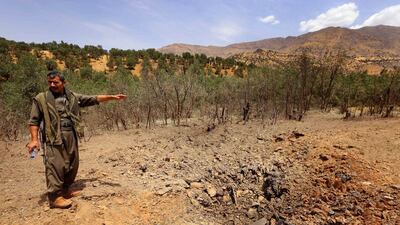
A member of the PKK inspects a crater reportedly caused by an air strike by Turkish warplanes on July 29, 2015, in the Qandil Mountains in northern Iraq. AFP -
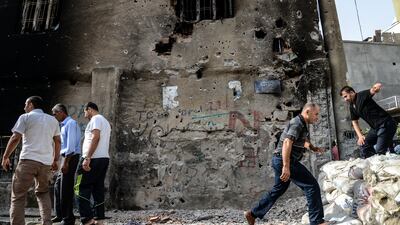
Locals assess the damage following clashes between Turkish forces and PKK militants in the Kurdish-majority city of Cizre, in south-eastern Turkey, on September 12, 2015. AFP -
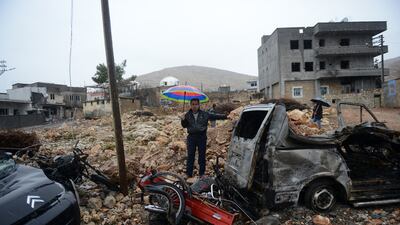
People return to their homes in Dargecit after a curfew imposed by the Turkish government was lifted on December 30, 2015, in Mardin province. AFP -
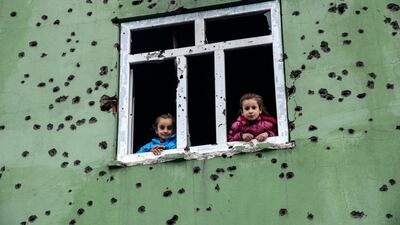
Children look out from a window of a bullet-scarred house in the Kurdish town of Silopi in south-eastern Turkey, near the border with Iraq, on January 19, 2016. AFP -
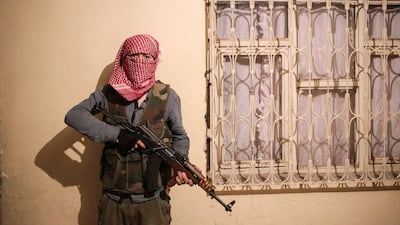
A member of the Patriotic Revolutionary Youth Movement (YDG-H), a division of the PKK, stands guard in the south-eastern Turkish city of Nusaybin on February 25, 2016. Getty Images


While Kurdish-led forces in Syria have not commented nor claimed responsibility for the attacks, the Syrian Democratic Forces in Monday vowed to respond to Turkish air strikes “effectively and efficiently at the right time and place.”
Turkey is targeting the Kurdistan Workers’ Party, or PKK, a group that has been fighting an insurgency against the government since the late 1970s, first demanding a separate Kurdish state and later Kurdish autonomy.
The strikes also hit militias in Iraq and Syria that Ankara says are allied to the PKK.
The Turkish security forces said the PKK planned the attacks from northern Syria and has sent its forces further into Syrian territory to root out the Kurdish groups.
This has raised tensions with the US and Europe who, although having designated the PKK as a terrorist organisation, have supported the mainly Kurdish Syrian Democratic Forces in fighting ISIS.
Turkish forces occupy several strips of land in northern Syria bordering Turkey, alongside allied Islamist militias that they have armed and trained.
In the latest violence, their forces advanced towards the town of Tel Rifaat, suffering eight casualties, according to Turkish media.
Turkey says its recent military operation has been a success.
"Air Operation Claw-Sword was successfully carried out within the scope of our strategy to eradicate terrorism at its source and eliminate terror attacks against our people and security forces from northern Iraq and Syria," a Defence Ministry statement read.

