



Live updates: Follow the latest on Israel-Gaza
At least 20 people have been killed in Israeli air strikes on the southern Gaza city of Rafah and central parts of the Palestinian enclave.
Shocked survivors of the bombings told The National the air strikes felt like some of the fiercest of the war so far, despite talk of a truce.
The strikes on Tuesday morning came hours after US President Joe Biden and Israeli Prime Minister Benjamin Netanyahu agreed to hold talks about the offensive.
Fourteen people were killed and dozens wounded in strikes that hit several houses and apartments in Rafah, where more than a million Palestinians have sought shelter, Gaza's medical officials said.
“After we settled in for the night, waiting for any news of a ceasefire, Israeli forces bombed everywhere as if we are in the first day of the war,” Mustafa Ibrahim, 30, who was displaced from Gaza city to the south of Gaza, told The National.
“We didn’t sleep for two days, due to the continuing shelling – shelling everywhere – so nothing is safe and we could suddenly find ourselves under rubble in minutes, with nobody to rescue us," he said.
The Palestinian Foreign Ministry said it condemned the attack on the southern city.
"Israel began to destroy Rafah without announcing, to avoid international reactions and without waiting for permission from anyone," the ministry said.
Mr Biden on Monday warned Mr Netanyahu an Israeli military operation in Rafah would deepen anarchy in Gaza.
The two leaders agreed that teams from each side would meet in Washington to discuss it, the White House said.
Gaza analyst Talal Awkal said the main purpose of an Israeli operation in Rafah would be “to save Netanyahu’s political career”.
“He is willing to prolong the war for any amount of time, in any place and in any way,” he said.
“He claims that going into Rafah will mean Israel destroys Hamas completely, despite the reality on the ground showing that Israel has still not even finished Hamas in Khan Younis and Gaza city.”
Mr Awkal also cast doubt on commitments by Israeli officials to evacuate the area of civilians.
“Netanyahu is saying Israel will evacuate civilians to reassure Americans, others and the media – but there is nowhere for [civilians] to go,” he said.
“There has not been a safe place in Gaza since the war began.”
White House National Security Adviser Jake Sullivan said the US and Israel would have a comprehensive discussion on the way forward in Gaza.
The meeting was scheduled to happen this week or next, said Mr Sullivan, adding that no Rafah operation would proceed before the talks.
US officials are said to be discussing with the Israelis a slow and targeted campaign against Hamas in Rafah, rather than a full-scale assault on the city. But there was little sign of such a cautious approach on Tuesday.
Describing a strike on his home, Mahmoud Al Hashash told The National: “My mother told me to go to sleep, then suddenly I woke up to find myself almost out of the house, I helped myself to move and I called for help.
“Two of my neighbours came and pulled me out of the house and then they took me to the hospital.
“I came to the hospital to find that all my family members were killed.”
Mr Al Hashash lost his parents, three sisters and one brother and is still looking for his baby sister who is two years old.
Israel's war has entered its sixth month and has killed more than 31,800 Gazans, according to Palestinian health officials.
It erupted after Hamas fighters attacked Israel on October 7, killing 1,200 people and taking 250 hostages.
-
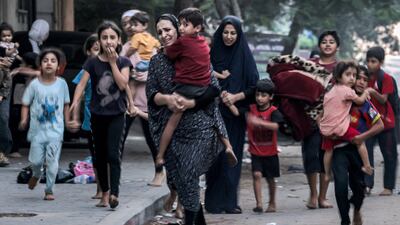
Palestinian women flee their homes with their children, after Israeli air strikes in Gaza city. AFP -
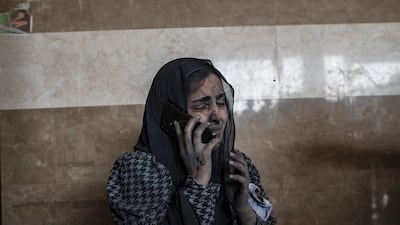
An injured woman on the phone at Nasser Hospital in Khan Younis. EPA -
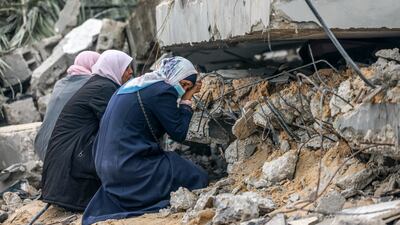
Palestinian women huddle over a spot where a relative is believed to be trapped under debris, in Rafah. AFP -
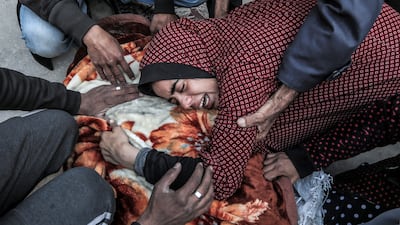
A woman mourns over the body of a loved one, killed during Israeli strikes at Al Aqsa Hospital in central Gaza. AFP -
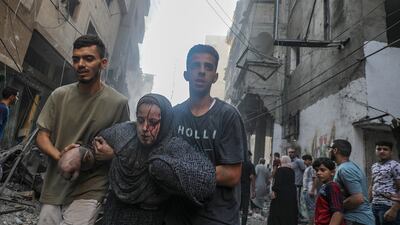
An injured woman is helped leave Al Shati refugee camp after an Israeli rocket attack. EPA -
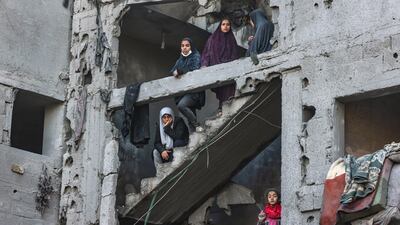
Palestinian women and children stand in the stairway of a badly damaged building. AFP -
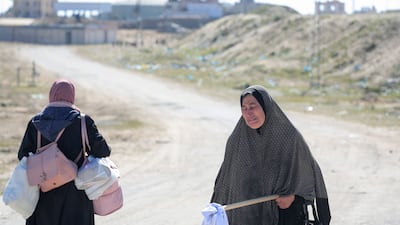
A Palestinian woman carries a white flag while fleeing from the Hamad City area of Khan Yunis. AFP -
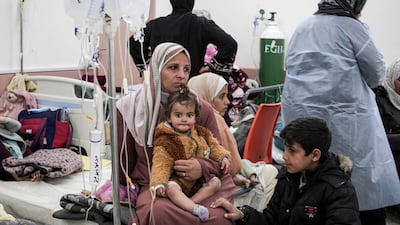
Palestinian women and children displaced from northern Gaza receive medical care at a clinic in Rafah. AFP -
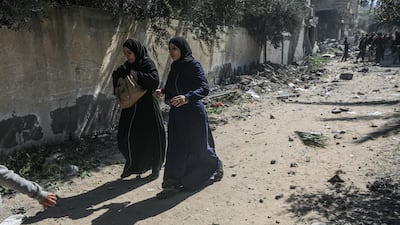
Palestinian women leave Al Nuseirat refugee camp shortly after an Israeli air strike. EPA -
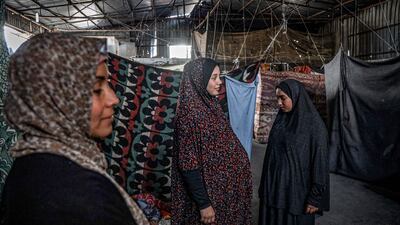
A pregnant Palestinian woman stands in a warehouse in Rafah, where she is taking shelter. AFP -
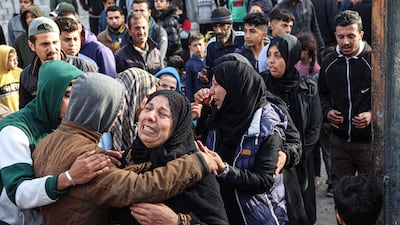
Women console each other after the destruction of homes in an Israeli air strike in Rafah. AFP


Mr Biden on Monday said he had told Mr Netanyahu to send a team to Washington to discuss how to avoid an all-out offensive in Rafah.
“I asked the Prime Minister to send a team to Washington to discuss ways to target Hamas without a major ground operation in Rafah,” Mr Biden said on social media platform X after speaking to Mr Netanyahu for the first time in more than a month.
The US President also repeated “the need for an immediate ceasefire as part of a deal to free hostages, lasting several weeks, so we can get hostages home and surge aid to civilians in Gaza”.
The call is the clearest attempt yet by Mr Biden to rein in the key US ally, amid fears that the already huge death toll and humanitarian crisis in Gaza could be drastically worsened by a full attack on Rafah.
The White House said separately that Israel had killed one of Hamas's top commanders in a strike in Gaza.
“Hamas's number three Marwan Issa was killed in an Israeli operation last week,” Mr Sullivan said.
Mr Sullivan said Israel had also “broken a significant number of Hamas battalions [and] killed thousands of Hamas fighters including senior commanders”.
“The rest of the top leaders are in hiding, likely deep in the Hamas tunnel network, and justice will come for them too,” he said.
Meanwhile, US Secretary of State Antony Blinken will travel to Saudi Arabia and Egypt this week to discuss efforts to secure a ceasefire in Gaza and increase humanitarian aid to the Palestinian territory.
Mr Blinken said Gaza’s population faces “severe levels of acute food insecurity,” during a press conference in the Philippines on Tuesday.
“That’s the first time an entire population has been so classified,” he added.
Mr Blinken will hold talks with Saudi leaders in Jeddah on Wednesday before travelling to Cairo on Thursday for talks with Egyptian authorities.
The trip has several aims, including reaching a ceasefire agreement between Israel and Hamas and securing the release of hostages, Mr Blinken said.
The visit will be to "discuss the right architecture for lasting regional peace", he said at a press conference during a visit to Manila.

