

Live updates: Follow the latest news on Israel-Gaza
Gaza will not be governed by Hamas or Israel after the conflict is over, Israeli Defence Minister Yoav Gallant said on Thursday as he presented his plan for the postwar administration of the Palestinian enclave.
Under the plan, Israel's assault will continue until it has secured the return of the remaining hostages taken on October 7, dismantled the “military and governing capabilities” of Hamas and removed any military threats.
Mr Gallant is to submit his plan for the “day after” the war to Prime Minister Benjamin Netanyahu's war cabinet, which has been divided in recent weeks over the future of Gaza.
The next stage of the conflict is to involve a more focused approach by Israeli forces in the northern part of the enclave, while Hamas leaders continue to be pursued in the south.
“In the northern region of the Gaza Strip, we will transition to a new combat approach in accordance with military achievements on the ground,” Mr Gallant said in a statement issued by his office.
He said operations would include raids, demolishing tunnels used by militants, air and ground strikes and special forces operations. These will “continue for as long as is deemed necessary”, he said.
After the war, Mr Gallant said Hamas would no longer control Gaza and Israel would reserve its operational freedom of action.
But he said there would be no Israeli civilian presence and Palestinians would be in charge of the enclave.
“Gaza residents are Palestinian, therefore Palestinian bodies will be in charge, with the condition that there will be no hostile actions or threats against the state of Israel,” Mr Gallant said.
-

A protester in Sana'a, Yemen, covering his face with a keffiyeh. EPA -

Izzat Hirbawi showing a keffiyeh at the textile factory in Hebron. Reuters -

A newly-recruited member of the Houthis' popular army covering his face with a keffiyeh during a parade in Sana'a, Yemen. EPA -

Two people wear Palestinian keffiyehs, during a Pro-Palestinian demonstration march in Madrid, Spain. AP -

A Palestinian child wearing a keffiyeh and carrying a Palestinian flag during a protest in Beirut, Lebanon. EPA -

A worker sewing at the Hirbawi keffiyeh in Hebron. AFP -
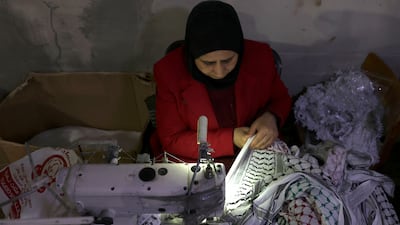
A worker sewing at the Hirbawi keffiyeh factory in Hebron. AFP -

A worker stands over a loom at a textile factory producing the Palestinian Keffiyeh scarf in the occupied West Bank city of Hebron. AFP -

Workers producing the traditional keffiyeh in Hebron. AFP -

A worker stands over a loom at the Hirbawi textile factory producing the Palestinian Keffiyeh scarf in the occupied West Bank city of Hebron. AFP -

A worker stands over a loom at a textile factory producing the Palestinian Keffiyeh scarf in the occupied West Bank city of Hebron. AFP -

A protester flashing the V for victory sign as people march during a demonstration near the US embassy in the capital Amman in solidarity with the people of Gaza. AFP -

Two pro-Palestinian protestors pose outside the Hilton Hotel in Philadelphia, Pennsylvania, where US President Joe Biden was attended a fundraiser on December 11, 2023. AFP -

Pro-Palestinian protestors gathering outside of the New York Times building to protest the newspaper’s coverage of the Israel-Hamas war in New York City. Getty -

A family in Mansfield, Massachusetts taking part in a protest calling for a cease fire in the war in Gaza. AP -

A demonstrator covering her face with a keffiyeh during a rally in support of the Palestinian people, in Sarajevo, Bosnia and Herzegovina. EPA


Mr Gallant unveiled his plan as US Secretary of State Antony Blinken was en route to the region for his fourth visit since the war began.
In Israel, he is expected to discuss transition to a new phase of Israeli military operations in Gaza and steps to better protect civilians there, State Department spokesman Matthew Miller said.
Washington suggested Gaza should be governed by a “revitalised” Palestinian Authority, which is based in the occupied West Bank.
Israeli National Security Minister Itamar Ben-Gvir on Monday called for Israeli settlers to return to Gaza after the war and for a “solution to encourage the emigration” of its Palestinian population. The remarks echoed comments by Finance Minister Bezalel Smotrich.
The comments were condemned by Arab states, as well as the US.

On Friday, Israel continued its heavy bombardment of the areas surrounding Al Amal Hospital in the southern city of Khan Younis. The hospital is run by the Palestine Red Crescent Society.
Hamas's armed wing, Ezzedine Al Qassam Brigades, said its targets were Israeli forces west of Al Maghazi camp in central Gaza, adding that it detonated a “minefield” comprising three explosive devices in Khozaah, east of Khan Younis.
The attack killed or wounded seven Israeli soldiers, it said.
The Palestinian Red Crescent Society said it received 5,283 lorries of aid from Egypt through the Rafah border crossing between October 21 and December 30.
More than 9,600 children and 6,700 women have been killed in the Gaza war, now in its fourth month, with 45,000 rockets and bombs used in attacks on the enclave since October 7.
At least 22,600 Palestinians have been killed and 57,910 injured in Gaza since October 7, the enclave's Health Ministry said on Friday.
It said 162 Palestinians were killed while 296 were wounded by Israeli strikes in the past 24 hours.
The Hamas government's media office said 1.9 million people had been displaced and 65,000 tonnes of explosives used by Israel, damaging 290,000 homes.

