The normally bustling city of Bethlehem is quiet as tourists and pilgrims stay away while the war rages on. Willy Lowry / The National

Sadness and fear in West Bank as Israel resumes Gaza offensive


  • English
  • Arabic

Live updates: Follow the latest news on Israel-Gaza

The day after Israel resumed its offensive in the Gaza Strip, Palestinians in the West Bank looked at the unfolding humanitarian catastrophe with growing fears for their own safety and a mounting sense of dismay over what has become an indefinite economic freeze.

Israeli security forces have conducted repeated raids in West Bank cities since October 7, when Hamas militants from Gaza stormed southern Israel and killed about 1,200 people.

As Israel looks for Hamas members and sympathisers in the West Bank, security forces have arrested more than 3,000 people since the war began. West Bank residents say many of those caught in Israel's drag net have no affiliation to Hamas – or any political party.

In Bethlehem on Saturday, the normally bustling place of Jesus Christ's birth was devoid of tourists and pilgrims, and business owners complained that life is at a standstill while the war rages on.

Basil Khalil, 35, who runs a small bookshop, said he was living under a de facto curfew.

“I'm afraid to go out with friends after 8pm because it's not safe,” Mr Khalil told The National. “They're storming the West Bank every day and detaining people.”

Mr Khalil said his 22-year-old cousin, who has no political affiliations, was arrested recently for no good reason.

The bookseller was dismayed by news of the resumption of the war in Gaza because businesses have no way of knowing when tourists might return.

“Here in the West Bank life is not moving, the economic situation is not moving,” he said.

Israeli war planes and artillery bombarded the south of the Gaza Strip on Saturday, hitting mosques, homes and close to a hospital, after the collapse of a week-long truce between Israel and Hamas militants.

The end of the ceasefire means traumatising footage of collapsed buildings and dead and wounded civilians has returned to TV screens.

Renewed misery in Gaza as Israel recommences air strikes – in pictures

  • Palestinians help a man injured in an Israeli strike in Rafah, in the southern Gaza Strip. AFP
    Palestinians help a man injured in an Israeli strike in Rafah, in the southern Gaza Strip. AFP
  • Palestinians assess the damage after an Israeli strike in Rafah. AFP
    Palestinians assess the damage after an Israeli strike in Rafah. AFP
  • A drone flies above Gaza after a temporary truce between Israel and Palestinian militant group Hamas expired. Reuters
    A drone flies above Gaza after a temporary truce between Israel and Palestinian militant group Hamas expired. Reuters
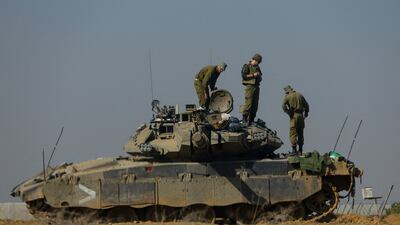
  • Israeli soldiers work on a tank near the border with Gaza. Reuters
    Israeli soldiers work on a tank near the border with Gaza. Reuters
  • Palestinians help a boy injured in an Israeli strike in Rafah. AFP
    Palestinians help a boy injured in an Israeli strike in Rafah. AFP
  • A Palestinian girl sits on the floor of Nasser hospital in Khan Younis after an Israeli strike. Reuters
    A Palestinian girl sits on the floor of Nasser hospital in Khan Younis after an Israeli strike. Reuters
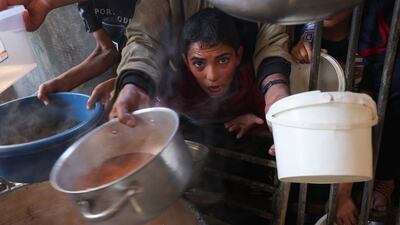
  • Palestinians wait to receive food aid as the conflict between Israel and Hamas continues. Reuters
    Palestinians wait to receive food aid as the conflict between Israel and Hamas continues. Reuters
  • A woman injured in an Israeli strike sits amid the rubble in Rafah. AFP
    A woman injured in an Israeli strike sits amid the rubble in Rafah. AFP
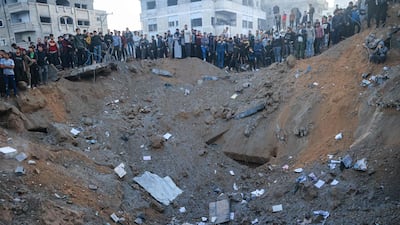
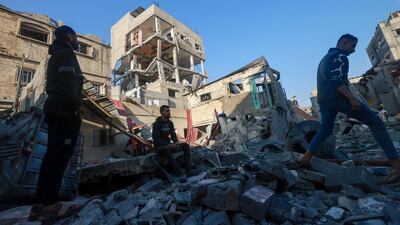
  • Palestinians stand on the edge of a crater after an Israeli strike in Rafah. AFP
    Palestinians stand on the edge of a crater after an Israeli strike in Rafah. AFP
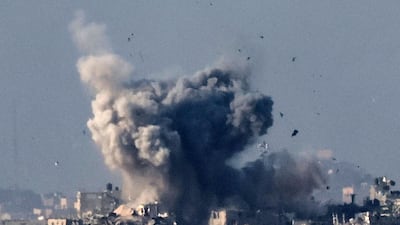
  • Smoke billows over the Gaza Strip on Saturday after a temporary truce between Israel and Hamas ended. AFP
    Smoke billows over the Gaza Strip on Saturday after a temporary truce between Israel and Hamas ended. AFP
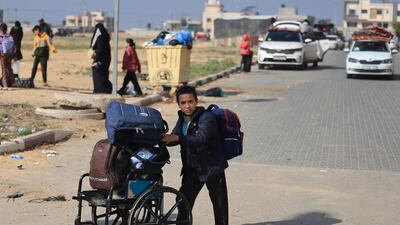
  • A Palestinian boy carries bags on a wheelchair as he flees with family members after receiving notice of an imminent Israeli strike. AFP
    A Palestinian boy carries bags on a wheelchair as he flees with family members after receiving notice of an imminent Israeli strike. AFP
  • People mourn next to the bodies of Palestinians killed in Israeli strikes at Nasser hospital, in Khan Younis. Reuters
    People mourn next to the bodies of Palestinians killed in Israeli strikes at Nasser hospital, in Khan Younis. Reuters
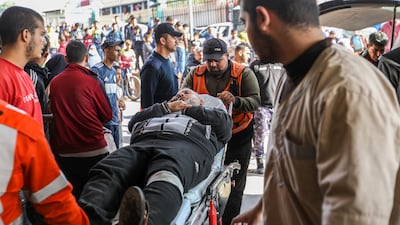
  • Palestinians wounded in Israeli air strikes arrive at Nasser Hospital. Getty Images
    Palestinians wounded in Israeli air strikes arrive at Nasser Hospital. Getty Images
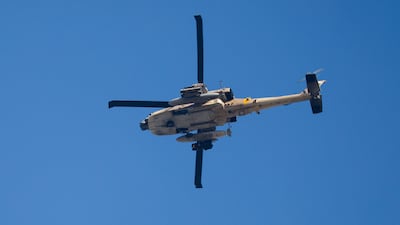
  • An Apache helicopter of the Israeli military patrols over a territory near Gaza. Reuters
    An Apache helicopter of the Israeli military patrols over a territory near Gaza. Reuters
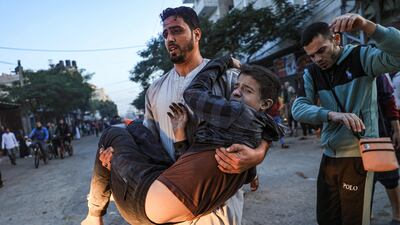
  • A Palestinian man carries a child injured during Israeli bombardment in Rafah. AFP
    A Palestinian man carries a child injured during Israeli bombardment in Rafah. AFP
  • Palestinians inspect a building damaged during Israeli bombardment in Rafah. AFP
    Palestinians inspect a building damaged during Israeli bombardment in Rafah. AFP
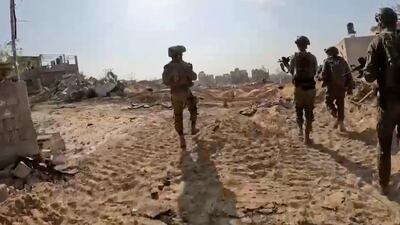
  • Israeli soldiers operate in the Gaza Strip, after a temporary truce expired between Israel and the Palestinian group Hamas. Reuters
    Israeli soldiers operate in the Gaza Strip, after a temporary truce expired between Israel and the Palestinian group Hamas. Reuters
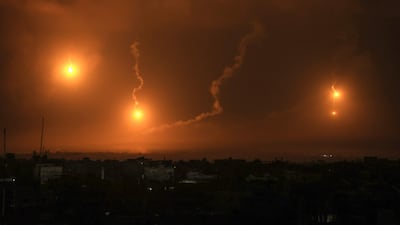
  • Israeli flares light the sky above Khan Younis in the southern Gaza Strip. AFP
    Israeli flares light the sky above Khan Younis in the southern Gaza Strip. AFP
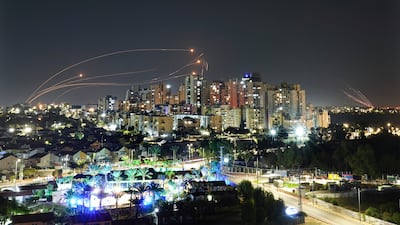
  • The Israeli Iron Dome air defence system fires to intercept a rocket fired from the Gaza Strip, in Ashkelon, Israel. AP
    The Israeli Iron Dome air defence system fires to intercept a rocket fired from the Gaza Strip, in Ashkelon, Israel. AP

The Gaza health ministry said at least 193 Palestinians had been killed and 650 wounded since the truce ended – adding to the more than 15,000 Palestinian dead since the start of the war.

“We had in our mind that this war had come to an end, but unfortunately they resumed it and they resumed killing children again,” said Abdullah, a 22-year-old construction worker.

Sitting alongside his friend Mohammed in Manger Square in the centre of Bethlehem, he said he feels powerless as he watches news footage of the bloodshed in the Gaza Strip.

“As Palestinians living in Bethlehem, we can't do anything to stop it,” he said. “We're just watching and getting sad.”

Like Mr Khalil, Abdullah said he fears for his safety while walking the streets of the occupied West Bank city.

“I'm afraid, they're killing people without any reason,” Abdullah said of the Israeli military.

He only wanted to give his first name as he hoped one day to be able to work in Israel, where the pay is three or four times higher than in Bethlehem.

Just off Manger Square, diners ate hummus and falafel in Afteem, a cavelike restaurant with arched limestone ceilings.

Randa Hreimi and her two daughters and granddaughter dug into their lunch during a rare family outing. Since October 7, they've barely gone out and this was their first meal out at a restaurant.

“For 12 days we haven't left the house,” Ms Hreimi said.

“We needed a change and the weather is beautiful. … We are at home all the time watching TV and just feeling more and more depressed, so we decided to go out for some change.”


Randa Hreimi took her daughters and granddaughter out for lunch in Bethlehem for the first time since October 7. Willy Lowry / The National
Emirates exiles

Will Wilson is not the first player to have attained high-class representative honours after first learning to play rugby on the playing fields of UAE.

Jonny Macdonald
Abu Dhabi-born and raised, the current Jebel Ali Dragons assistant coach was selected to play for Scotland at the Hong Kong Sevens in 2011.

Jordan Onojaife
Having started rugby by chance when the Jumeirah College team were short of players, he later won the World Under 20 Championship with England.

Devante Onojaife
Followed older brother Jordan into England age-group rugby, as well as the pro game at Northampton Saints, but recently switched allegiance to Scotland.

Ten tax points to be aware of in 2026

1. Domestic VAT refund amendments: request your refund within five years

If a business does not apply for the refund on time, they lose their credit.

2. E-invoicing in the UAE

Businesses should continue preparing for the implementation of e-invoicing in the UAE, with 2026 a preparation and transition period ahead of phased mandatory adoption. 

3. More tax audits

Tax authorities are increasingly using data already available across multiple filings to identify audit risks. 

4. More beneficial VAT and excise tax penalty regime

Tax disputes are expected to become more frequent and more structured, with clearer administrative objection and appeal processes. The UAE has adopted a new penalty regime for VAT and excise disputes, which now mirrors the penalty regime for corporate tax.

5. Greater emphasis on statutory audit

There is a greater need for the accuracy of financial statements. The International Financial Reporting Standards standards need to be strictly adhered to and, as a result, the quality of the audits will need to increase.

6. Further transfer pricing enforcement

Transfer pricing enforcement, which refers to the practice of establishing prices for internal transactions between related entities, is expected to broaden in scope. The UAE will shortly open the possibility to negotiate advance pricing agreements, or essentially rulings for transfer pricing purposes. 

7. Limited time periods for audits

Recent amendments also introduce a default five-year limitation period for tax audits and assessments, subject to specific statutory exceptions. While the standard audit and assessment period is five years, this may be extended to up to 15 years in cases involving fraud or tax evasion. 

8. Pillar 2 implementation 

Many multinational groups will begin to feel the practical effect of the Domestic Minimum Top-Up Tax (DMTT), the UAE's implementation of the OECD’s global minimum tax under Pillar 2. While the rules apply for financial years starting on or after January 1, 2025, it is 2026 that marks the transition to an operational phase.

9. Reduced compliance obligations for imported goods and services

Businesses that apply the reverse-charge mechanism for VAT purposes in the UAE may benefit from reduced compliance obligations. 

10. Substance and CbC reporting focus

Tax authorities are expected to continue strengthening the enforcement of economic substance and Country-by-Country (CbC) reporting frameworks. In the UAE, these regimes are increasingly being used as risk-assessment tools, providing tax authorities with a comprehensive view of multinational groups’ global footprints and enabling them to assess whether profits are aligned with real economic activity. 

Contributed by Thomas Vanhee and Hend Rashwan, Aurifer

Updated: December 02, 2023, 4:32 PM