
Live updates: Follow the latest news on Israel-Gaza
Nora Daher is one of the few residents left in Marjaayoun, a religiously mixed town perched on a hill on Lebanon's southern edges.
A few kilometres away is the highly contested border of Israel – behind that lies the Israeli settlement of Metula, which is now a ghost town.
“Everyone is afraid because no one knows what will happen,” said Ms Daher.
Metula and the border region have become prominent sites for renewed and increasingly violent clashes between the Lebanese armed group Hezbollah and their Palestinian allies against Israel.
Marjaayoun is almost a perfect watching post, with sweeping views down to the border and behind.
And while the conflict has not quite come to Marjaayoun yet, the villages on both sides of the border are now practically deserted – save for military or armed figures – as fears of a second front in Israel's latest war on Gaza continue to rise.
Ms Daher was in Marjaayoun in 2006, when Israel and Hezbollah last fought a full-fledged conflict.
The exchanges over the border have steadily increased in the 10 days, but they are nothing compared to the early moments of the month-long 2006 war.
“In 2006, we knew there's a bombing, every single minute, all the time," Ms Daher said.
"It was very bad, but we knew what was going on. Now that there is war, but we don't know what's going on.
“You can hear, see the bombing, but they're still far away, not on this village. Now, we are waiting minute by minute, me and all the old people."
Then, a boom in the distance. On Tuesday, Hezbollah confirmed five of its members had died – the most in a single day since the Gaza-Israel again broke out.
It was arguably the most heated day yet, with repeated exchanges of rocket and missile fire, and reports that armed men had sought to enter Israel from Lebanese territory.
Ms Daher, whose husband works in the village and son is in the Lebanese Army near by, stuck it out for most of the month-long war in Marjaayoun.
Towards the end of that conflict, she joined a convoy heading north towards Beirut in search of safety, only to come under attack from Israel.
A mother of four and a grandmother of 10, she has lived her whole life in south Lebanon.
She looks out from her balcony, pointing to the different villages lying in the distance and their religious majorities.
“It's very beautiful,” Ms Daher says with a smile. “And not just the south, the whole of Lebanon. I live in a beautiful country but I feel sorry for what's going on.
“Every time we think about the situation in Lebanon and we have something different. The President, the politicians, the banks, the war. We're not safe anywhere, any time. So we are tired.
“We don't live like any other society in this this world.”
Since 2019 Lebanon has been in embroiled in severe economic crisis. Its banks have dried up, corruption is rampant and it is approaching a year without a president.
Now the country stands on yet another precipice with the sounds of gunshots and explosions on the border with Israel again becoming a daily occurrence.
Most politicians in Lebanon have sought to highlight how Lebanon cannot endure a war, even as Hezbollah and its allies threaten to fan the flames if Israel does not back down over Gaza.
“It's not our war,” said Ms Daher. “No one talks about it in front of the camera, if they think like me. Even if we are with the Palestinians, what's our relation with this?”
-
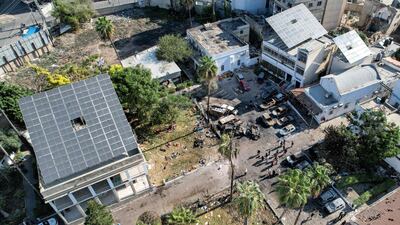
An aerial view of the complex housing the Al Ahli Arab hospital in Gaza City in the aftermath of Tuesday night's blast. AFP -

People inspect a church on the premises of Al Ahli Hospital in Gaza City where hundreds of Palestinians were killed in a blast that Israeli and Palestinian officials blamed on each other. Reuters -
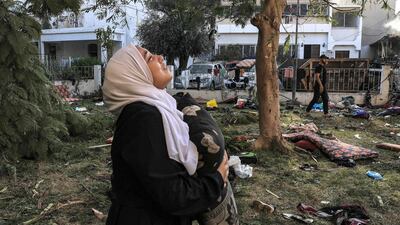
A woman among the debris outside Al Ahli Arab Hospital in central Gaza. AFP -

People at Al Ahli Arab Hospital in central Gaza. AFP -
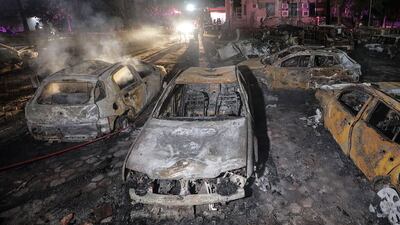
The scene at Al Ahli Hospital after an air strike in Gaza City. EPA -

A doctor at Al Ahli Hospital after an air strike in Gaza city. EPA -
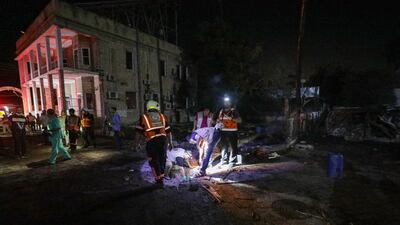
Emergency services search the rubble at Al Ahli Hospital after an air strike in Gaza city. EPA -
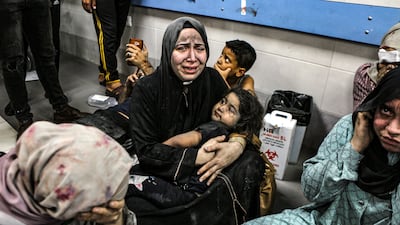
Palestinians wait for treatment at Al Shifa Hospital in Gaza city after being wounded in an air strike that killed at least 500 people at Al Ahli Hospital. AP -
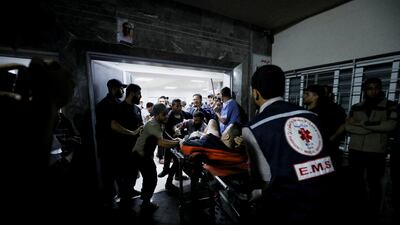
Ambulances and private cars rushed about 350 casualties from the blast at Al Ahli to Al Shifa, Gaza City's main hospital. Reuters -

Children in an ambulance on the way to Al Shifa Hospital. Reuters -

Al Shifa Hospital was already overwhelmed with wounded from other strikes. Reuters -
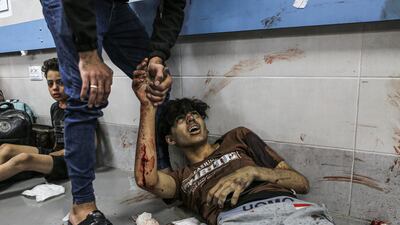
A wounded Palestinian on the floor in Al Shifa Hospital in Gaza City. AP -
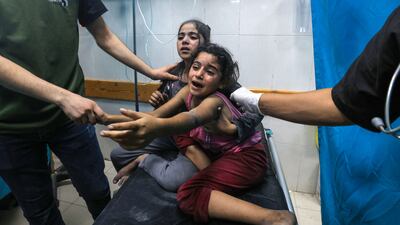
Hundreds of Palestinians had taken refuge in Al Ahli and other hospitals in Gaza City, hoping they would be spared bombardment. AFP -
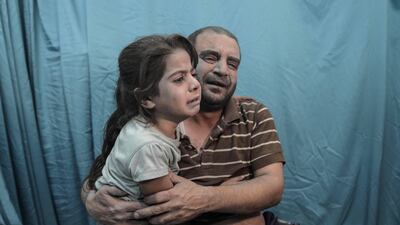
The explosion at Al Ahli Hospital left gruesome scenes. EPA -
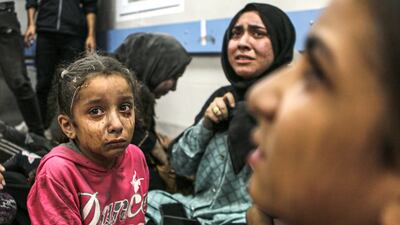
Many of the victims of the blast at Al Ahli Hospital were young children. AP -
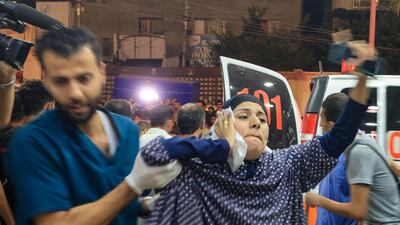
A wounded Palestinian woman is taken for treatment. AFP -
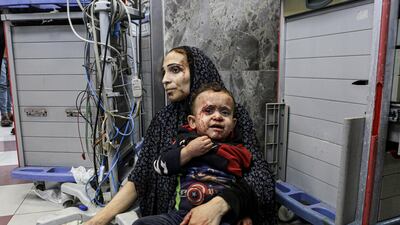
Wounded Palestinians wait for treatment. AP


The Deep South of the country is known for having a Shiite Muslim majority, from which Hezbollah draws its main power base – even if many from the sect insist that all they want is peace.
But the Shiite population is a majority, not an entirety. Marjaayoun, for instance, is mainly Christian – but that is not to say there are not good intercommunal relations.
“The politicians … maybe someone likes Hezbollah, doesn't like Hezbollah; likes Amal, doesn't like Amal,” said Ms Daher.
“But as for the people, they are good. We are all good to each other … neighbours, we work together.”

