

Carlos Ghosn was famed for his intense work ethic at the helm of three of the largest automotive companies in the world.
But that lifestyle, and its punishing travel schedule, came to an abrupt halt in 2018 when he was detained in Japan amid accusations of financial irregularities at Nissan – before he was famously smuggled out in a music equipment box while awaiting trial in late 2019.
His final destination was Lebanon, the country where he spent much of his childhood.
“I always loved Lebanon, I always maintained contact with Lebanon. Not as a country where I would work, but certainly as a country where I have friends, part of my family. I really enjoy the beautiful landscape, the food and the warmth of the people,” Mr Ghosn, who holds Lebanese, Brazilian and French citizenship, said.
“This being said, I travelled so much in my life,” he told The National, adding that he was now in a period of “forced rest”.
“I’m enjoying it. The fact that I don’t have any more jet lags, I have a very stable time of sleeping, eating. I see the people I want to see, not the people I have to see. All of this is a new world for me,” Mr Ghosn said.
“I lived 40 years in the corporate world, where you are used to completely different standards. So yes, I miss some things. But I’m enjoying a lot of new things that are happening in my life.”
Mr Ghosn vehemently rejects the accusations levied against him, which include allegations he under-reported his earnings and misappropriated company funds. He has not left Lebanon since his remarkable escape and Lebanese judge issued a travel ban against him in early 2020.
He has, however, not stayed still, as an upbeat Mr Ghosn told The National at an office in Beirut.
“I work at a university, I’m giving a seminar on management on performance. I'm writing new books, participating in movies, I'm helping a lot of start-ups in development.
“I think one of the big opportunities for Lebanon is to use the intelligence, the talent and the education of its people to just get out of the problems that it is facing today.

“That's why guiding, helping [and] investing in start-ups is one of the best ways to help young people turn around the country or contribute to the country,” he said, wearing a light blue shirt - in contrast to the suit and tie he was typically seen in during his time at Nissan.
Mr Ghosn recently filed a lawsuit of more than $1 billion against Nissan in a Lebanese court for – among other things – defamation, breaching the sanctity of his residence and fabricating charges that led to his detention in Japan.
Asked what he would do with the money if he won, Mr Ghosn said part would be used to support Lebanon.
“There are a lot of needs here. Not only in terms of supporting start-ups and employment, but also supporting education,” he said.
“But also to recover a big part of what has been taken directly and indirectly from me. They didn't pay the retirement, they took all the stock options,” Mr Ghosn said, naming a couple of the things he accused Nissan of taking from him.
-
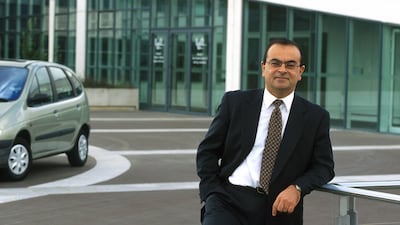
Former Renault-Nissan chief executive Carlos Ghosn in France in 1998. Getty Images -

Mr Ghosn, British prime minister Tony Blair and trade secretary Stephen Byers, right, announce the expansion of the carmaker's plant in Sunderland in January 2001. Getty Images -

Carlos Ghosn at the Tokyo unveiling of the latest model of Nissan's Primera sedan in 2001. Reuters -
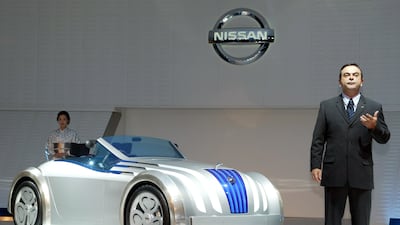
Mr Ghosn poses in front of the Jikoo concept car at the 2003 Tokyo Motor Show. Getty Images -

Former Renault-Nissan chief executive Carlos Ghosn speaks at news conference at the carmaker's Tokyo headquarters in 2004. Reuters -

Mr Ghosn takes a ride in a Nissan Pivo concept car ahead of the Tokyo Motor Show in 2005. Reuters -

Mr Ghosn meets Russian President Vladimir Putin at St Petersburg International Economic Forum in 2006. Reuters -

The former executive presents the Renault Koleos four-wheel drive concept car at the Paris Mondial de l'Automobile in 2006. Reuters -

Mr Ghosn and family members attend gala screening of Serbian director Emir Kusturica's film Promise Me This at Cannes Film Festival in 2007. Reuters -

Mr Ghosn is seeking more than $1 billion from Nissan, including $500 million in moral damages. Reuters -

The former executive was arrested in Japan in November 2018 amid allegations he under-reported his earnings and misappropriated company funds. Reuters -
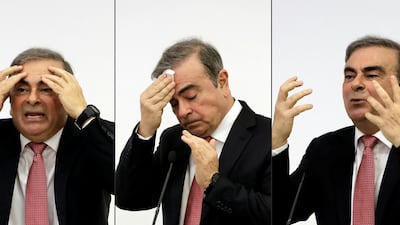
The former automotive executive addresses journalists in Beirut after leaving Japan in January 2020 ahead of his financial misconduct trial. AFP -
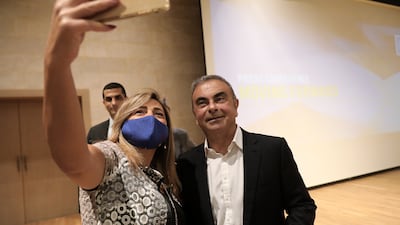
Mr Ghosn poses for a selfie after a press conference to launch a joint initiative with the University of Kaslik in Jounieh, Lebanon in September 2020. AFP


Nissan has not commented since the lawsuit was launched.
Mr Ghosn’s escape is as famous as it is dramatic. After repeatedly being detained before then being bailed, he had lost any faith in the Japanese justice system and describes it as being rigged.
With the help of private security contractors, including a former US Special Forces operator, he was smuggled in a musical equipment box on to a private jet before arriving in Beirut via Turkey.
“The most scary part of the escape is that it would fail. Everything else was OK. My big fear, frankly, was failure, that hope would be eliminated completely,” he said.
“Because what the Japanese had prepared for me is a slow death through a very, very lengthy trial.
“And this is what is shocking, you know, you dedicate 20 years of your life to resuscitate a Japanese company, which becomes one of the major companies in Japan. And you're being rewarded like this?”
But there is still an affection for Japan and its people, even if not for some of his former colleagues.
“I like Japan, I have lots of Japanese friends. It's part of my life, I spent 20 years. It's not because of the behaviours of some thugs both inside and outside Nissan that I'm going to hate a country that is part of my life.”
Even as Lebanon languishes in one of the worst economic crises in modern history, do not, however, expect him to suddenly enter into the political world.
“No, it’s not in my space,” he said, when asked if he would ever have political ambitions.
“I’m a little bit the contrary of a politician, I'm more of a straightforward guy. I like to take jobs, to fix things – not fake fixing them. But I will help politicians into turning around the situation, if they were asking.”

