


A UN investigation into the Beirut port blast could eventually be carried out as a result of a joint statement issued before the Human Rights Council on Tuesday in Geneva, a French diplomatic source has told The National.
Thirty-eight countries at the council, a UN intergovernmental body, urged Lebanon to conduct “a swift, independent, impartial, credible and transparent investigation into the explosion”.
A domestic inquiry in Lebanon has been suspended for over a year amid political meddling into the investigation, which has sought to determine the cause of the explosion on August 4 2020.
Around 220 people died and more than 7,000 were injured when nearly 3,000 tonnes of poorly-stored ammonium nitrate, a chemical mainly used in fertiliser, caught fire and exploded in the port.
The statement denounced the “systemic obstruction, interference, intimidation,” and hampering of the local probe.
“We urge Lebanon to abide by its international human rights obligations to take all the necessary measures to safeguard in law and in practice, the full independence and impartiality of the Lebanese judiciary,” it said.
-

Fahed Abu Salah’s film 'Beirut After the Blast' aims to highlight how the healing process for many people is being strained by the lack of accountability. All Photos: MContent -

It features interviews with several people affected by the blast, as well as with activists trying to secure justice for the victims. -
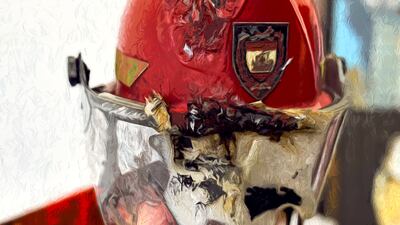
The film also honours the firefighters who died trying to contain the fire that led to the blast. -
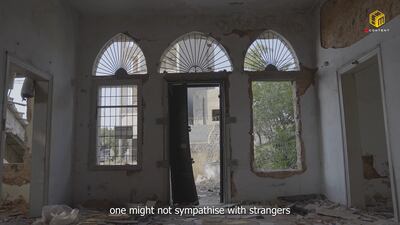
The documentary was filmed over the course of 50 days and aims to show the humanitarian issues caused by the blast. -

A shorter director’s cut of the documentary was shown in the metaverse in an event at the Waldorf Astoria Hotel in the DIFC. -

Abu Salah says it was also important for him that the documentary makes it to MContent and the 'cineverse', to encourage other Arab filmmakers to make use of the metaverse as well.


The statement, delivered by Australia's ambassador to Geneva, Amanda Gorely, on behalf of the 38 member states, followed a speech by UN High Commissioner for Human Rights Volker Turk, who called for a “serious investigation” into the Beirut Port explosion, “without political interference or further delay”.
Tuesday's joint statement, initiated by Australia, homeland of the blast's youngest victim, laid the foundation for the establishment of a UN fact-finding mission, a French diplomatic source confirmed to The National — even if it is not explicitly mentioned in the text.
“The statement is a first step towards a swift, independent and impartial UN fact-finding mission,” the source said, stressing that France, which is one of the 38 signatories of the statement, has pushed for an international investigation from the beginning.
“It was Lebanon's sovereign choice to refuse an international investigation. But faced with the slowness of the domestic probe, we support the establishment of a UN mission into the explosion to push for accountability,” the source said.
The next step would be the presentation of a country-led resolution before the Human Rights Council in Geneva at the next session in June. Such a resolution will have to be adopted by a majority vote for the UN mission to be established.
Lebanon rejected the opening of an international investigation, despite widespread calls, with Michel Aoun, who was Lebanon's president at the time, dismissing it as an attempt to “dilute the truth”.
But more than two-and-a-half years since the devastating blast, which destroyed swathes of the capital, no senior official in Lebanon has been held accountable for the tragedy.
The domestic probe stopped again in January after lead investigator Tarek Bitar, who charged multiple top-ranking officials in connection with the blast, tried to resume his inquiry.
Mr Bitar was blocked by Lebanon Prosecutor General Ghassan Oueidat, also named in the case, who filed charges against Mr Bitar for rebelling against the judiciary.
Unlike international inquiries, a UN fact-finding mission does not require an invitation from the receiving state.
The last UN fact-finding mission has been established in Iran, looking at Tehran's rights violations in crackdowns against protesters, especially with respect to women and children
Growing campaign for justice
Civil society and opposition groups have long supported the establishment of a UN fact-finding mission.
The August Fourth Collective, which brings together families of the victims, has advocated a UN fact-finding mission since the end of 2020, Paul Naggear, a member of the collective, told The National.
In collaboration with non-governmental organisations such as Legal Action Worldwide, Human Rights Watch, lawyers and activists, it has been working to identify the best way to look for justice abroad, he said.
“We identify the UN fact-finding mission as the best option among the ones available,” said Mr Naggear, whose three-year-old daughter died in the explosion.
“Its mission will be the establish the facts: from the arrival of the ammonium nitrate leading to the moment of explosion. The team will work in collaboration the local lead investigator, Mr Bitar, and add their expertise to his investigation.”
Aya Majzoub, Amnesty International’s Deputy Regional Director for the Middle East and North Africa, told The National, that the move is a “good first step towards accountability”.
The joint statement, “put pressure on Lebanese authorities and called them out in their shameful efforts to block the domestic investigation,” she said.
“But in the absence of meaningful measures to resolve the blockage of the investigation, we call on the international community to escalate the response and establish an international fact-finding mission into the explosion,”

