


A long-running saga involving seagulls, Beirut International Airport and Middle East Airlines (MEA) has threatened to rear its head again in Lebanon.
The country’s only international airport sits near the Costa Brava landfill site — described by one observer as an "open dump", a symptom of its repeated waste crises.
The rotting waste has been blamed for attracting a host of scavenging seagulls, which pose a danger to aircraft landing and taking off at Beirut-Rafic Hariri International Airport.
In 2017, after an incoming plane had a near miss with a large flock of the birds, Lebanon's national airline came up with a radical plan to cull them. Then-transport minister Youssef Fenianos had warned of an “emergency … posed to civil aviation movement by the birds”.
Current MEA chairman Mohamad El Hout is now repeating threats of a cull. This month, in an interview with local channel Al Jadeed, he demanded action, urging the Interior Ministry and security forces to intervene “or permit the MEA to bring in hunters”.
But to do so would be an "international environmental crime", said Paul Abi Rached, president of the Lebanon Eco Movement.
“We can find many other ways to push them away from the airport … you should use all the ways you have but you cannot kill them," he told The National.
In 2017, MEA contracted 125 hunters who killed more than 10,000 seagulls. Mr El Hout defended the move at the time, arguing that passenger safety must be the priority.
But it has not turned out to be a long-term solution. Rights groups have for years been warning that Lebanon's repeated short-term measures to remedy its waste management system were simply a stopgap that failed to tackle the heart of the issue.
Costa Brava was opened in 2016 supposedly as a temporary site to provide an interim solution after the closure of the main landfill receiving waste from Beirut.
Mr Abi Rached said it was a “government mistake” to choose this location. “The landfill is the problem, not the seagulls," he said.
He pointed out that the birds' annual winter migration from Europe to Lebanon was part of their natural life cycle.
-

After losing four relatives to respiratory illness, Zeina Matar fled her hometown north of Lebanon's capital Beirut, where she says a decaying power plant generates little electricity but very deadly pollution. Thick black smoke sometimes billows from its red and white chimneys, leaving a grey haze in the air above the Zouk Mikael industrial district, where the toxins remain trapped by a nearby mountain chain. All photos: AFP -

Ms Matar, 40, says she lost her younger sister and a cousin to pulmonary fibrosis and that two of her uncles died of lung cancer years earlier. They all lived near the plant where, experts and residents believe, air pollution means people are more likely to develop cancer and respiratory disease than anywhere else in the crisis-torn country. -

A Greenpeace study found that the surrounding Jounieh area was ranked fifth in the Arab world and 23rd globally for cities most contaminated by nitrogen dioxide, a dangerous pollutant released when fuel is burnt. The environmental group's 2018 study singled out the Zouk plant, built in the 1940s, as well as cars on a busy motorway and privately owned electricity generators as the main causes of pollution. -

The walls of Ms Matar's balconies in her old Zouk Mikael home are blackened by the smoke, and laundry she used to hang outside would be damaged by toxic chemicals emanating from the plant, she said. 'Whenever they refilled the station with fuel oil, we would close the windows,' she said. 'The smell was unbearable.' -

Another former resident is Paul Makhlouf, a lung doctor at the Notre Dame du Liban Hospital in Jounieh, who said he abandoned his local apartment after noticing a rise in respiratory disease among patients. In 2014, he found that lung ailments had increased by 3 per cent in patients living near the plant, compared with the previous year, an annual rise he estimates has now doubled. 'When I saw the results, I moved from there,' he said. 'I fled.' -
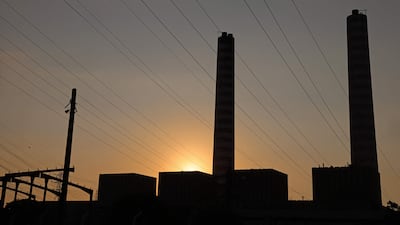
Pictures went viral online last month of thick black smoke again billowing from the Zouk plant as it burnt low-quality fuel oil to produce only one hour of power that day. The energy ministry said the plant had been forced to use heavy fuel to 'keep supplying the airport, hospitals and other vital institutions' with electricity. Since then, the plant has mostly operated at night. -

Elie Beaino, who heads the Zouk municipality, said a second plant, which built without authorisation in 2014, runs somewhat more cleanly on higher-quality fuel or gas. However, it stopped working as its operators cannot afford higher-quality hydrocarbons. 'Most residents want the power plants to close down,' he said. -

Member of Parliament Najat Saliba, an atmospheric chemist, said residents near Zouk are at least seven times more likely to develop cancer than those in Beirut, citing a 2018 study she helped write for the American University of Beirut. -

She said the heavy fuel oil it uses releases harmful chemicals. 'The solution is to import quality fuel oil and gas,' Ms Saliba said. However, she noted that Lebanon cannot afford those fuels. -

"We have two options today," she said. "To switch the lights off at the airport and in hospitals, or to sit under a black cloud in Zouk."


Environment Minister Nasser Yassin, who did not respond to requests for comment, recently said his ministry had proposed noise machines at the airport to scare off the seagulls — but had not received a response from the interior department.
Environmental groups have pointed out that Lebanon is a signatory to international treaties that protect birds such as seagulls, and they are say the focus should be on what attracts the seagulls — the Lebanese rubbish crisis and the Costa Brava landfill site.
“The right solution would be to eradicate the causes attracting the birds and the closure of the Costa Brava landfill,” the Society for the Protection of Nature in Lebanon said in 2017.
Some unfortunate events have taken place at Beirut’s airport, including celebratory gunfire in nearby areas on December 31 hitting two stationary aircraft.
Lebanon is embroiled in a political crisis, with no president since the end of October and a caretaker government severely stripped of power.

