

The Covid-19 ward at Lebanon’s largest public hospital has reopened amid a marked rise in cases, the head of Rafic Hariri University Hospital said on Tuesday.
The reopening of the ward, however, is purely a “preparatory” move, said Dr Jihad Saadeh.
The ward was never completely closed but was scaled down when Covid cases declined last year.
But now, cases caused by the newest Covid variant are on the rise, and the ward has been re-expanded and placed under total isolation as it takes in patients from across the country, Dr Saadeh told The National.
The rise in Covid cases has renewed fears of a return to 2020, when cases were at their peak and the nation was placed under lockdown.
At the time, experts worried Lebanon’s struggling health sector would be unable to handle an influx of cases amid a steep economic crisis. Wards often overflowed with patients as hospitals struggled with a lack of oxygen, electricity and medicine.
The rise in cases is attributed to a highly contagious Omicron sub-variant, which is less dangerous but highly infectious, Dr Saadeh said.
“This is a new variant — very new. Even people who have taken three vaccines don’t have immunity to these variants.”
The variant does not appear to be more dangerous than other strains, he added, but “it’s unpredictable and we don't know what this variant will do”.
“Maybe there will be danger to those who were infected a month later — we don’t know. It’s still new.”
According to Dr Saadeh, people should take precautions by wearing masks and avoiding large gatherings.
Although the variant has not proved fatal to anyone in Lebanon so far, “those who are immunocompromised need to be extra careful”.
Lebanon's economic crisis is continuing into its fourth year and shortages in the health sector continue to affect daily life, but the less dangerous mutations of Covid have given some respite to the health sector.
“With enough preparation, everything will be fine,” Dr Saadeh added.
-
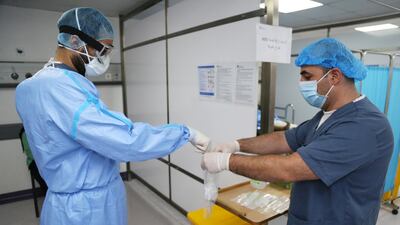
A doctor wearing protective gear handles a coronavirus test sample at Rafik Hariri University Hospital in Beirut, Lebanon. The pandemic has put the country's healthcare system in crisis, officials said on January 2, 2020. Reuters -
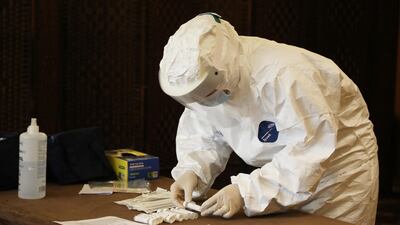
A health worker gathers PCR tests of migrant domestic workers at a hotel in Beirut, Lebanon. Reuters -

An empty street at Beirut's Martyrs' Square during one of the health lockdowns ordered by Lebanon's government that have further damaged the country's crisis-hit economy. AFP -
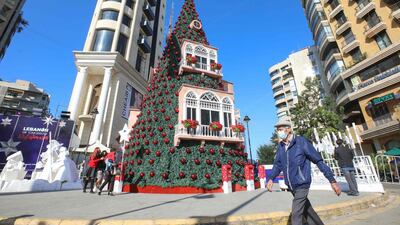
A Lebanese man wearing a protective mask walks past a Christmas tree in Beirut's Achrafieh district. AFP -

Volunteers with Dafa Campaign collect and distribute donations for those in need at Forum de Beyrouth in the Lebanese capital Beirut. The United Nations estimates that more than half of Lebanon's population is living in poverty. AFP -

A demonstrator attends a protest in Beirut against growing economic hardship. Reuters -

Beirut's nightlife districts of Gemmayzeh and Mar Mikhael, known for their bars, restaurants and art galleries, were some of the areas hit hardest by the massive explosion at Beirut port on August 4, 2020. AFP -

A worker disinfects a room where patients undergo tests for the coronavirus at Rafik Hariri University Hospital in Beirut. Reuters -
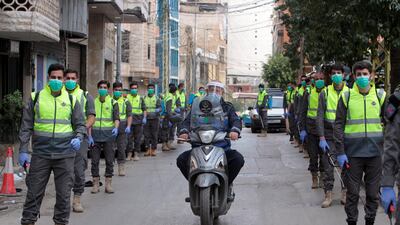
Volunteers from Hezbollah's medical wing, the Islamic Health Society, prepare to disinfect streets in southern Beirut as part of the Lebanese group's initiatives to deal with the country's coronavirus outbreak. Reuters -
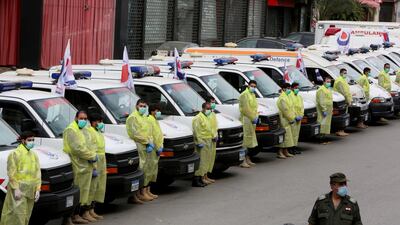
Hezbollah’s Islamic health unit personnel wearing protective gear stand near ambulances as part of a press tour in Lebanon. Reuters -

A woman wearing a protective mask walks past Central Bank building in Beirut. Lebanon has eased banking secrecy laws for a one-year period to facilitate a forensic audit of the Central Bank and other state institutions. Reuters



