


Lebanon's state power company increased the price it charges for electricity for first time since the 1990s on Tuesday, a move officials hope will pave the way for an eventual increase in power supply and help to stabilise the country's electricity sector — if a corresponding fuel supply is ensured.
The Lebanese people have had to cope with rolling power cuts since the 1990s and damaging losses caused by corruption and mismanagement in the sector, contributing tens of billions of dollars to the country's public debt.
Although the increase in electricity rates was approved in August, according to a spokesman for state electricity provider Electricity Du Liban (EDL), the new tariff did not take effect until Tuesday.
The tariff rise “is in line with our implementation of the national emergency plan which is part of our new electricity sector policy,” caretaker Energy Minister Walid Fayad told The National. “It is designed to achieve cost recovery.”
The increase is expected to bring some stability to Lebanon's electricity sector, allowing for the import of fuel to power its plants.
Fuel supply in doubt
But the mark-up in EDL’s prices will only amount to more power for Lebanese households if fuel supply is ensured.
The price of the first 100 kilowatt hours (kWh) consumed will be $0.10 cents per kWh, while every kWh after that will cost $0.27 cents, based on the central bank’s Sayrafa rate, which is about 30,000 to the dollar.
-
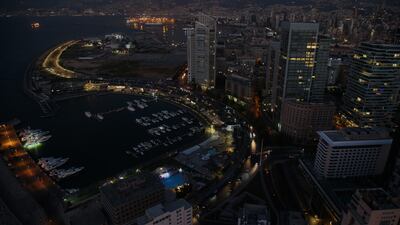
A view of Lebanon's capital, Beirut, with the lights on only in some buildings. Lebanese rely on highly polluting diesel generators run by private neighbourhood operators to make up for shortfalls in electricity supply from the state utility. EPA -
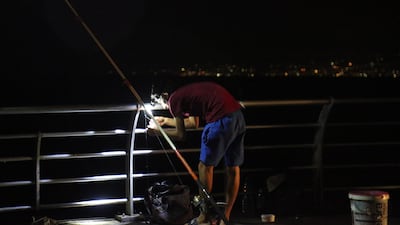
A fisherman uses a headlamp at the seaside corniche in Beirut, Lebanon. EPA -
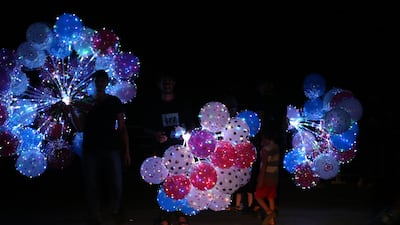
A vendor sells LED balloons in full darkness at the corniche in Beirut. EPA -
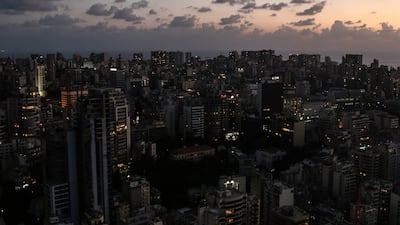
The near collapse of the national grid has increased the duration of power cuts across Lebanon. EPA -
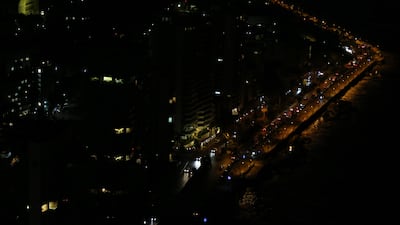
Residents of Beirut are experiencing power cuts of up to 20 hours a day. EPA


Although Dr Fayad is hopeful the plan will result in increased state electricity supply, he said that financing would still depend on achieving guarantees from Lebanon’s central bank.
Its reserves are dwindling, meaning the state can no longer afford to import enough fuel to keep EDL’s power plants operational.
But Prime Minister Najib Mikati is reported to have told Dr Fayad the central bank would be willing to guarantee the financing for fuel imports and receive payment through the revenue generated by the electricity tariff.
“He shared with us that he has secured the financing with the Bank Du Liban and that it will work out,” Dr Fayad said.
The central bank’s financing of fuel, if it comes through, would provide Lebanon with about eight hours of electricity a day. In turn, EDL would cover the cost through the increase in tariffs.
State provision of electricity has become a phantom phenomenon since Lebanon’s economic crisis began in 2019.
The financial collapse has left the state's electricity sector in a shambles, while many residents depend on expensive private generator subscriptions.
But such subscriptions are increasingly difficult for many to afford following the end of petrol subsidies and as fuel prices rise.
In theory, if financing for fuel imports is secured, the tariff rise will allow for more fuel and therefore more state electricity, which would help reduce residents’ dependence on the private generators.
Energy analysts doubt the tariffs will contribute to a significantly increased electricity supply.
“Instead of implementing serious reforms, the government is penalising the paying consumers in the hope of getting some funds into EDL,” said independent energy policy consultant Jessica Obeid.
“The issues of the power sector are neither technical nor financial at the core, but are corruption, mismanagement and weak governance.”
And if financing is not secured, residents will pay higher prices for what little state electricity they receive, while also paying costly generator subscriptions.
But Mr Fayyad said the decision was taken following a delay in a US and World Bank-facilitated initiative to revive the Arab gas pipeline, by paying Egypt for fuel through a World Bank loan and then funnelling it to Lebanon through Jordan and Syria.
The plan was expected to provide Lebanon with up to six hours of electricity each day, but internal delays appear to have stalled that plan.
Among the reasons for the delay was the imposition by the World Bank of a number of conditions, one of which, according to Dr Fayad, was raising electricity tariffs.
Tuesday's increase constitutes a step towards unlocking financing from the World Bank to import gas through Egypt’s pipeline.
“I'm crossing my fingers,” said Dr Fayad.

