


Lebanon's deeply divided Parliament will on Thursday hold its first session to decide on the country’s next president. However, the successful candidate is unlikely to be confirmed this week as a consensus figure has not yet come to the fore.
The 11am session, called for by Parliamentary Speaker Nabih Berri, will take place about a month before incumbent President Michel Aoun's term ends on October 31.
In Lebanon’s confessional political system, the president is always a Maronite Christian.
Electing Mr Aoun’s successor requires a two-thirds majority in the first session, or an absolute majority after that in Lebanon’s 128-seat Parliament.
A protracted wait for the next president is not without precedent — it took 46 sessions and 29 months for MPs to agree on Mr Aoun in 2016. That ended after a series of backdoor deals between rival factions.
Following parliamentary elections earlier this year, no political bloc holds an absolute majority.
Almost all of Lebanon’s previous presidents since independence from France in 1943 have been elected after agreements or interventions between regional or world powers and the country's rival parties.
If a new president is not elected before the end of Mr Aoun’s tenure, the government will take on presidential powers.
-
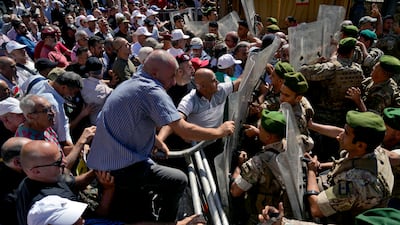
Soldiers scuffle with retired army members outside the Beirut parliament building. AP -
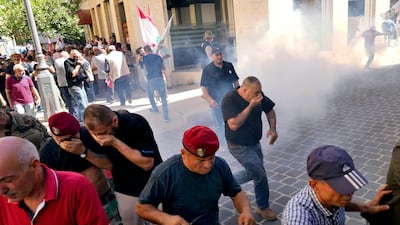
Retired army members run from tear gas fired by riot police. AP -
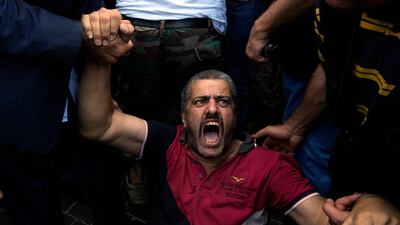
A retired army member chants slogans from the ground. AP -
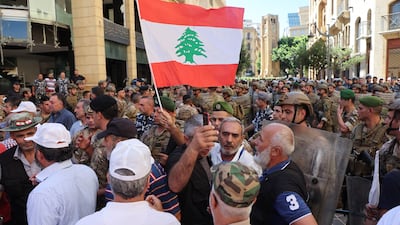
A demonstrator holds a Lebanese flag during the protest. Reuters -
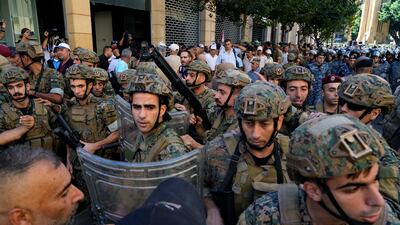
The was a heavy army presence. AP -

Emotions run high in central Beirut. EPA -

Lebanese army soldiers clash with protesters. EPA -
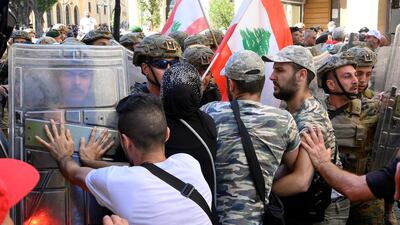
Politicians were attending a parliament session to approve the 2022 budget. EPA -
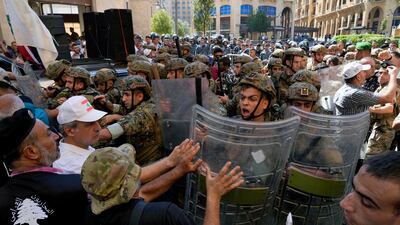
Retired army members tried to enter to the parliament building. AP


But the government is currently in a caretaker capacity because an agreement has not been found over the Cabinet's formation.
This would be the first time a caretaker government could potentially take on the presidential powers since the end of Lebanon's civil wars more than three decades ago.
Lebanon is engulfed in an economic crisis which first became apparent in 2019 and which has been described as one of the worst in modern history.
The following year, the World Bank said the country's economy contracted by 20 per cent and in 2021 said that there was "a lack of political consensus over effective policy initiatives," as well as an existing "political consensus in defence of a bankrupt economic system, which benefited a few for so long".
But progress towards reform has been painstakingly slow and in May 2022 the World Bank said the impact of government inaction would be "colossal not only on daily lives of citizens, but also on the future of the Lebanese people".
Much of the population has been thrown into poverty and the local currency has plummeted in value by more than 95 per cent. There are also widespread shortages in bread, water, electricity, medicine and other basic goods.

