• Ibrahim Hoteit, surrounded by the families of the victims of the Beirut blast, addresses the media outside the port of Beirut on the sixth-month anniversary of the explosion in February 2021.
    Ibrahim Hoteit, surrounded by the families of the victims of the Beirut blast, addresses the media outside the port of Beirut on the sixth-month anniversary of the explosion in February 2021.
  • Kayan Tleiss sits in front of the shrine dedicated to his brother in his living room in Khalde, in the southern suburbs of Beirut.
    Kayan Tleiss sits in front of the shrine dedicated to his brother in his living room in Khalde, in the southern suburbs of Beirut.
  • A photograph of Mohammad Tleiss is flanked by an image of the Virgin Mary and a copy of the Quran in Kayan Tleiss’s living room in Khalde in Beirut.
    A photograph of Mohammad Tleiss is flanked by an image of the Virgin Mary and a copy of the Quran in Kayan Tleiss’s living room in Khalde in Beirut.
  • Kayan’s mother, holding a photograph of her son, Mohammed, sits outside the port of Beirut on the sixth-month anniversary of the explosion.
    Kayan’s mother, holding a photograph of her son, Mohammed, sits outside the port of Beirut on the sixth-month anniversary of the explosion.
  • Tharwat and Nada Noureddine sit in their living groom in Mar Elias in Beirut surrounded by photographs of Tharwat’s brother and Nada’s son, Ayman.
    Tharwat and Nada Noureddine sit in their living groom in Mar Elias in Beirut surrounded by photographs of Tharwat’s brother and Nada’s son, Ayman.
  • Tharwat Noureddine holds a photograph that Ayman kept on his desk in Beirut. The frame was damaged during the explosion.
    Tharwat Noureddine holds a photograph that Ayman kept on his desk in Beirut. The frame was damaged during the explosion.
  • Photographs of Tharwat’s brother and Nada’s son, Ayman, adorn the family's living room in Mar Elias in Beirut. Ayman had returned from five months of training in the US right before the explosion.
    Photographs of Tharwat’s brother and Nada’s son, Ayman, adorn the family's living room in Mar Elias in Beirut. Ayman had returned from five months of training in the US right before the explosion.
  • Salam Iskandar, her husband, Jaber, and their son, Ali, sit in their living room in Borj El Brajneh in the southern suburbs of Beirut, surrounded by photographs of Salam's brother, Hamza, who died in the Beirut port blast. All photos: Oliver Marsden / The National
    Salam Iskandar, her husband, Jaber, and their son, Ali, sit in their living room in Borj El Brajneh in the southern suburbs of Beirut, surrounded by photographs of Salam's brother, Hamza, who died in the Beirut port blast. All photos: Oliver Marsden / The National
  • Salam Iskandar holds a photograph of her brother, Hamza, on her lap.
    Salam Iskandar holds a photograph of her brother, Hamza, on her lap.

Beirut blast: lack of justice compounds grief for families of victims


Jamie Prentis
  • English
  • Arabic

Almost two years ago, Mireille Khoury was at her home in Beirut with her children Elias and Nour when an explosion at the city’s port ripped through the Lebanese capital.

The walls of the house collapsed, leaving Ms Khoury and Nour with long-lasting injuries. Elias, who was 15 and an aspiring musician, fell into a coma before succumbing to his injuries two weeks later.

Since that day, Ms Khoury has had to endure living with the grief of losing her son ― but with no answers as to why or how a huge stock of ammonium nitrate was left in storage at the port for years. The stock eventually caught fire and caused the explosion.

More than 215 people died in the August 4 blast, which is regarded as a damning symptom of decades of corruption and mismanagement by Lebanon’s ruling elite.

“My daughter has injuries and scars that she will carry all her life. This is not to mention the trauma, and not to mention the loss of her brother,” Ms Khoury told The National, days before the second anniversary of the explosion.

Two years on, there has been no justice for the victims.

An investigation led by judge Tarek Bitar stalled and has been on hold for eight months. Among those charged in connection with the investigation are two sitting MPs, but they have refused to attend interrogation hearings. Hassan Diab, who was prime minister at the time of the explosion, has also been charged with negligence.

Mr Bitar, who also charged several top security officials in the matter and is the second judge to take on the case, has repeatedly been impeded by legal challenges from former Cabinet ministers.

The complete absence of accountability has only exacerbated the trauma felt.

“In addition to the grief, the loss and all that we went through ... I mean, I don’t know how I am still able to talk to you in this way,” Ms Khoury said.

“There is also the issue of this injustice. It triggers inside you a very strong feeling of bitterness, and a feeling of injustice and feeling of frustration, but on a different scale. It's like a scale that you've never encountered in your life.

“You sometimes feel injustice in life, you sometimes feel bitter. But this is a scale [that] you can never imagine, because the tragedy is out of this world.”

Elias Khoury, 15, was a victim of the August 4 Beirut explosion. Photo: Mireille Khoury, Elias's mother

Lebanon is in the middle of an economic collapse that first became apparent in 2019, and has been described by the World Bank as one of the worst in modern history.

The explosion, the economic downturn, Covid-19 and the fall-out from Russia’s invasion of Ukraine have individually and collectively ensured miserable living conditions for much of Lebanon's population.

A large proportion of the population has been plunged into poverty, the local currency has lost more than 90 per cent of its value, and there are widespread shortages in basic supplies such as medicine, water, bread and electricity.

Mariana Fodoulian, who lost her 29-year-old sister Gaia in the blast, said it was “cruel” to see MPs in parliament voting on laws when they had been charged in connection with the investigation.

“For me, the government is killing us every day, the government is stopping justice every day. They are fighting against their population,” she said.

“I don't know how governments can kill the population and then also stop the investigation into it.”

Ms Khoury bemoaned the fact the authorities “were supposed to care about us and to care about the safety of the country”.

Beirut’s port, where the ammonium nitrate was held, is close to the city and residential areas.

“They didn't care to inform anyone, they didn't care to take any precautions. They didn't even warn us. I wouldn't have lived there,” Ms Khoury said.

“They kept it for seven years, half the years of the life of my son. They are denying [us] justice.”

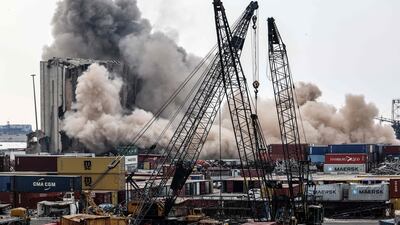
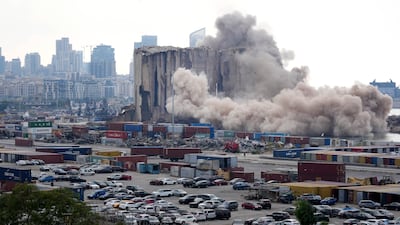
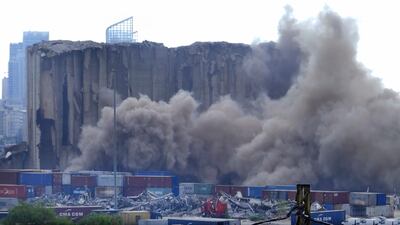
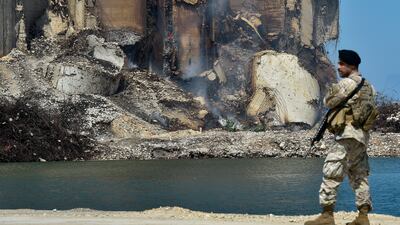
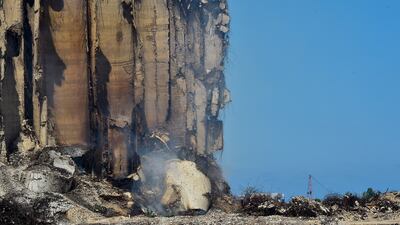
  • Part of the grain silos in Beirut's port collapse as Lebanon marks the second anniversary of a deadly explosion at the site. AFP
    Part of the grain silos in Beirut's port collapse as Lebanon marks the second anniversary of a deadly explosion at the site. AFP
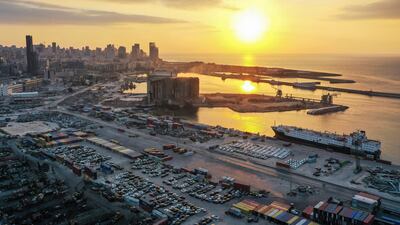
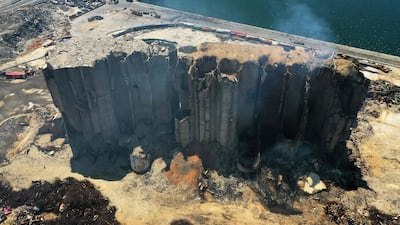
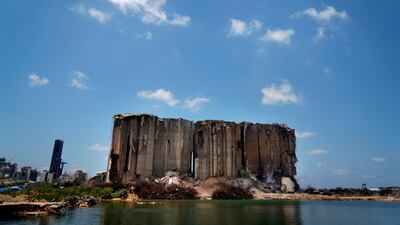
  • The silos were damaged during the blast in August 2020. AP
    The silos were damaged during the blast in August 2020. AP
  • The collapse happened as people gathered at the site to mark the anniversary. AP
    The collapse happened as people gathered at the site to mark the anniversary. AP
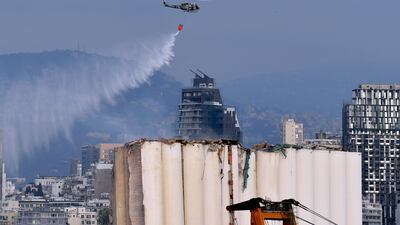
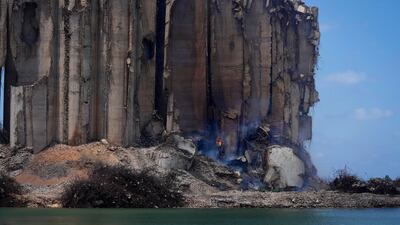
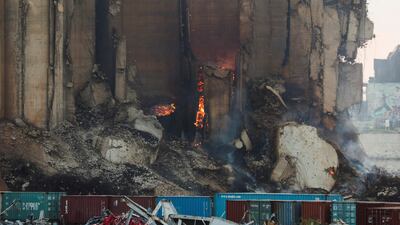
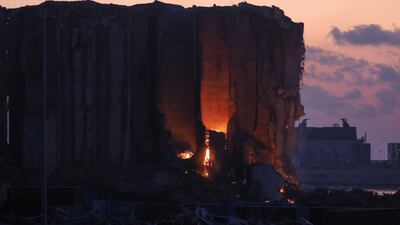
  • A fire at the silos blazed for weeks before the collapse. AFP
    A fire at the silos blazed for weeks before the collapse. AFP
  • Some people in Lebanon believe the government wants to use the fire as an excuse to demolish the silos. AFP
    Some people in Lebanon believe the government wants to use the fire as an excuse to demolish the silos. AFP
  • Relatives of those killed in the port blast wanted the silos to stand as a memorial to the victims. Reuters
    Relatives of those killed in the port blast wanted the silos to stand as a memorial to the victims. Reuters
  • Water is dropped from a military helicopter to tackle the fire at the silos. EPA
    Water is dropped from a military helicopter to tackle the fire at the silos. EPA
  • Video footage shows clouds of smoke and dust spreading across the port. AP
    Video footage shows clouds of smoke and dust spreading across the port. AP
  • It is feared that other parts of the site will also collapse. AFP
    It is feared that other parts of the site will also collapse. AFP
  • The fire was thought to have been sparked by the remnants of fermented grain in storage. AP
    The fire was thought to have been sparked by the remnants of fermented grain in storage. AP
  • Lebanon's caretaker economy minister Amin Salam said the silos were at risk of collapse as the authorities struggled to contain the fire. AP
    Lebanon's caretaker economy minister Amin Salam said the silos were at risk of collapse as the authorities struggled to contain the fire. AP
  • Fire and smoke at the silos at Beirut port. EPA
    Fire and smoke at the silos at Beirut port. EPA
  • There were no reports of deaths or injuries after the collapse. EPA
    There were no reports of deaths or injuries after the collapse. EPA
  • In April, the Lebanese Cabinet approved the demolition of the silos. EPA
    In April, the Lebanese Cabinet approved the demolition of the silos. EPA
  • A survey had found that the silos were at risk of collapse. AFP
    A survey had found that the silos were at risk of collapse. AFP
  • Rubble at the port after part of the silos collapsed. Reuters
    Rubble at the port after part of the silos collapsed. Reuters
  • The fire burns at part of the silos that remains standing. Reuters
    The fire burns at part of the silos that remains standing. Reuters

She said that there was a 20 minute period after the fire started on August 4 ― but before the explosion occurred ― when the authorities could have evacuated nearby properties.

"No one cared to warn the people. This is a double crime. If they had evacuated the area, many people would still be alive."

Some MPs have suggested the Supreme Council, a 15-member body comprised of eight judges and seven MPs , should be the sole body prosecuting politicians charged in connection with the blast. The council has a mandate to prosecute politicians — but no MP has yet been tried by the council, despite it having existed for decades.

Critics believe it is an attempt by those accused of responsibility for the blast to evade justice.

Speaking ahead of the anniversary, a number of NGOs collectively called for the creation of a UN Human Rights Council-mandated international fact-finding mission, with it “now, more than ever, clear that the domestic investigation cannot deliver justice”.

“As the Lebanese authorities continue to brazenly obstruct and delay the domestic investigation into the port explosion, an international investigation is the only way forward to ensure that justice is delivered,” said Diana Semaan, acting deputy director at Amnesty International. “The Lebanese authorities tragically failed to protect the lives of its people killed in the port explosion and since then they have stood against victims in their fight for justice.”

Even if those responsible are held accountable and justice is found, it will never replace what was lost.

“There will never be justice equivalent to what was lost, no way,” Ms Khoury said.

“But at least there should be some sort of accountability. Such a horrendous thing … it cannot just pass unnoticed.”


The specs: 2018 Audi RS5

Price, base: Dh359,200

Engine: 2.9L twin-turbo V6

Transmission: Eight-speed automatic

Power: 450hp at 5,700rpm

Torque: 600Nm at 1,900rpm

Fuel economy, combined: 8.7L / 100km

Squad

Ali Kasheif, Salim Rashid, Khalifa Al Hammadi, Khalfan Mubarak, Ali Mabkhout, Omar Abdulrahman, Mohammed Al Attas, Abdullah Ramadan, Zayed Al Ameri (Al Jazira), Mohammed Al Shamsi, Hamdan Al Kamali, Mohammed Barghash, Khalil Al Hammadi (Al Wahda), Khalid Essa, Mohammed Shaker, Ahmed Barman, Bandar Al Ahbabi (Al Ain), Al Hassan Saleh, Majid Suroor (Sharjah) Walid Abbas, Ahmed Khalil (Shabab Al Ahli), Tariq Ahmed, Jasim Yaqoub (Al Nasr), Ali Saleh, Ali Salmeen (Al Wasl), Hassan Al Muharami (Baniyas) 

Breaking News: The Remaking of Journalism and Why It Matters Now
Alan Rushbridger, Canongate

Ten tax points to be aware of in 2026

1. Domestic VAT refund amendments: request your refund within five years

If a business does not apply for the refund on time, they lose their credit.

2. E-invoicing in the UAE

Businesses should continue preparing for the implementation of e-invoicing in the UAE, with 2026 a preparation and transition period ahead of phased mandatory adoption. 

3. More tax audits

Tax authorities are increasingly using data already available across multiple filings to identify audit risks. 

4. More beneficial VAT and excise tax penalty regime

Tax disputes are expected to become more frequent and more structured, with clearer administrative objection and appeal processes. The UAE has adopted a new penalty regime for VAT and excise disputes, which now mirrors the penalty regime for corporate tax.

5. Greater emphasis on statutory audit

There is a greater need for the accuracy of financial statements. The International Financial Reporting Standards standards need to be strictly adhered to and, as a result, the quality of the audits will need to increase.

6. Further transfer pricing enforcement

Transfer pricing enforcement, which refers to the practice of establishing prices for internal transactions between related entities, is expected to broaden in scope. The UAE will shortly open the possibility to negotiate advance pricing agreements, or essentially rulings for transfer pricing purposes. 

7. Limited time periods for audits

Recent amendments also introduce a default five-year limitation period for tax audits and assessments, subject to specific statutory exceptions. While the standard audit and assessment period is five years, this may be extended to up to 15 years in cases involving fraud or tax evasion. 

8. Pillar 2 implementation 

Many multinational groups will begin to feel the practical effect of the Domestic Minimum Top-Up Tax (DMTT), the UAE's implementation of the OECD’s global minimum tax under Pillar 2. While the rules apply for financial years starting on or after January 1, 2025, it is 2026 that marks the transition to an operational phase.

9. Reduced compliance obligations for imported goods and services

Businesses that apply the reverse-charge mechanism for VAT purposes in the UAE may benefit from reduced compliance obligations. 

10. Substance and CbC reporting focus

Tax authorities are expected to continue strengthening the enforcement of economic substance and Country-by-Country (CbC) reporting frameworks. In the UAE, these regimes are increasingly being used as risk-assessment tools, providing tax authorities with a comprehensive view of multinational groups’ global footprints and enabling them to assess whether profits are aligned with real economic activity. 

Contributed by Thomas Vanhee and Hend Rashwan, Aurifer

Other IPL batting records

Most sixes: 292 – Chris Gayle

Most fours: 491 – Gautam Gambhir

Highest individual score: 175 not out – Chris Gayle (for Royal Challengers Bangalore against Pune Warriors in 2013)

Highest strike-rate: 177.29 – Andre Russell

Highest strike-rate in an innings: 422.22 – Chris Morris (for Delhi Daredevils against Rising Pune Supergiant in 2017)

Highest average: 52.16 – Vijay Shankar

Most centuries: 6 – Chris Gayle

Most fifties: 36 – Gautam Gambhir

Fastest hundred (balls faced): 30 – Chris Gayle (for Royal Challengers Bangalore against Pune Warriors in 2013)

Fastest fifty (balls faced): 14 – Lokesh Rahul (for Kings XI Punjab against Delhi Daredevils in 2018)


The specs: 2019 Lincoln MKC

Price, base / as tested: Dh169,995 / Dh192,045

Engine: Turbocharged, 2.0-litre, in-line four-cylinder

Transmission: Six-speed automatic

Power: 253hp @ 5,500rpm

Torque: 389Nm @ 2,500rpm

Fuel economy, combined: 10.7L / 100km

Seven tips from Emirates NBD

1. Never respond to e-mails, calls or messages asking for account, card or internet banking details

2. Never store a card PIN (personal identification number) in your mobile or in your wallet

3. Ensure online shopping websites are secure and verified before providing card details

4. Change passwords periodically as a precautionary measure

5. Never share authentication data such as passwords, card PINs and OTPs  (one-time passwords) with third parties

6. Track bank notifications regarding transaction discrepancies

7. Report lost or stolen debit and credit cards immediately

The biog

Favourite car: Ferrari

Likes the colour: Black

Best movie: Avatar

Academic qualifications: Bachelor’s degree in media production from the Higher Colleges of Technology and diploma in production from the New York Film Academy

THE RESULTS

5pm: Maiden (PA) Dh80,000 1,400m

Winner: Alnawar, Connor Beasley (jockey), Helal Al Alawi (trainer)

5.30pm: Maiden (PA) Dh80,000 1,400m

Winner: Raniah, Noel Garbutt, Ernst Oertel

6pm: Handicap (PA) Dh90,000 2,200m

Winner: Saarookh, Richard Mullen, Ana Mendez

6.30pm: Sheikh Zayed bin Sultan Al Nahyan Jewel Crown (PA) Rated Conditions Dh125,000 1,600m

Winner: RB Torch, Tadhg O’Shea, Eric Lemartinel

7pm: Al Wathba Stallions Cup Handicap Dh70,000 1,600m

Winner: MH Wari, Antonio Fresu, Elise Jeane

7.30pm: Handicap Dh90,000 1,600m

Winner: Mailshot, Royston Ffrench, Salem bin Ghadayer


Our family matters legal consultant

Name: Hassan Mohsen Elhais

Position: legal consultant with Al Rowaad Advocates and Legal Consultants.

Genesis G80 2020 5.0-litre Royal Specs

Engine: 5-litre V8

Gearbox: eight-speed automatic

Power: 420hp

Torque: 505Nm

Fuel economy, combined: 12.4L/100km

Price: Dh260,500

Gender equality in the workplace still 200 years away

It will take centuries to achieve gender parity in workplaces around the globe, according to a December report from the World Economic Forum.

The WEF study said there had been some improvements in wage equality in 2018 compared to 2017, when the global gender gap widened for the first time in a decade.

But it warned that these were offset by declining representation of women in politics, coupled with greater inequality in their access to health and education.

At current rates, the global gender gap across a range of areas will not close for another 108 years, while it is expected to take 202 years to close the workplace gap, WEF found.

The Geneva-based organisation's annual report tracked disparities between the sexes in 149 countries across four areas: education, health, economic opportunity and political empowerment.

After years of advances in education, health and political representation, women registered setbacks in all three areas this year, WEF said.

Only in the area of economic opportunity did the gender gap narrow somewhat, although there is not much to celebrate, with the global wage gap narrowing to nearly 51 per cent.

And the number of women in leadership roles has risen to 34 per cent globally, WEF said.

At the same time, the report showed there are now proportionately fewer women than men participating in the workforce, suggesting that automation is having a disproportionate impact on jobs traditionally performed by women.

And women are significantly under-represented in growing areas of employment that require science, technology, engineering and mathematics skills, WEF said.

* Agence France Presse

How the bonus system works

The two riders are among several riders in the UAE to receive the top payment of £10,000 under the Thank You Fund of £16 million (Dh80m), which was announced in conjunction with Deliveroo's £8 billion (Dh40bn) stock market listing earlier this year.

The £10,000 (Dh50,000) payment is made to those riders who have completed the highest number of orders in each market.

There are also riders who will receive payments of £1,000 (Dh5,000) and £500 (Dh2,500).

All riders who have worked with Deliveroo for at least one year and completed 2,000 orders will receive £200 (Dh1,000), the company said when it announced the scheme.

%20Ramez%20Gab%20Min%20El%20Akher
%3Cp%3E%3Cstrong%3ECreator%3A%3C%2Fstrong%3E%20Ramez%20Galal%3C%2Fp%3E%0A%3Cp%3E%3Cstrong%3EStarring%3A%3C%2Fstrong%3E%20Ramez%20Galal%3C%2Fp%3E%0A%3Cp%3E%3Cstrong%3EStreaming%20on%3A%20%3C%2Fstrong%3EMBC%20Shahid%3C%2Fp%3E%0A%3Cp%3E%3Cstrong%3ERating%3A%20%3C%2Fstrong%3E2.5%2F5%3C%2Fp%3E%0A
Why it pays to compare

A comparison of sending Dh20,000 from the UAE using two different routes at the same time - the first direct from a UAE bank to a bank in Germany, and the second from the same UAE bank via an online platform to Germany - found key differences in cost and speed. The transfers were both initiated on January 30.

Route 1: bank transfer

The UAE bank charged Dh152.25 for the Dh20,000 transfer. On top of that, their exchange rate margin added a difference of around Dh415, compared with the mid-market rate.

Total cost: Dh567.25 - around 2.9 per cent of the total amount

Total received: €4,670.30 

Route 2: online platform

The UAE bank’s charge for sending Dh20,000 to a UK dirham-denominated account was Dh2.10. The exchange rate margin cost was Dh60, plus a Dh12 fee.

Total cost: Dh74.10, around 0.4 per cent of the transaction

Total received: €4,756

The UAE bank transfer was far quicker – around two to three working days, while the online platform took around four to five days, but was considerably cheaper. In the online platform transfer, the funds were also exposed to currency risk during the period it took for them to arrive.

Stan%20Lee
%3Cp%3E%3Cstrong%3EDirector%3A%3C%2Fstrong%3E%20David%20Gelb%3C%2Fp%3E%0A%3Cp%3E%3Cstrong%3ERating%3A%3C%2Fstrong%3E%203%2F5%3C%2Fp%3E%0A
Updated: August 03, 2022, 12:56 PM