



The entrance to the Keyrouz bakery in the Beirut suburb of Hazmeyeh was guarded by members of Lebanon's army intelligence ― an apparent attempt to prevent violence as long bread lines formed outside on Thursday.
In the morning heat, army intelligence created two long queues for Arabic bread, a staple that is increasingly hard to acquire: Lebanese nationals waited on the left, while Syrians and other foreigners waited on the right.
The queue for Lebanese citizens was moving faster.
Waddah al Dimashqi, a Syrian labourer in his mid 30s, said he did not mind the segregated queue.
“It’s fine. People from this area should get the priority,” he told The National. “It’s better this way, it avoids problems.”
But not everyone agreed. An older Lebanese man queuing for bread, who did not want to be identified, said the segregated lines were shameful.
“Now they’re checking people’s ID cards, aren’t people ashamed of themselves? Lebanese here and Syrians there, what kind of thinking is this? What era are we in?" he asked incredulously. "What will foreigners standing in line think of us?”
While the segregated lines outside the Keyrouz bakery are not unique, others The National spoke to around the greater Beirut area said bakeries are still operating on a first-come-first-served basis.
“We don’t segregate our line,” a clerk at Wooden Bakery said. “Whoever wants bread gets bread, as long as it’s in stock.”
Lebanon’s caretaker Economy Minister Amin Salam announced the formation of a security committee last week that will be responsible for ensuring an equitable distribution of wheat and flour to bakeries and mills, while cracking down on black market trade.
But he said the line segregation at the Keyrouz bakery was not organised by this committee.
“Security forces are trying to keep people from causing problems,” he said.

Lebanon is suffering from a wheat shortage. Long lines for bread in front of bakeries and supermarkets have become a routine feature in the early mornings and evenings.
In some parts of the country, hundreds jostle outside bakeries as they try to buy a bundle of the subsidised but rationed bread before the stock runs out.
In the summer heat, tensions can flare in queues that could last for hours. Scuffles and fist-fights are not uncommon. In mid-July, a gunfight sparked by an argument over who was next in a queue at a bakery left two people wounded in Tripoli, north Lebanon.
The bread shortage stems from Lebanon’s protracted financial crisis, now in its fourth year.
As the crisis drags on, the cash-strapped nation’s treasury has been steadily depleted. A steep plunge in the local currency has unpegged it from the dollar, leaving the state struggling to subsidise wheat imports paid in dollars.
It is not just wheat ― as resources have run dry, the state has gradually rolled back subsidies on medicine, fuel and other necessities and prices have rocketed out of reach of many.
About 80 per cent of Lebanon’s population has slipped below the poverty line and the United Nations World Food Programme says half the population is now food insecure.
While assistance has been cut, the state is trying to keep subsidies on the wheat for Arabic bread in an effort to keep the essential product affordable to an increasingly impoverished population.
As bread supplies dwindle, tensions flare
-

November 1, 2019: Banks implement capital controls after shutting for two weeks. Reuters -
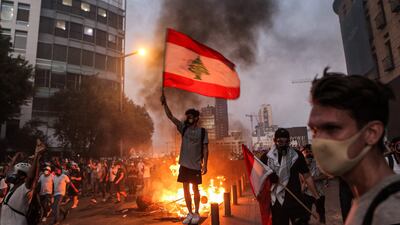
March 2020: Lebanon defaults on its sovereign debt for the first time in its history, amid protests in the country. AFP -
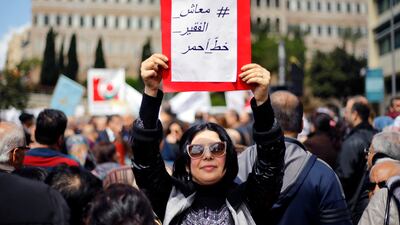
April 2020: The government of Hassan Diab, prime minister at the time, pictured with President Michel Aoun, approves a financial recovery plan. Reuters -
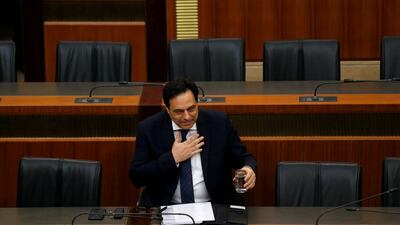
May 1, 2020: Mr Diab's government requests assistance from the International Monetary Fund. The Association of Banks in Lebanon rejects the plan. Reuters -
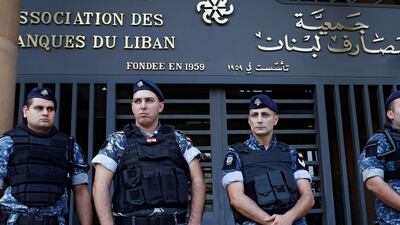
May 20, 2020: the ABL presents an alternative plan. Reuters -
July 1, 2020: a Parliamentary fact-finding committee backs the ABL. The IMF suspends negotiations with Lebanon. AP -
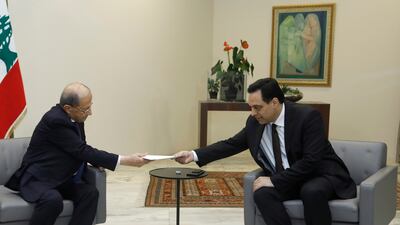
August 10, 2020: Mr Diab resigns following a devastating explosion at Beirut’s port, in which at least 232 people died and 7,000 were injured. AP -
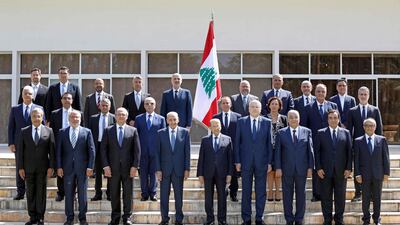
September 10, 2021: Najib Mikati, fourth from right, forms a government. AFP -
January 2022: Lebanon re-starts negotiations with the IMF. Reuters -
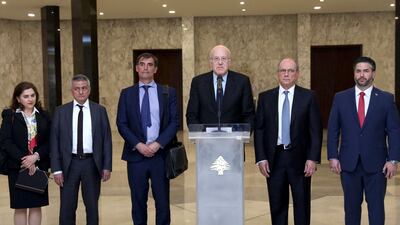
April 7, 2022: The IMF and Lebanon reach a staff-level agreement. AFP -
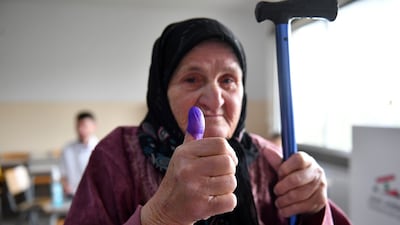
May 15, 2022: Lebanon holds parliamentary elections. EPA -
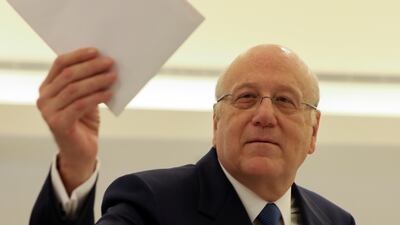
May 20, 2022: Mr Mikati’s government approves a new financial recovery plan. Reuters -
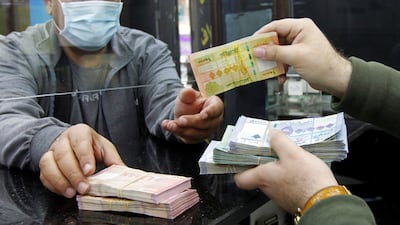
May 24, 2022: The ABL rejects the plan. The local currency hits the record low of 34,000 Lebanese pounds to the dollar – 95 per cent lower than the official rate. Reuters


Politicians in recent weeks have resorted to blaming the at least one million Syrian refugees hosted by Lebanon for the bread crisis.
Last month at a press conference, Mr Salam said that Lebanese were being left without bread because Syrians bought nearly 400,000 bundles of the subsidised loaves a day.
Mr Salam claimed that some Syrians were smuggling subsidised bread over the border to sell it for higher prices.
He also said that “some bakeries and merchants personally benefit from the subsidised wheat”, by selling bread on the black market at inflated prices.
Syrian refugees buying bread for themselves is not the problem, according to socio-economic researcher Cynthia Saghir, who works at The Policy Initiative, a Lebanese think tank.
“It’s not like subsidised bread is being handed out free,” she said. “Syrian refugees purchase bread just like anyone else in Lebanon.”
The underlying issue, she said, is that “subsidies are not enough ― they’re supposed to complement a social protection system which is meant to be in place for the economically vulnerable. In Lebanon, subsidies and fragmented poverty-targeting programmes are used instead of developing a coherent national social protection strategy”.
Ms Saghir said that the exploitation of subsidies on the black market is a natural consequence of rising poverty because there are no social protections in place to help those most in need.
On Tuesday, Lebanon's parliament finally approved a long-awaited $150 million World Bank loan to finance wheat imports for the next six to nine months.
"We still have to fine tune the details of the loan before execution, and study the market to see how to execute," Mr Salam said.
"In one month the programme should be ready."
He maintained that subsidies would remain in place for the time being. But, he warned, prices may have to change in the near future.
But the news that stocks may soon improve has done little for people like Ghinwa Hamou, a housewife who lives in the Beirut suburb of Choueifat.
“We haven’t had any bread in the house for days,” she told The National. “Yesterday, honestly, we ate macaroni with tomato sauce because that one doesn’t require bread,” she said.
“But today I managed to snag a couple of loaves from my mom.”
Arabic bread is the most fundamental element in an array of Levantine dishes.
Eggs, hummus, labneh, cheese, olives ― all are eaten with Arabic bread. Roasted chicken ― Arabic bread. Sandwiches ― rolled with Arabic bread. A fattoush salad is garnished with fried Arabic bread.
Ms Hamou said buying the unsubsidised french loaves or Saj ― for example ― was not sustainable "[but] we should not have to wait in line for hours, risking our lives for bread".

