Lebanon's new MPs face a tough challenge to dismantle 'corrupt ruling class'


  • English
  • Arabic

Ramy Finge spent two years braving tear gas and rubber bullets, sometimes trying to scale the cement walls surrounding Lebanon’s Parliament during anti-government protests.

Soon, he will be able to walk in through the front door.

The dentist from the northern city of Tripoli is among 13 independent newcomers who won seats in Parliament in the May 15 elections, building on the protest movement that seeks to break the hold of the traditional parties.

The unexpectedly strong showing by civil society activists restored some hope among despairing Lebanese that change in their ailing country is possible.

But the nascent reform movement is fragmented and faces enormous challenges in fighting an entrenched ruling class.

Many worry the incoming Parliament will exacerbate polarisation and paralysis at a time when the country is dealing with one of the worst economic meltdowns in history. It is hobbled by divisions between the old guard and newcomers, as well as between supporters and opponents of the militant group Hezbollah.

In the run-up to the elections, candidates drawn from the protest movement that formed in October 2019 ran on competing lists.

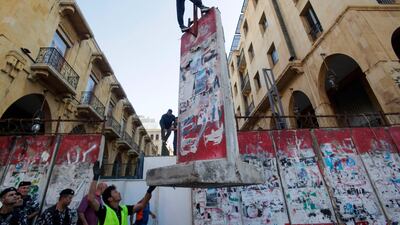
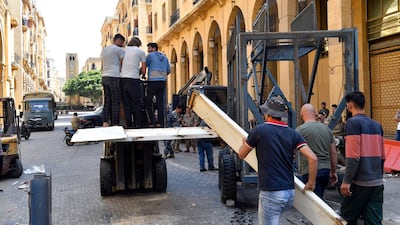
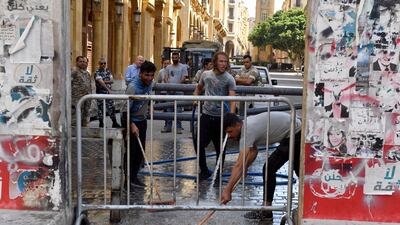
  • Workers remove sections of the concrete barrier, which was erected by Lebanese security forces in 2020 to bar access to streets leading to the country's parliament building, at the entrance of the Lebanese Parliament in the capital Beirut. AFP
    Workers remove sections of the concrete barrier, which was erected by Lebanese security forces in 2020 to bar access to streets leading to the country's parliament building, at the entrance of the Lebanese Parliament in the capital Beirut. AFP
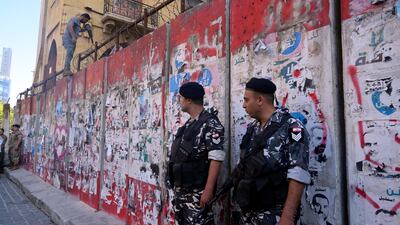
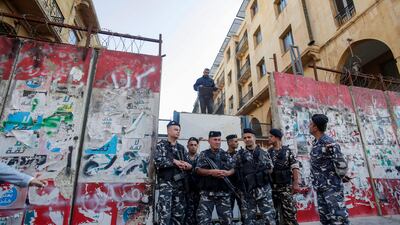
  • Lebanese authorities have ordered that the concrete barriers that have blocked access to the Parliament building since 2019 be removed. EPA
    Lebanese authorities have ordered that the concrete barriers that have blocked access to the Parliament building since 2019 be removed. EPA
  • The blockade was put in place after nationwide protests against Lebanon's ruling classes broke out. EPA
    The blockade was put in place after nationwide protests against Lebanon's ruling classes broke out. EPA
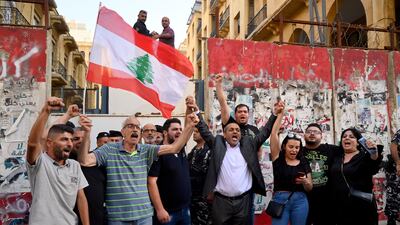
  • The removal of the barrier comes after parliamentary elections on May 15. EPA
    The removal of the barrier comes after parliamentary elections on May 15. EPA
  • Among those elected were 13 independent opposition MPs — many of whom were linked to the uprising in 2019. AFP
    Among those elected were 13 independent opposition MPs — many of whom were linked to the uprising in 2019. AFP
  • Of the independents, 12 will be entering Parliament for the first time, most of whom had previously called for the barriers to be taken down. AP
    Of the independents, 12 will be entering Parliament for the first time, most of whom had previously called for the barriers to be taken down. AP
  • New MP Elias Jradi said: 'There are no walls that rise between the representatives of the nation and citizens.' EPA
    New MP Elias Jradi said: 'There are no walls that rise between the representatives of the nation and citizens.' EPA
  • The blocks were being carted away and workers cleaned the surrounding streets. EPA
    The blocks were being carted away and workers cleaned the surrounding streets. EPA

Broadly, they share the view that the decades-old grip on power by civil war-era warlords and sectarian-based political dynasties is the root cause behind rampant corruption, mismanagement, lack of services and lack of accountability that have driven the country into ruin.

But in the details, they are divided on almost everything, from their approach to reforming the economy and restructuring the collapsed banking sector, to their views on Hezbollah’s weapons and whether disarming the Iranian-backed group should be prioritised.

Still, it is no small accomplishment that they were able to break through despite an electoral law tailored for a ruling class with enormous power at its disposal. The elections were a setback for the Hezbollah-led coalition, which lost its majority in the 128-seat Parliament, though it remains the largest bloc.

“This is the first achievement by the Thawra [Arabic for revolution] because we were able to get in,” Mr Finge, 57, said at his modest home in Lebanon’s impoverished city of Tripoli this week.

Ramy Finge says he hopes to work from inside parliament to dismantle an entrenched ruling clique. AP

“And from inside we will work with all our strength and courage to … dismantle this corrupt ruling class, which is destined to fall no matter how long it takes."

Like his colleagues from the protest movement, Mr Finge said he has been subjected to pressure and intimidation in the past two years. He proudly recalled the exuberant protests in Tripoli and Beirut that filled the squares starting in late 2019, when police would fire volleys of tear gas and pellets at demonstrators who often tried to scale the giant security barriers around Parliament.

In February 2021, he was summoned by security and questioned about a makeshift kitchen he had set up in Tripoli distributing food to protesters and the needy. He called it Matbakh Al Thawra, or the Revolution Kitchen.

The independents who won seats are a motley group of doctors, professors, professionals and activists from across Lebanon and from a variety of religious sects.

Among them is Firas Hamdan, 35, a lawyer and activist who was hit in the chest by a rubber bullet fired by police during a protest at the Parliament. Elias Jaradeh, an eye surgeon, won a seat held for 30 years by a pro-Syrian politician.

Newly elected Lebanese MP Firas Hamdan's picture hangs in the southern Lebanese village of Kfeir in May. AFP

Najat Aoun, a chemistry professor and environmental activist, was one of four female independents who won, bringing the number of women in parliament from six to eight.

The newcomers say they plan to form a unified bloc to strengthen their influence in parliament, but that won’t be easy considering what they are up against.

Their mere presence in parliament is a decent start, but the challenge now is to organise and carry out a programme, Bilal Saab, senior fellow and founding director of the defence and security programme at the Middle East Institute, wrote in an analysis.

“This obviously will be very difficult given the still considerable power of Hezbollah and its allies, and the next presidential race in October will show the immediate impact of these parliamentary elections,” he wrote.

The first test will be at parliament’s first meeting, expected in the coming days, when lawmakers must elect a Speaker. The incumbent, Nabih Berri, 84, has held the position for the past 30 years and is running again for a seventh term, so far uncontested. The powerful head of the Shiite Amal militia is seen by many as the godfather of Lebanon’s corrupt sectarian-based and elite-dominated political system.

Independents and some of the Christian parties in parliament have said they will not vote for him, risking his re-election with a much slimmer than usual majority from mainly Shiite parties. Some have speculated Mr Berri may refrain from calling for the inaugural session, which according to the constitution must be held before June 6, if he is not assured of the desired number of votes he will get.

“For us, it’s clear that we will not elect any symbol of the ruling class, including Speaker Berri,” one of the new independents, architect Ibrahim Mneimneh, 46, told AP. He acknowledged, however, that they have yet to develop a clear alternative course of action.

A bigger test will be formation of a Cabinet that can win parliament’s confidence on key issues such as an economic recovery plan, finalising a bailout deal with the IMF, resuming the stalled investigation into the 2020 blast at Beirut port, and how to deal with the longtime central bank governor Riad Salameh.

The top banker is being investigated locally and in several European countries on charges of money laundering and embezzlement. Backed by the ruling class, he remains in his position despite a financial meltdown.

The new parliament will have to elect a new president when President Michel Aoun’s six-year term ends on October 31, with no clear successor.


Company Profile

Company name: Fine Diner

Started: March, 2020

Co-founders: Sami Elayan, Saed Elayan and Zaid Azzouka

Based: Dubai

Industry: Technology and food delivery

Initial investment: Dh75,000

Investor: Dtec Startupbootcamp

Future plan: Looking to raise $400,000

Total sales: Over 1,000 deliveries in three months

UAE central contracts

Full time contracts

Rohan Mustafa, Ahmed Raza, Mohammed Usman, Chirag Suri, Mohammed Boota, Sultan Ahmed, Zahoor Khan, Junaid Siddique, Waheed Ahmed, Zawar Farid

Part time contracts

Aryan Lakra, Ansh Tandon, Karthik Meiyappan, Rahul Bhatia, Alishan Sharafu, CP Rizwaan, Basil Hameed, Matiullah, Fahad Nawaz, Sanchit Sharma

Email sent to Uber team from chief executive Dara Khosrowshahi

From: Dara

To: Team@

Date: March 25, 2019 at 11:45pm PT

Subj: Accelerating in the Middle East

Five years ago, Uber launched in the Middle East. It was the start of an incredible journey, with millions of riders and drivers finding new ways to move and work in a dynamic region that’s become so important to Uber. Now Pakistan is one of our fastest-growing markets in the world, women are driving with Uber across Saudi Arabia, and we chose Cairo to launch our first Uber Bus product late last year.

Today we are taking the next step in this journey—well, it’s more like a leap, and a big one: in a few minutes, we’ll announce that we’ve agreed to acquire Careem. Importantly, we intend to operate Careem independently, under the leadership of co-founder and current CEO Mudassir Sheikha. I’ve gotten to know both co-founders, Mudassir and Magnus Olsson, and what they have built is truly extraordinary. They are first-class entrepreneurs who share our platform vision and, like us, have launched a wide range of products—from digital payments to food delivery—to serve consumers.

I expect many of you will ask how we arrived at this structure, meaning allowing Careem to maintain an independent brand and operate separately. After careful consideration, we decided that this framework has the advantage of letting us build new products and try new ideas across not one, but two, strong brands, with strong operators within each. Over time, by integrating parts of our networks, we can operate more efficiently, achieve even lower wait times, expand new products like high-capacity vehicles and payments, and quicken the already remarkable pace of innovation in the region.

This acquisition is subject to regulatory approval in various countries, which we don’t expect before Q1 2020. Until then, nothing changes. And since both companies will continue to largely operate separately after the acquisition, very little will change in either teams’ day-to-day operations post-close. Today’s news is a testament to the incredible business our team has worked so hard to build.

It’s a great day for the Middle East, for the region’s thriving tech sector, for Careem, and for Uber.

Uber on,

Dara

Specs%3A%202024%20McLaren%20Artura%20Spider
%3Cp%3E%3Cstrong%3EEngine%3A%3C%2Fstrong%3E%203.0-litre%20twin-turbo%20V6%20and%20electric%20motor%3Cbr%3E%3Cstrong%3EMax%20power%3A%3C%2Fstrong%3E%20700hp%20at%207%2C500rpm%3Cbr%3E%3Cstrong%3EMax%20torque%3A%3C%2Fstrong%3E%20720Nm%20at%202%2C250rpm%3Cbr%3E%3Cstrong%3ETransmission%3A%3C%2Fstrong%3E%20Eight-speed%20dual-clutch%20auto%3Cbr%3E%3Cstrong%3E0-100km%2Fh%3A%3C%2Fstrong%3E%203.0sec%3Cbr%3E%3Cstrong%3ETop%20speed%3A%20%3C%2Fstrong%3E330kph%3Cbr%3E%3Cstrong%3EPrice%3A%3C%2Fstrong%3E%20From%20Dh1.14%20million%20(%24311%2C000)%3Cbr%3E%3Cstrong%3EOn%20sale%3A%3C%2Fstrong%3E%20Now%3C%2Fp%3E%0A
Ferrari 12Cilindri specs

Engine: naturally aspirated 6.5-liter V12

Power: 819hp

Torque: 678Nm at 7,250rpm

Price: From Dh1,700,000

Available: Now

UAE currency: the story behind the money in your pockets
ACL Elite (West) - fixtures

Monday, Sept 30

Al Sadd v Esteghlal (8pm)
Persepolis v Pakhtakor (8pm)
Al Wasl v Al Ahli (8pm)
Al Nassr v Al Rayyan (10pm)

Tuesday, Oct 1
Al Hilal v Al Shorta (10pm)
Al Gharafa v Al Ain (10pm)

THE%C2%A0SPECS
%3Cp%3EEngine%3A%204-cylinder%202.5-litre%20%2F%202-litre%20turbo%0D%3Cbr%3EPower%3A%20188hp%20%2F%20248hp%0D%3Cbr%3ETorque%3A%20244Nm%20%2F%20370Nm%0D%3Cbr%3ETransmission%3A%207-speed%20auto%0D%3Cbr%3EOn%20sale%3A%20now%0D%3Cbr%3EPrice%3A%20From%20Dh110%2C000%0D%3C%2Fp%3E%0A

Mercer, the investment consulting arm of US services company Marsh & McLennan, expects its wealth division to at least double its assets under management (AUM) in the Middle East as wealth in the region continues to grow despite economic headwinds, a company official said.

Mercer Wealth, which globally has $160 billion in AUM, plans to boost its AUM in the region to $2-$3bn in the next 2-3 years from the present $1bn, said Yasir AbuShaban, a Dubai-based principal with Mercer Wealth.

Within the next two to three years, we are looking at reaching $2 to $3 billion as a conservative estimate and we do see an opportunity to do so,” said Mr AbuShaban.

Mercer does not directly make investments, but allocates clients’ money they have discretion to, to professional asset managers. They also provide advice to clients.

“We have buying power. We can negotiate on their (client’s) behalf with asset managers to provide them lower fees than they otherwise would have to get on their own,” he added.

Mercer Wealth’s clients include sovereign wealth funds, family offices, and insurance companies among others.

From its office in Dubai, Mercer also looks after Africa, India and Turkey, where they also see opportunity for growth.

Wealth creation in Middle East and Africa (MEA) grew 8.5 per cent to $8.1 trillion last year from $7.5tn in 2015, higher than last year’s global average of 6 per cent and the second-highest growth in a region after Asia-Pacific which grew 9.9 per cent, according to consultancy Boston Consulting Group (BCG). In the region, where wealth grew just 1.9 per cent in 2015 compared with 2014, a pickup in oil prices has helped in wealth generation.

BCG is forecasting MEA wealth will rise to $12tn by 2021, growing at an annual average of 8 per cent.

Drivers of wealth generation in the region will be split evenly between new wealth creation and growth of performance of existing assets, according to BCG.

Another general trend in the region is clients’ looking for a comprehensive approach to investing, according to Mr AbuShaban.

“Institutional investors or some of the families are seeing a slowdown in the available capital they have to invest and in that sense they are looking at optimizing the way they manage their portfolios and making sure they are not investing haphazardly and different parts of their investment are working together,” said Mr AbuShaban.

Some clients also have a higher appetite for risk, given the low interest-rate environment that does not provide enough yield for some institutional investors. These clients are keen to invest in illiquid assets, such as private equity and infrastructure.

“What we have seen is a desire for higher returns in what has been a low-return environment specifically in various fixed income or bonds,” he said.

“In this environment, we have seen a de facto increase in the risk that clients are taking in things like illiquid investments, private equity investments, infrastructure and private debt, those kind of investments were higher illiquidity results in incrementally higher returns.”

The Abu Dhabi Investment Authority, one of the largest sovereign wealth funds, said in its 2016 report that has gradually increased its exposure in direct private equity and private credit transactions, mainly in Asian markets and especially in China and India. The authority’s private equity department focused on structured equities owing to “their defensive characteristics.”

MOUNTAINHEAD REVIEW

Starring: Ramy Youssef, Steve Carell, Jason Schwartzman

Director: Jesse Armstrong

Rating: 3.5/5

The specs: Macan Turbo

Engine: Dual synchronous electric motors
Power: 639hp
Torque: 1,130Nm
Transmission: Single-speed automatic
Touring range: 591km
Price: From Dh412,500
On sale: Deliveries start in October

MATCH INFO

Day 2 at the Gabba

Australia 312-1 

Warner 151 not out, Burns 97,  Labuschagne 55 not out

Pakistan 240 

Shafiq 76, Starc 4-52

Drivers’ championship standings after Singapore:

1. Lewis Hamilton, Mercedes - 263
2. Sebastian Vettel, Ferrari - 235
3. Valtteri Bottas, Mercedes - 212
4. Daniel Ricciardo, Red Bull - 162
5. Kimi Raikkonen, Ferrari - 138
6. Sergio Perez, Force India - 68

Classification from Tour de France after Stage 17

1. Chris Froome (Britain / Team Sky) 73:27:26"

2. Rigoberto Uran (Colombia / Cannondale-Drapac) 27"

3. Romain Bardet (France / AG2R La Mondiale)

4. Fabio Aru (Italy / Astana Pro Team) 53"

5. Mikel Landa (Spain / Team Sky) 1:24"

Babumoshai Bandookbaaz

Director: Kushan Nandy

Starring: Nawazuddin Siddiqui, Bidita Bag, Jatin Goswami

Three stars

PREMIER LEAGUE FIXTURES

Tuesday (UAE kick-off times)

Leicester City v Brighton (9pm)

Tottenham Hotspur v West Ham United (11.15pm)

Wednesday

Manchester United v Sheffield United (9pm)

Newcastle United v Aston Villa (9pm)

Norwich City v Everton (9pm)

Wolves v Bournemouth (9pm)

Liverpool v Crystal Palace (11.15pm)

Thursday

Burnley v Watford (9pm)

Southampton v Arsenal (9pm)

Chelsea v Manchester City (11.15pm)

The low down on MPS

What is myofascial pain syndrome?

Myofascial pain syndrome refers to pain and inflammation in the body’s soft tissue. MPS is a chronic condition that affects the fascia (­connective tissue that covers the muscles, which develops knots, also known as trigger points).

What are trigger points?

Trigger points are irritable knots in the soft ­tissue that covers muscle tissue. Through injury or overuse, muscle fibres contract as a reactive and protective measure, creating tension in the form of hard and, palpable nodules. Overuse and ­sustained posture are the main culprits in developing ­trigger points.

What is myofascial or trigger-point release?

Releasing these nodules requires a hands-on technique that involves applying gentle ­sustained pressure to release muscular shortness and tightness. This eliminates restrictions in ­connective tissue in orderto restore motion and alleviate pain. ­Therapy balls have proven effective at causing enough commotion in the tissue, prompting the release of these hard knots.

Timeline

2012-2015

The company offers payments/bribes to win key contracts in the Middle East

May 2017

The UK SFO officially opens investigation into Petrofac’s use of agents, corruption, and potential bribery to secure contracts

September 2021

Petrofac pleads guilty to seven counts of failing to prevent bribery under the UK Bribery Act

October 2021

Court fines Petrofac £77 million for bribery. Former executive receives a two-year suspended sentence 

December 2024

Petrofac enters into comprehensive restructuring to strengthen the financial position of the group

May 2025

The High Court of England and Wales approves the company’s restructuring plan

July 2025

The Court of Appeal issues a judgment challenging parts of the restructuring plan

August 2025

Petrofac issues a business update to execute the restructuring and confirms it will appeal the Court of Appeal decision

October 2025

Petrofac loses a major TenneT offshore wind contract worth €13 billion. Holding company files for administration in the UK. Petrofac delisted from the London Stock Exchange

November 2025

180 Petrofac employees laid off in the UAE

Results

United States beat UAE by three wickets

United States beat Scotland by 35 runs

UAE v Scotland – no result

United States beat UAE by 98 runs

Scotland beat United States by four wickets

Fixtures

Sunday, 10am, ICC Academy, Dubai - UAE v Scotland

Admission is free

FFP EXPLAINED

What is Financial Fair Play?
Introduced in 2011 by Uefa, European football’s governing body, it demands that clubs live within their means. Chiefly, spend within their income and not make substantial losses.

What the rules dictate?
The second phase of its implementation limits losses to €30 million (Dh136m) over three seasons. Extra expenditure is permitted for investment in sustainable areas (youth academies, stadium development, etc). Money provided by owners is not viewed as income. Revenue from “related parties” to those owners is assessed by Uefa's “financial control body” to be sure it is a fair value, or in line with market prices.

What are the penalties?
There are a number of punishments, including fines, a loss of prize money or having to reduce squad size for European competition – as happened to PSG in 2014. There is even the threat of a competition ban, which could in theory lead to PSG’s suspension from the Uefa Champions League.

Fixtures

Opening day Premier League fixtures for August 9-11

August 9

Liverpool v Norwich 11pm

August 10

West Ham v Man City 3.30pm

Bournemouth v Sheffield Utd 6pm

Burnley v Southampton 6pm

C Palace v Everton 6pm

Leicester v Wolves 6pm

Watford v Brighton 6pm

Tottenham v Aston Villa 8.30pm

August 11

Newcastle v Arsenal 5pm

Man United v Chelsea 7.30pm


Updated: May 26, 2022, 8:07 AM