


The Association of Banks in Lebanon (ABL) on Tuesday rejected a financial recovery road map adopted by the Lebanese government for a second time, drawing a sharp rebuke from the Cabinet.
On the same day, the local currency dropped to a record low of 34,000 Lebanese pounds against the US dollar, meaning it has lost 95 per cent of its value compared to pre-crisis levels.
The ABL and successive governments have disagreed for more than two years about how to address the country’s financial meltdown. The disagreements have held up vital reforms and talks on an IMF bailout.
In the absence of decision-making, small depositors have suffered the brunt of the losses. About three quarters of the population have slid into poverty, according to the UN.
How did Lebanon get here and what caused the country's financial crisis?
How did it all start?
In the summer of 2019, depositors with important cash-flow needs, such as goods importers, reported that they were struggling to withdraw large amounts of dollars from banks.
This had never happened, even during Lebanon's civil war between 1975 and 1990.
For years, people have used dollars and Lebanese pounds interchangeably and Lebanon prided itself on its strong banking sector, which allowed for banking secrecy and attracted foreign depositors thanks to its high interest rates.
But as dollars dried up, the local currency started to slowly slip for the first time since the central bank, the Banque du Liban, and the government pegged it to the dollar in 1997 at the rate of 1,507.5 Lebanese pounds to the greenback.
On its website, the BDL still lists this official exchange rate but in practice, it is not used by anyone except for some transactions involving the state, such as tax payments.
Banks offer a different rate — if they give out dollars to depositors at all — and at currency exchanges, the rates are trading at up to 34,000 Lebanese pounds to the dollar.
In October 2019, banks closed for two weeks as nationwide protests erupted after a minister suggested taxing WhatsApp, a mobile phone application that is popular for its free messages and calls.
When banks reopened on November 1, 2019, they introduced capital controls and banned transfers outside Lebanon. These measures were, and remain, illegal because Parliament did not approve them.
People with accounts in dollars can only withdraw a fraction of their money. If they close their account, banks issue them a check that they could use at other Lebanese banks, which also implemented capital controls.
Depositors with accounts in Lebanese pounds can withdraw most of their cash, but it is now worth around 20 times less than it was three years ago.
The first plan under Hassan Diab
In March 2020, Prime Minister Hassan Diab announced the first sovereign default in Lebanon's history as he said the country could not repay $1.2 billion owed to creditors on time.
Mr Diab said that Lebanon needed these funds because foreign currency reserves had dropped to “worrying and dangerous levels”.
The government then approved a financial recovery plan prepared with the help of US investment bank Lazard.
The plan evaluated Lebanon’s losses at $69bn, equal at the time to 271 trillion Lebanese pounds, including $44bn of combined net losses between the Banque du Liban and commercial banks.
The plan was intended to protect most deposits, prioritising small and mid-sized accounts at the expense of large deposits.
A source said all deposits under $500,000 could have been preserved at the time, essentially allowing many Lebanese to be spared the worst of the crisis.
Owners of large deposits were to be offered different options, including converting part of their deposits into capital in the bank.
These large depositors were considered to have benefitted from “excessive interest income”, which sources say could go as high as 15 per cent to 20 per cent.
This proposal, called the “Lazard plan”, was supposed to be a basis for negotiations with the IMF for a bailout package.
On May 1, Mr Diab signed a request for assistance from the IMF.
ABL and Parliament kill the Diab plan
-
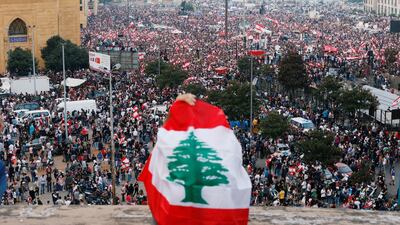
A general view of demonstrators during an anti-government protest in central Beirut. Reuters -
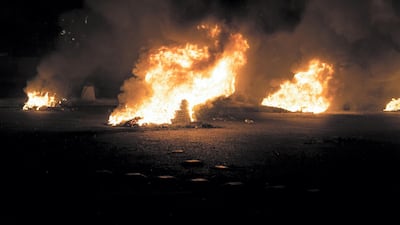
Protesters burn tyres and set up a roadblock on the Beirut-Saida motorway. William Lowry / The National -

Protesters in Nabatiyeh wave flags during an afternoon demonstration. William Lowry / The National -
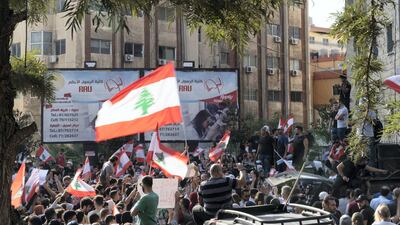
Protesters in Nabatiyeh wave flags. William Lowry / The National -
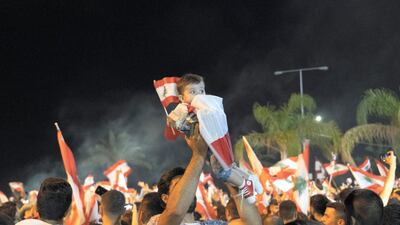
A man holds a baby wrapped in the Lebanese flag high in the air during a protest in Sour. William Lowry / The National -
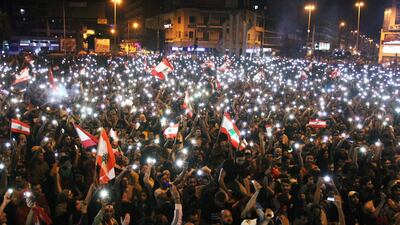
Demonstrators take part in an anti-government protest in Beirut. Reuters -
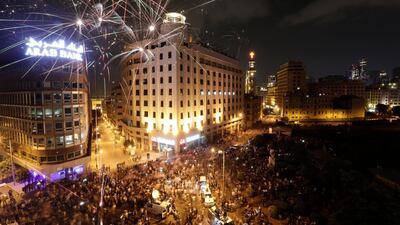
Anti-government protesters shout slogans in Beirut. AP Photo -

A general view of demonstrators during an anti-government protest in central Beirut. Reuters -
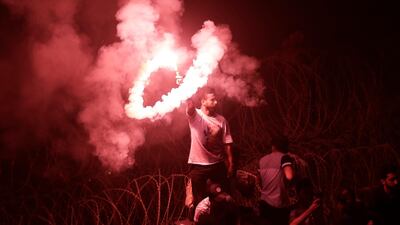
An anti-government protester waves a flare during a street demonstration. AP Photo -

A man lifts a child as demonstrators chant and carry national flags during an anti-government protest in the southern city of Nabatiyeh.


But on the same day, the ABL called on Parliament to reject the plan. The ABL said that it was “biased at the expense of the banks” and blamed the state for mismanaging the money that banks lent it.
A few weeks later, the ABL presented an alternative proposal that suggested that the government should sell $40 billion worth of public assets.
Later asked by local daily L’Orient Today how they came up with that figure, the ABL said “there was no study, it was [just] a valuation”.
The ABL was supported by a parliamentary fact-finding committee that included representatives of all major political parties.
In addition to its chairman, Ibrahim Kanaan, from President Michel Aoun’s Free Patriotic Movement, the committee included Nicolas Nahas, who is close to current Prime Minister Najib Mikati, Ali Fayyad from Hezbollah, Yassine Jaber and Ali Hassan Khalil from the Amal Movement, Eddy Abi Lamaa from the Lebanese Forces and Faysal Sayeg from the Progressive Socialist Party.
They calculated that overall losses at between half and a quarter of the Lazard plan.
The Lebanese Centre for Policy Studies, an independent think tank, said that the parliamentary committee had brought the figure down in a number of ways, including by re-evaluating losses for debt maturing after 2027 at the official exchange rate in the “questionable anticipation of a revaluation of the Lebanese pound over time”.
The think tank also reported that the committee weakened the bargaining position of its own government by proposing a lower cut on government debt. Its aim was, reportedly, to allow banks to remain solvent and for them to preserve some of their equity.
Political and financial elites were then united in their opposition to the government’s financial recovery plan.
The think tank explained their hostility by describing the banking sector as “one of the most effective tools of clientelist redistribution and elite integration”.
The IMF told the media at the time that it backed the government’s figures.
Negotiations unravelled. Two members of Lebanon’s negotiating team quit in protest. In July, the IMF suspended discussions with Lebanon.
In August, a devastating blast at Beirut’s port destroyed large parts of the city and killed at least 190 people.
Mr Diab’s government resigned. Its plan was buried. Lebanese politicians took 11 months to agree on his successor, Mr Mikati, who then formed a government in September.
IMF talks restart
A Lebanese team, headed by Deputy Prime Minister Saadeh Al Shami, began to negotiate again with the IMF in January. France sent an adviser from its economy ministry to counsel Mr Al Shami during the discussions.
Mr Al Shami estimated that the country's financial losses stood at about $69bn in December and at $72bn earlier this month.
On April 7, the IMF and Lebanon reached a staff-level agreement. The fund said that it could support Lebanon with the equivalent of about $3bn over four years.
The ABL hailed the agreement as a “crucial first step” towards recovery and urged the banking sector to remain “open to any solution that resolves the crisis”.
But Lebanon must put into effect several difficult reforms before the IMF board meeting in July.
Reforms include a financial sector restructuring that addresses the “large losses” and unifies the country’s numerous exchange rates.
Parliament must approve an “appropriate emergency bank resolution”, reform Lebanon’s bank secrecy law and approve the 2022 budget. However, none of the above has yet to be put into effect.
In April, Parliament was about to vote on a capital control law but backed down in the face of protesters who said that it allowed Lebanese politicians to evade responsibility for the crisis.
A parliamentary election took place on May 15. The new Parliament’s mandate began on May 22. No faction or party won a majority and experts expect it has set the legislature up for further deadlock.
The second government financial recovery plan
-
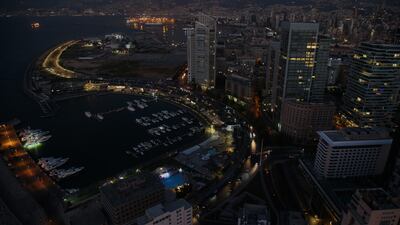
A view of Lebanon's capital, Beirut, with the lights on only in some buildings. Lebanese rely on highly polluting diesel generators run by private neighbourhood operators to make up for shortfalls in electricity supply from the state utility. EPA -

A fisherman uses a headlamp at the seaside corniche in Beirut, Lebanon. EPA -

A vendor sells LED balloons in full darkness at the corniche in Beirut. EPA -
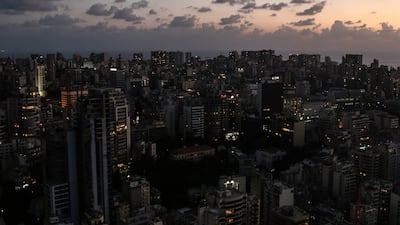
The near collapse of the national grid has increased the duration of power cuts across Lebanon. EPA -
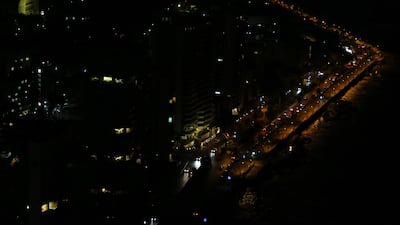
Residents of Beirut are experiencing power cuts of up to 20 hours a day. EPA


On May 20, in one of its final official acts two days before the end of its mandate, Mr Mikati's government approved a new financial recovery plan.
Yet to be released publicly, media reports indicate that the plan calls for an audit of Lebanon’s 14 largest banks. Viable banks would be recapitalised with “significant contributions” from bank shareholders and large depositors.
Reuters reported that the plan would cancel “a large part” of the central bank's foreign currency obligations to commercial banks.
The plan also reportedly states that a full audit of the central bank’s finances should be completed by July and that non-viable banks should be dissolved by November.
Mr Mikati said that deposits under $100,000 would be preserved. This figure, which was not stated in the plan, is five times lower than what the previous government believed was possible in 2020.
Since then, the central bank's reserves have further shrunk. It has been spending about half a million dollars a month to, among other things, support the Lebanese pound. It has about $10 billion left.
It is widely believed that Mr Mikati's now-caretaker government will face difficulties in enacting the reforms requested by the IMF.
Political parties are expected to start the usual back-door negotiations to appoint a new prime minister. This can take months due to Lebanon’s sectarian power-sharing system.
ABL's rejection of the second recovery plan
In a statement issued on Tuesday, the ABL said that it “stood with depositors” in rejecting the Mikati administration's plan.
The ABL wrote that Mr Al Shami's plan “absolved the state and the Banque du Liban of their obligations to pay their debts” to commercial banks.
It also said that deposits had been “cancelled at the stroke of a pen” and derided “genius” experts who did not take heed of the ABL’s alternative plan that calls for a fund that manages state assets.
In a statement released a few hours later, Mr Al Shami's media office said the accusations against the state and the BDL were “baseless” and “false”.
He described the ABL’s statement as a “scandalous attempt at claiming to protect depositors” who had “suffered great harm as a result of bad policies”.
“We are in the middle of negotiations that seek to protect the largest possible number of depositors without burdening the state with additional debt,” said Mr Al Shami.
“This state of denial, if it continues, will make everyone regret their actions.”
Mr Al Shami said that Lebanon would not have access to IMF funds if it failed to adopt the plan.
In theory, ABL’s approval is not necessary for Parliament to pass the Mikati government’s financial recovery plan.
But its personal criticism of Mr Al Shami “suggests there is little political and Cabinet buy-in for this plan”, said financial analyst Mike Azar.
“Like the Lazard plan before it, it is a political orphan supported by a handful of technocrats in the government who may be thrown under the bus. It is looking as if the IMF deal was all theatrics to buy time,” he told The National.

