
Lebanon went to the polls on Sunday, May 15 to elect 128 MPs to represent the country for the next four years.
The Lebanese forces say they are now the largest Christian party in parliament for the first time while Hezbollah and its allies have not managed to secure over 65 seats that would give them a majority.
However, that doesn't mean that the Iran-backed group's opponents will form a cohesive bloc to elect a government or set the agenda. Experts anticipate the new legislative body will be fractured and passing needed bills will be a struggle.
-
An electoral worker sits next to ballot boxes, at the Justice Palace, in Jdeideh. Reuters -
A soldier stands guard as ballots are counted at the Justice Palace. Reuters -
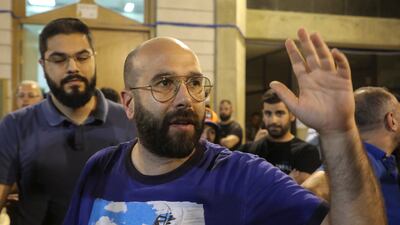
Jad Ghosn, an opposition candidate, gestures as people wait for the announcement of official election results, in Jdeideh. Reuters -
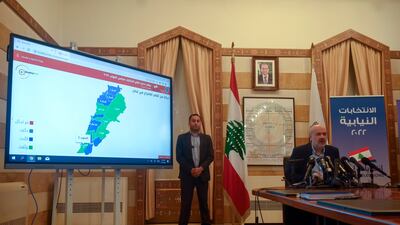
Lebanese Interior Minister Bassam Mawlawi announces the final results for some districts. EPA -

Opposition candidate Yassin Yassin gestures as he is greeted by supporters in Jeb Jennin, West Bekaa. Reuters -
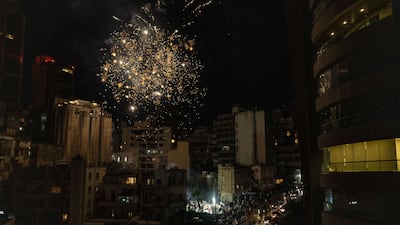
Supporters of the Lebanese Forces take to the streets during parliamentary elections in the Ashrafieh district of Beirut. Bloomberg -
Lebanon headed to the polls with its economy in the grip of hyperinflation. Bloomberg -
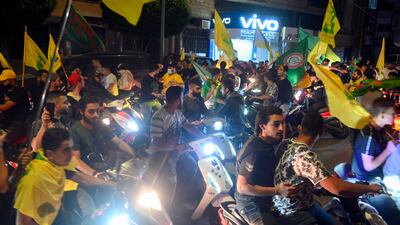
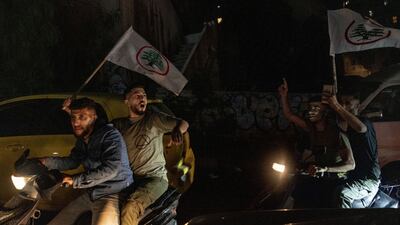
Lebanese youths supporting Hezbollah and Amal movement wave their party flags after parliamentary elections in a suburb of Beirut. EPA -
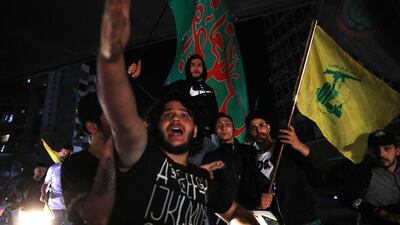
Supporters of Lebanon's Shiite groups Hezbollah and Amal lift their flags during a motorbike rally after voting. AFP -

Children swim in an inflatable pool that supporters of former prime minister Saad Hariri installed to illustrate their intention to boycott parliamentary elections in Beirut, Lebanon. AP Photo -
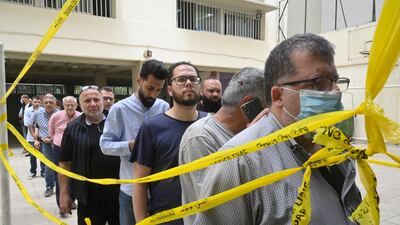
Voters queue to place their vote in parliamentary elections in Beirut, Lebanon. EPA -

Nabih Berri, Speaker of the Lebanese Parliament, stands in a polling booth to vote in Tebnin. Reuters -

Voters register at a polling station in Beirut. Bloomberg -
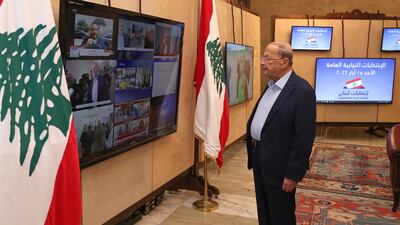
Lebanese President Michel Aoun follows the parliamentary elections on screens from the Presidential Palace in Beirut. AP -

A Lebanese woman shows her inked finger after she cast her vote at a polling station in Beirut. AP -
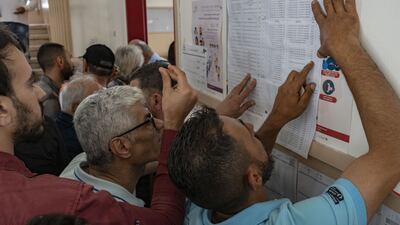
Voters look at a list of candidates at a polling station in Beirut. Bloomberg -

Lebanese policemen help a voter into a polling station in Beirut. AP -
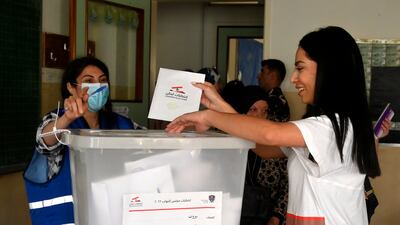
A Lebanese voter casts her ballot paper in Beirut. EPA -
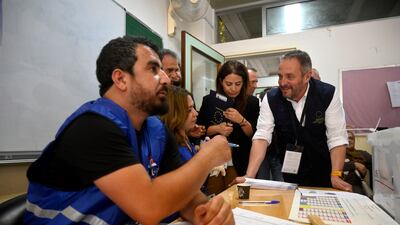
Gyorgy Holvenyi (R), chief observer of the European Union election observation mission, visits a polling station in Beirut. EPA -
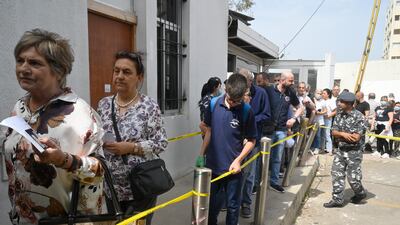
Lebanese people wait to vote during parliamentary elections in the capital city. EPA -
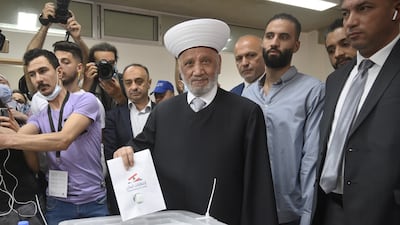
Sheikh Abdul Latif Derian, Grand Mufti of Lebanon, casts his ballot paper during parliamentary elections in Beirut. EPA -
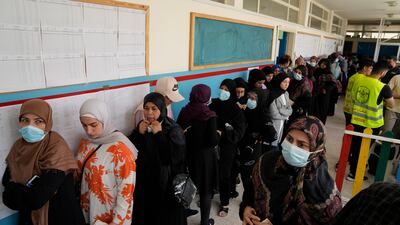
People queue to cast their votes in the Lebanese capital. AP -
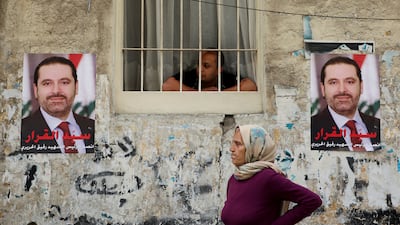
Posters in Al Tariq Al Jadida, Beirut, depict Lebanon’s former prime minister Saad Hariri. Reuters -
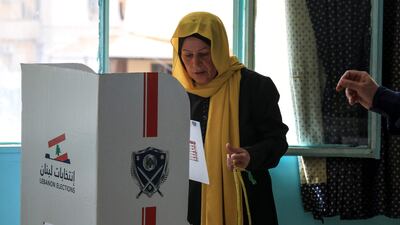
A woman prepares her ballot at a polling station in a southern suburb of Beirut. AFP -
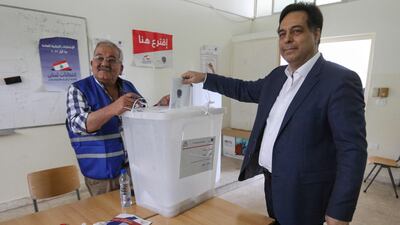
Former prime minister Hassan Diab, who succeeded Saad Hariri, casts his ballot in Beirut. AFP -

A voter checks lists for the parliamentary election at a polling station in the Lebanese capital Beirut. AFP -
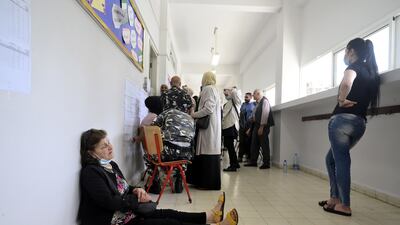
A woman waits to vote in Beirut. EPA -
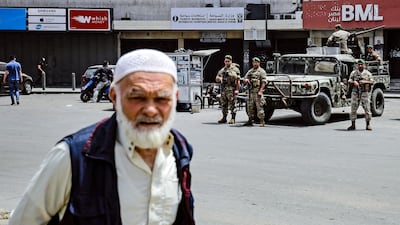
Security forces stand guard at Nur Square on the southern entrance of the northern Lebanese port city Tripoli. AFP -
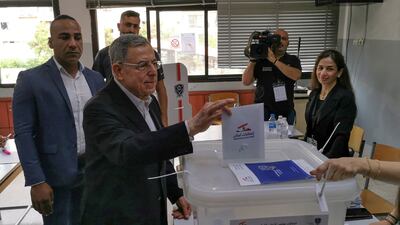
Former Lebanese prime minister Fouad Siniora casts his vote at a polling station during the parliamentary election, in Sidon, southern Lebanon. Reuters -
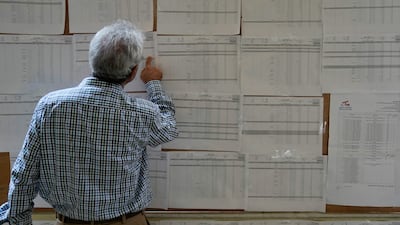
A man check voters' lists in the capital Beirut. AP -
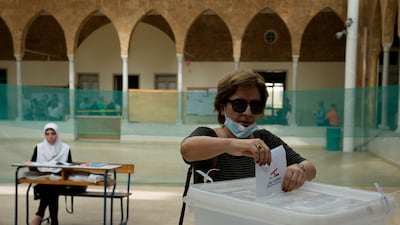
A woman votes in Lebanon's parliamentary elections in Beirut. AP -
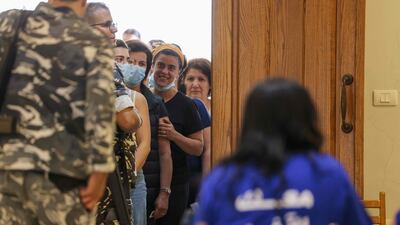
Police check the ID of voters outside a polling station near the Lebanese coastal city of Byblos (Jbeil), north of Beirut. AFP -
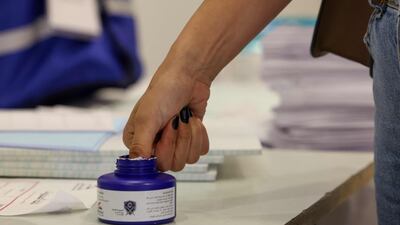
A voter dips her finger in ink after casting her ballot in the parliamentary election at a polling station near Byblos. AFP -
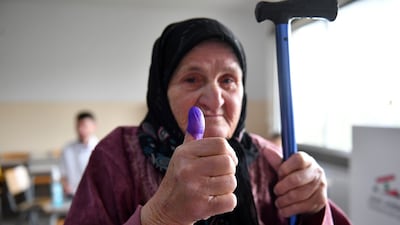
A Lebanese woman shows her ink-marked thumb after voting in Shmustar, Bekaa valley. EPA -
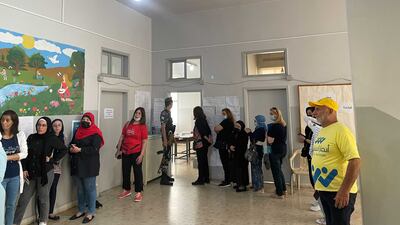
People queueing to vote at Ras El Nabeh Public School for Girls. Fatima Al Mahmoud/ The National
Lebanese parliament 2018 vs 2020
The following table shows the 2018 parliament vs the results for 2022.
It's important to keep in mind that the electoral landscape has changed significantly while alliances and parliamentary blocs are always shifting making a direct comparison difficult.
The major changes are seen in the absence of the Future Movement in the 2022 race after former prime minister and party head Saad Hariri did not field candidates. Several of his MPs ran on other party lists but not as a national party.
In 2018, the Free Patriotic Movement ran a list with a large number of allies rather than direct party members. While these locally popular figures were elected in large numbers — as seen with their 29 seats altogether — they were not in fact a cohesive body in parliament and did not pursue the same coalition strategy in this election.
Full results by district:
The full results are now in and barring any upsets following legal challenges or recounts, the above table represents the full parliament for the 2022-2026 session.
Several key figures, such as deputy parliament speaker Elie Ferzli, lost their seat. Meanwhile, there is a new crop of opposition candidates ready to bring the demands of the 2019 protest movement to the chamber floor.
The Pope's itinerary
Sunday, February 3, 2019 - Rome to Abu Dhabi
1pm: departure by plane from Rome / Fiumicino to Abu Dhabi
10pm: arrival at Abu Dhabi Presidential Airport
Monday, February 4
12pm: welcome ceremony at the main entrance of the Presidential Palace
12.20pm: visit Abu Dhabi Crown Prince at Presidential Palace
5pm: private meeting with Muslim Council of Elders at Sheikh Zayed Grand Mosque
6.10pm: Inter-religious in the Founder's Memorial
Tuesday, February 5 - Abu Dhabi to Rome
9.15am: private visit to undisclosed cathedral
10.30am: public mass at Zayed Sports City – with a homily by Pope Francis
12.40pm: farewell at Abu Dhabi Presidential Airport
1pm: departure by plane to Rome
5pm: arrival at the Rome / Ciampino International Airport
While you're here
Watch: Davos 2021 panel discusses the future of work for women
Alice Haine: Investing in gender parity 'makes good business sense'
Kareem Shaheen: How the pandemic could set Arab women back
Simon Rushton: Home schooling forces UK mothers to quit jobs
COMPANY PROFILE
● Company: Bidzi
● Started: 2024
● Founders: Akshay Dosaj and Asif Rashid
● Based: Dubai, UAE
● Industry: M&A
● Funding size: Bootstrapped
● No of employees: Nine
More from Tom Fletcher
Specs
Engine: 51.5kW electric motor
Range: 400km
Power: 134bhp
Torque: 175Nm
Price: From Dh98,800
Available: Now
DEADPOOL & WOLVERINE
Starring: Ryan Reynolds, Hugh Jackman, Emma Corrin
Director: Shawn Levy
Rating: 3/5
Company profile
Name: Back to Games and Boardgame Space
Started: Back to Games (2015); Boardgame Space (Mark Azzam became co-founder in 2017)
Founder: Back to Games (Mr Azzam); Boardgame Space (Mr Azzam and Feras Al Bastaki)
Based: Dubai and Abu Dhabi
Industry: Back to Games (retail); Boardgame Space (wholesale and distribution)
Funding: Back to Games: self-funded by Mr Azzam with Dh1.3 million; Mr Azzam invested Dh250,000 in Boardgame Space
Growth: Back to Games: from 300 products in 2015 to 7,000 in 2019; Boardgame Space: from 34 games in 2017 to 3,500 in 2019
Key findings of Jenkins report
- Founder of the Muslim Brotherhood, Hassan al Banna, "accepted the political utility of violence"
- Views of key Muslim Brotherhood ideologue, Sayyid Qutb, have “consistently been understood” as permitting “the use of extreme violence in the pursuit of the perfect Islamic society” and “never been institutionally disowned” by the movement.
- Muslim Brotherhood at all levels has repeatedly defended Hamas attacks against Israel, including the use of suicide bombers and the killing of civilians.
- Laying out the report in the House of Commons, David Cameron told MPs: "The main findings of the review support the conclusion that membership of, association with, or influence by the Muslim Brotherhood should be considered as a possible indicator of extremism."
Mercer, the investment consulting arm of US services company Marsh & McLennan, expects its wealth division to at least double its assets under management (AUM) in the Middle East as wealth in the region continues to grow despite economic headwinds, a company official said.
Mercer Wealth, which globally has $160 billion in AUM, plans to boost its AUM in the region to $2-$3bn in the next 2-3 years from the present $1bn, said Yasir AbuShaban, a Dubai-based principal with Mercer Wealth.
“Within the next two to three years, we are looking at reaching $2 to $3 billion as a conservative estimate and we do see an opportunity to do so,” said Mr AbuShaban.
Mercer does not directly make investments, but allocates clients’ money they have discretion to, to professional asset managers. They also provide advice to clients.
“We have buying power. We can negotiate on their (client’s) behalf with asset managers to provide them lower fees than they otherwise would have to get on their own,” he added.
Mercer Wealth’s clients include sovereign wealth funds, family offices, and insurance companies among others.
From its office in Dubai, Mercer also looks after Africa, India and Turkey, where they also see opportunity for growth.
Wealth creation in Middle East and Africa (MEA) grew 8.5 per cent to $8.1 trillion last year from $7.5tn in 2015, higher than last year’s global average of 6 per cent and the second-highest growth in a region after Asia-Pacific which grew 9.9 per cent, according to consultancy Boston Consulting Group (BCG). In the region, where wealth grew just 1.9 per cent in 2015 compared with 2014, a pickup in oil prices has helped in wealth generation.
BCG is forecasting MEA wealth will rise to $12tn by 2021, growing at an annual average of 8 per cent.
Drivers of wealth generation in the region will be split evenly between new wealth creation and growth of performance of existing assets, according to BCG.
Another general trend in the region is clients’ looking for a comprehensive approach to investing, according to Mr AbuShaban.
“Institutional investors or some of the families are seeing a slowdown in the available capital they have to invest and in that sense they are looking at optimizing the way they manage their portfolios and making sure they are not investing haphazardly and different parts of their investment are working together,” said Mr AbuShaban.
Some clients also have a higher appetite for risk, given the low interest-rate environment that does not provide enough yield for some institutional investors. These clients are keen to invest in illiquid assets, such as private equity and infrastructure.
“What we have seen is a desire for higher returns in what has been a low-return environment specifically in various fixed income or bonds,” he said.
“In this environment, we have seen a de facto increase in the risk that clients are taking in things like illiquid investments, private equity investments, infrastructure and private debt, those kind of investments were higher illiquidity results in incrementally higher returns.”
The Abu Dhabi Investment Authority, one of the largest sovereign wealth funds, said in its 2016 report that has gradually increased its exposure in direct private equity and private credit transactions, mainly in Asian markets and especially in China and India. The authority’s private equity department focused on structured equities owing to “their defensive characteristics.”
Results
Stage 7:
1. Caleb Ewan (AUS) Lotto Soudal - 3:18:29
2. Sam Bennett (IRL) Deceuninck-QuickStep - same time
3. Phil Bauhaus (GER) Bahrain Victorious
4. Michael Morkov (DEN) Deceuninck-QuickStep
5. Cees Bol (NED) Team DSM
General Classification:
1. Tadej Pogacar (SLO) UAE Team Emirates - 24:00:28
2. Adam Yates (GBR) Ineos Grenadiers - 0:00:35
3. Joao Almeida (POR) Deceuninck-QuickStep - 0:01:02
4. Chris Harper (AUS) Jumbo-Visma - 0:01:42
5. Neilson Powless (USA) EF Education-Nippo - 0:01:45
The biog
Favourite hobby: taking his rescue dog, Sally, for long walks.
Favourite book: anything by Stephen King, although he said the films rarely match the quality of the books
Favourite film: The Shawshank Redemption stands out as his favourite movie, a classic King novella
Favourite music: “I have a wide and varied music taste, so it would be unfair to pick a single song from blues to rock as a favourite"
More from Rashmee Roshan Lall
Our legal consultant
Name: Hassan Mohsen Elhais
Position: legal consultant with Al Rowaad Advocates and Legal Consultants.
'Gehraiyaan'
Director:Shakun Batra
Stars:Deepika Padukone, Siddhant Chaturvedi, Ananya Panday, Dhairya Karwa
Rating: 4/5
Company profile
Name: Dukkantek
Started: January 2021
Founders: Sanad Yaghi, Ali Al Sayegh and Shadi Joulani
Based: UAE
Number of employees: 140
Sector: B2B Vertical SaaS(software as a service)
Investment: $5.2 million
Funding stage: Seed round
Investors: Global Founders Capital, Colle Capital Partners, Wamda Capital, Plug and Play, Comma Capital, Nowais Capital, Annex Investments and AMK Investment Office
• Remittance charges will be tackled by blockchain
• UAE's monumental and risky Mars Mission to inspire future generations, says minister
• Could the UAE drive India's economy?
• News has a bright future and the UAE is at the heart of it
• Architecture is over - here's cybertecture
• The National announces Future of News journalism competition
• Round up: Experts share their visions of the world to come
Dhadak 2
Director: Shazia Iqbal
Starring: Siddhant Chaturvedi, Triptii Dimri
Rating: 1/5
More from this package
More from Neighbourhood Watch
COMPANY%20PROFILE
MATCH INFO
Asian Champions League, last 16, first leg:
Al Ain 2 Al Duhail 4
Second leg:
Tuesday, Abdullah bin Khalifa Stadium, Doha. Kick off 7.30pm
Stamp duty timeline
December 2014: Former UK finance minister George Osbourne reforms stamp duty, replacing the slab system with a blended rate scheme, with the top rate increasing to 12 per cent from 10 per cent:
Up to £125,000 - 0%; £125,000 to £250,000 – 2%; £250,000 to £925,000 – 5%; £925,000 to £1.5m: 10%; Over £1.5m – 12%
April 2016: New 3% surcharge applied to any buy-to-let properties or additional homes purchased.
July 2020: Rishi Sunak unveils SDLT holiday, with no tax to pay on the first £500,000, with buyers saving up to £15,000.
March 2021: Mr Sunak decides the fate of SDLT holiday at his March 3 budget, with expectations he will extend the perk unti June.
April 2021: 2% SDLT surcharge added to property transactions made by overseas buyers.


