
Lebanese citizens in the UAE were casting their ballots on Sunday, days before their country’s parliamentary election scheduled for May 15.
Voting opened early at 7am, at Lebanon’s diplomatic missions in Abu Dhabi and Dubai, and registered voters aged 21 and above have until 10pm to cast their ballots for 128 representatives in parliament.
Lebanon's ambassador to the UAE Fouad Chehab Dandan says there has been a large increase in the number of registered voters, compared to the 2018 election when Lebanese expatriates worldwide were allowed to vote for the first time.
-
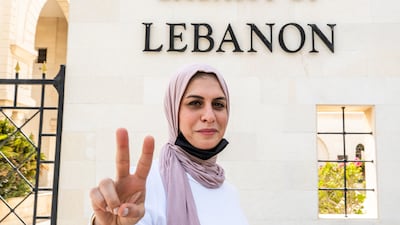
Samah Asmar Diab after voting outside the Embassy of Lebanon in Abu Dhabi. Victor Besa / The National -
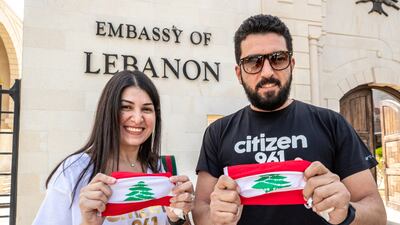
Nadine Abou Ghali and Rabah Sakr after casting their votes at the Embassy of Lebanon in Abu Dhabi. Victor Besa / The National -

Lebanese voters at the Embassy of Lebanon in Abu Dhabi. Victor Besa / The National -
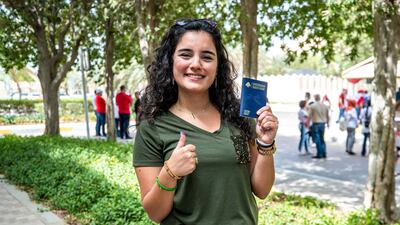
Dima Alameddine after casting her vote at the Embassy of Lebanon in Abu Dhabi. Victor Besa / The National -
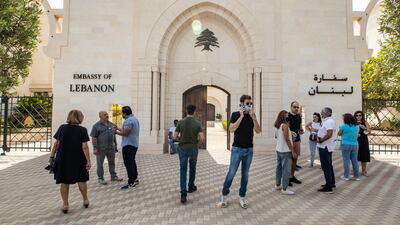
Lebanese voters at the Embassy of Lebanon in Abu Dhabi. Victor Besa / The National -
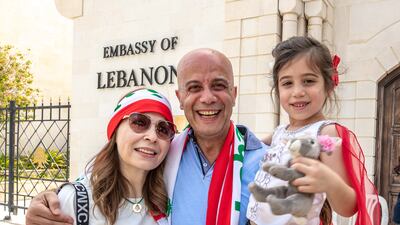
Abeer Hassan and Samir Kamal with daughter Lynn after casting their votes at the Embassy of Lebanon in Abu Dhabi. Victor Besa / The National -
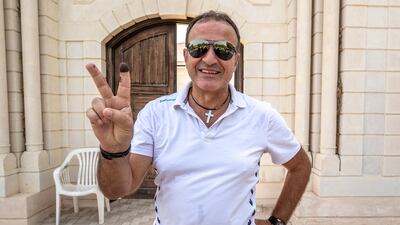
Antoine Harb after casting his vote at the Embassy of Lebanon in Abu Dhabi. Victor Besa / The National -
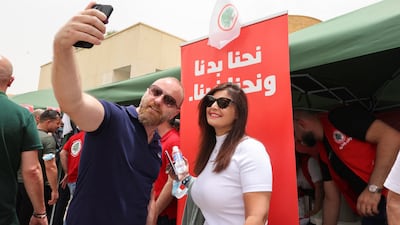
Lebanese expats take selfie in front of an election banner as they arrive to cast their vote in Lebanon's parliamentary election at the Lebanese Embassy in Riyadh, Saudi Arabia. Reuters -
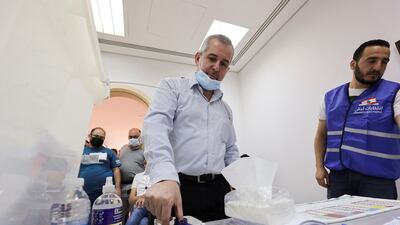
A Lebanese expat stains his finger with ink after casting his vote for Lebanon's parliamentary election at the Lebanese Embassy in Riyadh, Saudi Arabia. Reuters -
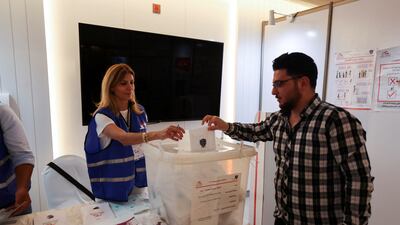
A Lebanese expat casts his vote for Lebanon's parliamentary election at the Lebanese Embassy in Riyadh, Saudi Arabia. Reuters -
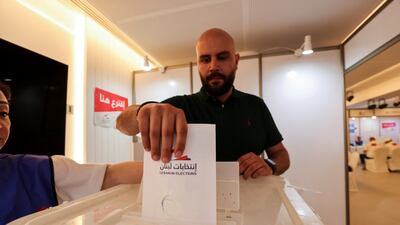
A Lebanese expat casts his vote for Lebanon's parliamentary election at the Lebanese Embassy in Riyadh, Saudi Arabia. Reuters -
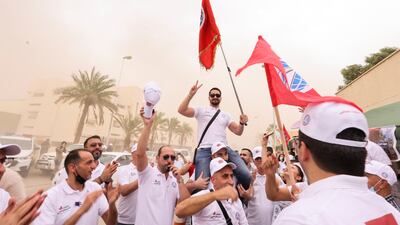
Lebanese expats gather to celebrate Lebanon's parliamentary election at the Lebanese Embassy in Riyadh, Saudi Arabia. Reuters -
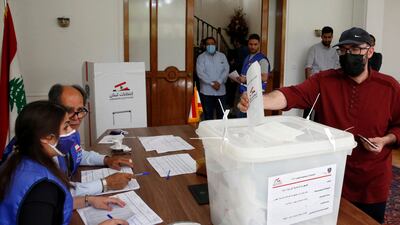
A Lebanese man casts his ballot at a voting point at the Lebanese embassy in Tehran ahead of Lebanon's May 15 legislative election. AFP -
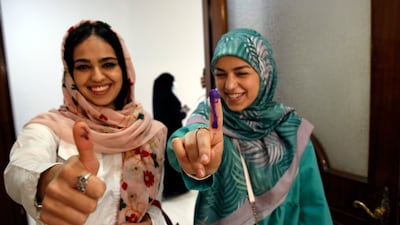
Lebanese girls residing in Iran show their inked fingers after casting their votes during the parliamentary elections at a polling station at the Lebanon embassy in Tehran, Iran. EPA -

Lebanese clerics residing in Iran register to vote during the parliamentary elections at a polling station at the Lebanon embassy in Tehran, Iran. EPA -
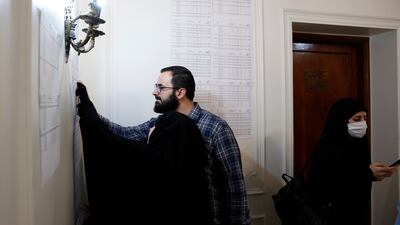
A Lebanese couple residing in Iran checks candidates list during the parliamentary elections at a polling station at the Lebanon embassy in Tehran, Iran. EPA -
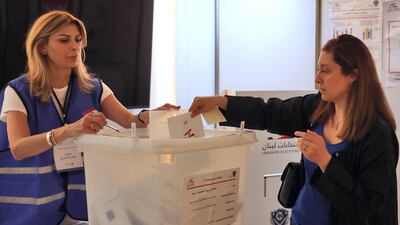
A Lebanese woman votes at the Lebanese embassy in Riyadh during parliamentary elections. AFP -
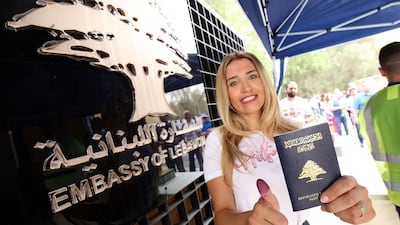
A Lebanese woman displays her ink-stained finger and passport after voting at a polling station at the Lebanese embassy in Kuwait City. AFP -
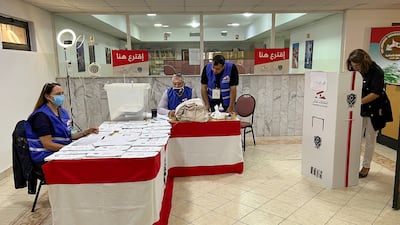
A Lebanese expat casts her vote in Lebanon's parliamentary election at the Lebanese embassy in Amman, Jordan. Reuters -
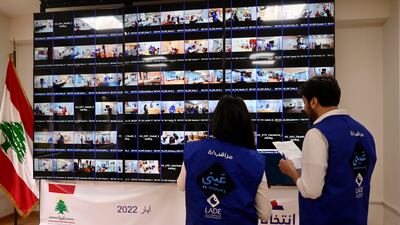
Observers from the LADE association monitor the parliamentary elections taking place outside Lebanon at an operation room to observe the voting process through screens at the Ministry of Foreign Affairs in downtown Beirut, Lebanon. EPA -
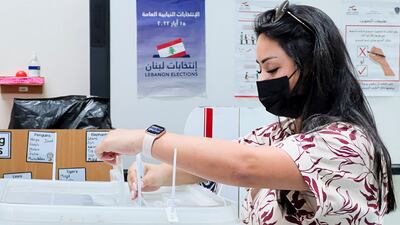
A Lebanese expat casts her vote in Lebanon's parliamentary election at the Lebanese school in Doha, Qatar. Reuters -

Lebanese line up to cast their ballots for Lebanon's parliamentary election from a polling station in Sydney, Australia. Reuters


“The number of registered voters for the May 2022 election reached 25,000, compared to only 8,000 in 2018. People are taking it seriously. To break it down, we have 19,925 registered voters in the consulate in Dubai and 5,142 in the embassy in Abu Dhabi,” Mr Dandan tells The National, as voters queue outside the embassy, passports in hand.
"I think the turnout of voters in the UAE, which will be announced after the election takes place at home, will be about 65 per cent compared to the 52 per cent turnout in 2018."
Lebanon held its last national election in 2018, the country’s first vote since the outbreak of the 2011 civil war in neighbouring Syria.
Politicians have ratified several extensions to parliament’s term on the basis of security concerns but also due to political and legislative gridlock.
Since 2005, politics has been divided across two rival blocs, the first being a broadly pro-West alliance known as March 14, and another alliance called March 8, which is aligned to Syria and includes Hezbollah and several other Shiite and Christian parties.

‘We want to defeat corruption’
Samah Al Asmar Diab, 44, has been living in Abu Dhabi for 17 years, and says her vote is the minimum effort she can make to create a better life for fellow Lebanese who haven’t left the country, or the generations to come.
“We want a decent country for our kids. They want to go back home one day, they want to visit it," says Ms Diab, a senior instructor at Zayed University, who was born in the southern city of Sidon.
"My son was studying at the American University in Beirut and last year we had to get him back to Abu Dhabi because the situation there was miserable. And this year I have another son who’s going to university but I can’t send him to Lebanon. The change is really hard but at least a step should be taken."

She says she feels at home in Abu Dhabi and has no plans to leave.
"We feel like home is here among the Emiratis who are really good friends and family members but it still doesn’t mean we should forget about our home country," she says.
"I recall when I first came here, I was very proud of being Lebanese and my students used to ask eagerly about Lebanon because they used to spend holidays there. Last year, no one wanted to go to Lebanon. No one feels safe and corruption is at its peak. We want to defeat corruption.”
Corruption has plagued Lebanon for many years but there have been several high-profile cases in the past three years, with leading members of the political elite being accused of misusing public funds.
Unemployment stood last year at 25 per cent and nearly a third of the population is living in abject poverty.
The election also comes at a difficult time for Lebanon. The country is enduring a sharp economic decline and financial crisis triggered in 2019 by years of mismanagement and corruption, analysts say.
'I'm a 72-year-old first-time voter'
Michael Chahine, 72, comes from the northern city of Tripoli. He has been living in Dubai for two years and on Sunday he was in Abu Dhabi to vote with his sister and her family at the Lebanese embassy.
Mr Chahine is deeply frustrated by his country's decades-old sectarian political system and has been boycotting elections his whole life.
"I'm 72 years old. Do I look like it, no?" laughs Mr Chahine.
"This is my first time to vote in any election. I want change. I lost faith in our political system and decided not vote in the past.
"This the climax of corruption and we want Lebanon to be back to where it belongs. And it belongs to the Arab world."
He recalls how Lebanon used to be called the "Switzerland of the Middle East".
"I will tell you it's even better. We have our own identity and character. We have a special charm."

"The corrupt establishment robbed Lebanon. They divided the cake among themselves and we have lost our money.
"Our money has evaporated. It's your money and you can't reach it. Even if you want to send money now, you know you won't get it back."
The Lebanese parliament was for years based on a confessional system, which reserved seats for candidates from certain religious communities ― mainly Muslims, Christians and the Druze minority.
Since its independence and the end of the French mandate in 1943, Lebanon has adopted a winner-takes-all majoritarian system.
But in practice decades-old parties, many based on sectarian identity, have held sway.
In 2017, election laws were reformed to adopt the more inclusive proportional representation system and preferential voting, which gives independent candidates a better chance to compete against established parties and win in parliament.
Nevertheless, traditional parties have still kept their parliamentary influence as their religious sects enjoy a majority and are entrenched in the country’s 15 districts up for grabs.
The traditional parties are still led by warlords from the 1975-1990 civil war. The new contenders, largely from civil society groups, hope they might be able to challenge the current political system.
‘It doesn’t feel safe any more’
The economic meltdown and lack of security have pushed many people to leave the country.
The discontent in Lebanon has been brewing for years and become intolerable for Dima Alameddine, 31, an IT worker.
She’s a first-time voter and left Lebanon last year because of the social and economic turmoil.
“If you don’t like something, you need to change it. The country came to a point where it’s really not acceptable any more and change is due,” says Ms Alameddine, who was born in Beirut.
"The people’s basic needs are not being met. If it doesn’t work out, at least you have done your part. I was suffocated by the situation in Lebanon and got a job offer here in Abu Dhabi and didn’t think twice."

The situation was really bad when she left.
"Not just from an economic point of view, it doesn’t feel safe any more," says Ms Alameddine.
"Electricity blackouts are frequent, I can’t go out at night, or when I do I look anxiously behind me every single minute to see if there’s going to be a mugger behind me.
"Even when it comes to money, most of my money was stuck in the bank. So, you work hard for long hours and you don’t have access to your money.”
'One vote adds to another to bring in change'
Though they live overseas and don’t experience the daily hardships of fellow Lebanese at home, such as daily power cuts, shortages of safe drinking water and limited public healthcare, many feel for their homeland and wish the election can bring about much-needed reforms.

Rabah Sakr, 42, is a general manager in the hospitality industry. He has been living in Abu Dhabi for 20 years.
Like many others voting today, it’s his first time.
“I didn’t believe in any of them. I had not seen any new faces. But this time I see new faces and hope we can bring in real change," says Mr Sakr.
"I used to say we didn’t need to vote because my vote wouldn’t change anything. But if one vote adds to another vote, this will have a positive impact and do something. We should always have hope and that’s why we are here.”
Chantal Harmouche, 32, an accounting director in Dubai, echoes the sense of enthusiasm and hopes of spurring a change.
"We need new faces in the parliament. That's what we are aiming at here today," she says.
Lebanon is gearing up for its first national election since a devastating explosion in Beirut on August 4, 2020.
The disaster at Beirut's port killed at least 200 people, injured about 5,000 others and led to the resignation of the government amid growing public anger at the political class.
Manal Sarrouf, 36, a communications consultant and Dubai resident, says people in Lebanon are waiting to know who bombed their capital city.
"No one's telling us what happened," she says.
"Children, young people, older people … everyone died in an explosion and we still don't have an explanation.
"I'm here because I want to vote for people who can explain to me what happened and to bring justice to the victims and their families."

