

A migrant worker in Lebanon who says she suffered violent abuse and was forced to work for years without pay is hoping for justice as a trial against her former employer begins.
A Beirut court hosted a preliminary hearing on Thursday, and the case will be heard again on March 31.
Meseret Hailu Deneke, 37, who returned to her native Ethiopia in 2019, is filing a criminal lawsuit against her former employer, May Saadeh, 49, as well as the Lebanese recruitment agency that brought her to Lebanon. Ms Saadeh appeared in court on Thursday, but representatives from the agency did not.
“I want justice. I wish my case could serve as a warning to all abusers that their crimes will catch up to them one day,” Ms Deneke told The National from her hometown in Dera, Ethiopia.
Ms Deneke spent eight years in the home of Ms Saadeh, a dentist and divorced mother of three. During that time, she says she was beaten, forced to work without pay for seven years and prevented from communicating with the outside world, including her family, who feared that she had died.
The case, brought by international non-profit Legal Action Worldwide, is reported to be the first of its kind, alleging slavery and slave trading enabled by Lebanon’s kafala system.
-

Ethiopian domestic workers wearing masks sit together with their belongings in front of the Ethiopian consulate in Hazmiyeh, Lebanon. Reuters -
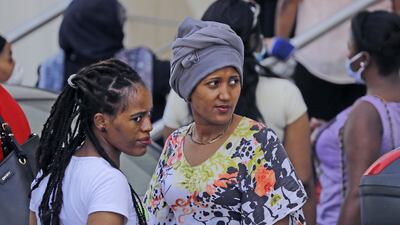
Ethiopian domestic workers wait outside their country's consulate to register for repatriation, in Hazmieh suburb of the Lebanese capital Beirut. AFP -
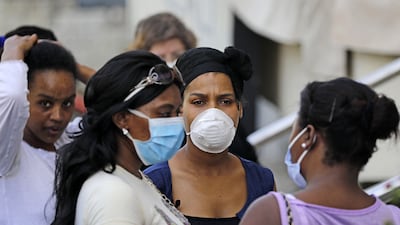
Ethiopian domestic workers wait outside their country's consulate to register for repatriation, in Hazmieh suburb of the Lebanese capital Beirut. AFP -
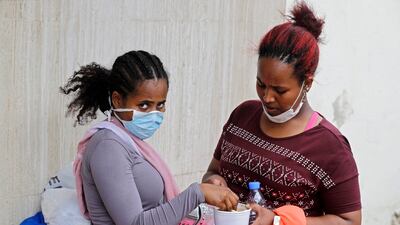
Ethiopian domestic workers who were dismissed by their employers gather with their belongings outside their country's embassy in Hazmiyeh, east of Beirut. AFP -
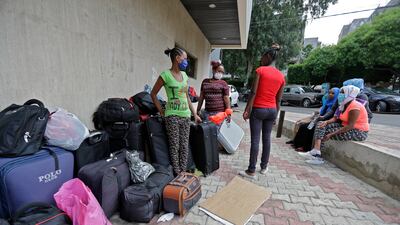
Ethiopian domestic workers who were dismissed by their employers gather with their belongings outside their country's embassy in Hazmiyeh, east of Beirut. AFP -
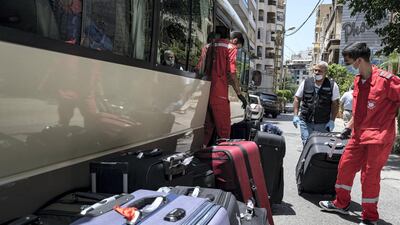
Staff from an NGO, Caritas Lebanon, carry luggage for stranded Ethiopian women in Beirut. Finbar Anderson for The National -

A woman waits to be called to take her place on the bus. Finbar Anderson for The National -
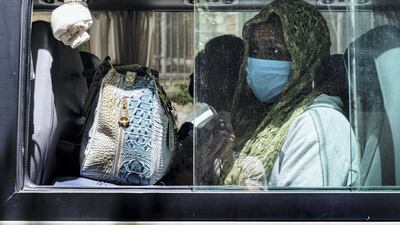
Women wait on a the bus to be taken to shelters, where they will stay until Beirut’s airport reopens. Finbar Anderson for The National -
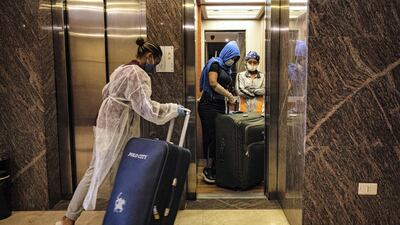
A group of women take the lift while waiting for transport to the shelter run by Caritas Lebanon. Finbar Anderson for The National


The kafala, or sponsorship system, regulates the relationship between employers and migrant workers in Lebanon and in other countries across the Middle East. It excludes migrant workers from the country’s labour law and prevents workers from seeking legal redress for abuses against them.
Human rights organisations have long called for Lebanon to abolish the system, describing it as being little more than a cover for modern-day slavery. In Lebanon, where abusive treatment and deaths of migrant domestic workers have become commonplace, estimates put the average death rate of domestic workers at two a week.
“Enslavement of domestc workers is extremely common,” says Patricia, a case worker at This Is Lebanon who uses a pseudonym for safety reasons. “Meseret’s case heading to court might be a novelty, but we’re aware of many cases of workers who leave Lebanon penniless, despite being owed years, even up to a decade, of salary.”
This Is Lebanon, a collective of underground migrant rights activists has for years lobbied on behalf of victims of the kafala system in Lebanon. The group contacts suspected abusive employers and threatens to expose them on their Facebook page to coerce them into freeing their workers from bondage.
Ms Deneke's family first approached This Is Lebanon in 2018, pleading for assistance in securing her rescue from the Saadeh family home.
Upon being contacted by the organisation, Ms Saadeh allowed Ms Deneke to leave her home in September 2019. She subsequently boarded a flight to her native country with no earnings after working for seven years. It was This Is Lebanon who eventually approached Legal Action Worldwide and secured legal representation for Ms Dene, paving the way for the lawsuit.
The preliminary hearing was scheduled for October 19, but Ms Saadeh, who is yet to comment publicly on the allegations, did not show up. The judge postponed the hearing to February, telling her lawyers that an arrest warrant would be issued in the event Ms Saadeh fails to show up again.
Egna Legna Besidet, a Beirut-based non-profit organisation run by migrant domestic workers, has been assisting Ms Deneke, who has been battling trauma and depression since her return to Ethiopia, with medical costs among other expenses.
Domestic workers forgotten
A representative of the organisation is not optimistic about the prospects for justice in her case.
“Historically, domestic workers have never received adequate justice,” Francisca Ankrah, a development officer at Egna Legna Besidet told The National.
“Sentences are rare and usually don’t correspond to the level of harm caused to the worker. This harm is multifaceted and includes physical and sexual violence.”
Convictions of Lebanese citizens for kafala system-enabled crimes are rare. Among the most high-profile incidents was the 2012 suicide of Alem Dechassa, an Ethiopian domestic worker who was filmed being savagely beaten by Ali Mahfouz, an employee at her recruitment agency. Mahfouz was charged but never served any time in prison.
Another high-profile case was that of Hussein Dia, the Lebanese employer of Faustina Tay, a Ghanaian domestic worker who suffered abuse and died in suspicious circumstances in 2020. Despite promises from Lebanon’s Labour Ministry to hold Dia accountable, nothing has been done other than adding his name to a blacklist banning him from hiring another worker.
The court proceedings look likely to go ahead behind closed doors after journalists were prevented from entering the courtroom on the initial hearing date. A small group of protesters held up posters outside the courtroom, expressing solidarity for Ms Deneke.
“It was hard to come back after all those years with nothing,” she said. “I’m from a poor family. My younger sister left for the Middle East to find work to support us. But at least I’m not suffering alone, as many people from around the world sympathise with me.”

