


Lebanon’s supervisory commission for elections will be unable to adequately monitor election campaigning or the vote itself without a funding injection and legislative tools, its president has warned.
The electoral campaign officially started on January 10 but the commission, without a budget, has not been able to hire the 40 or so necessary media observers. “We are ready to work but we need help,” said Nadim Abdelmalak, during an interview in his office with The National.
Mr Abdelmalak described the commission, which has existed in its current form since 2017, as a hypocritical attempt by the Lebanese political class to project an illusion of democracy and accountability.
The 79-year-old retired judge complained that parliament has no desire to make the necessary changes to give more power to the commission despite recommendations it issued following the 2018 elections.
-
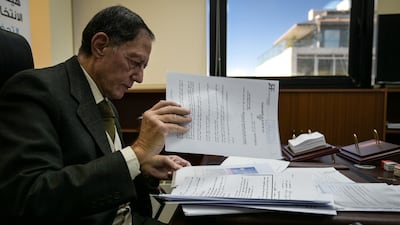
President of Lebanon's supervisory commission for elections, retired judge Nadim Abdelmalak, at his office in Beirut, talks about how current lack of power and funding mean the department is unable to effectively observe the upcoming general election. All Photos: Elizabeth Fitt for The National. -
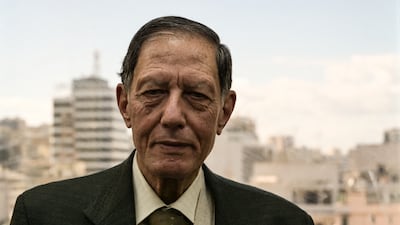
President of Lebanon's supervisory commission for elections, retired judge Nadim Abdelmalak, at his office in Beirut, talks about how current lack of power and funding mean the department is unable to effectively observe the upcoming general election. -
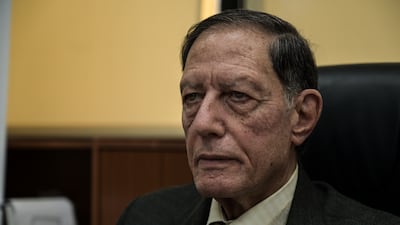
President of Lebanon's supervisory commission for elections, retired judge Nadim Abdelmalak, at his office in Beirut, talks about how current lack of power and funding mean the department is unable to effectively observe the upcoming general election. -
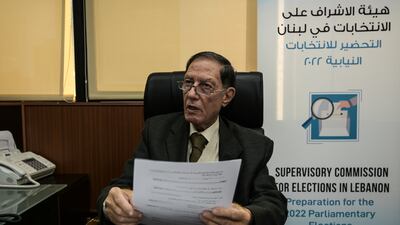
President of Lebanon's supervisory commission for elections, retired judge Nadim Abdelmalak, at his office in Beirut, talks about how current lack of power and funding mean the department is unable to effectively observe the upcoming general election. -
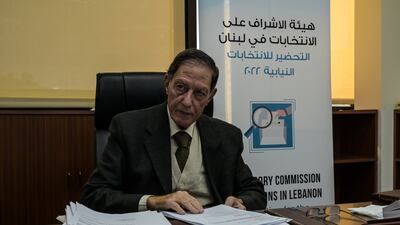
President of Lebanon's supervisory commission for elections, retired judge Nadim Abdelmalak, at his office in Beirut, talks about how current lack of power and funding mean the department is unable to effectively observe the upcoming general election. -
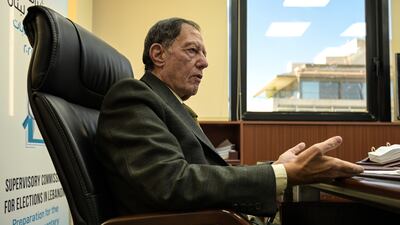
President of Lebanon's supervisory commission for elections, retired judge Nadim Abdelmalak, at his office in Beirut, talks about how current lack of power and funding mean the department is unable to effectively observe the upcoming general election. -
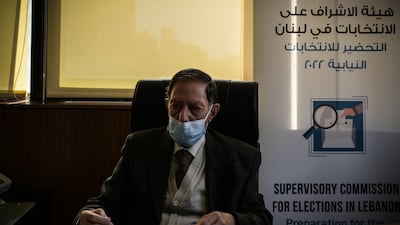
President of Lebanon's supervisory commission for elections, retired judge Nadim Abdelmalak, at his office in Beirut, talks about how current lack of power and funding mean the department is unable to effectively observe the upcoming general election. -
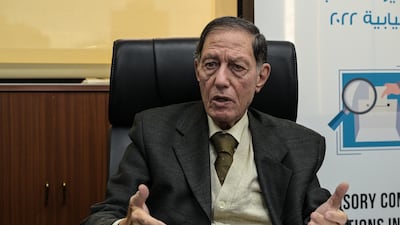
President of Lebanon's supervisory commission for elections, retired judge Nadim Abdelmalak, at his office in Beirut, talks about how current lack of power and funding mean the department is unable to effectively observe the upcoming general election. -
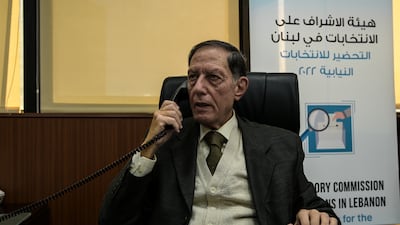
President of Lebanon's supervisory commission for elections, retired judge Nadim Abdelmalak, at his office in Beirut, talks about how current lack of power and funding mean the department is unable to effectively observe the upcoming general election. -
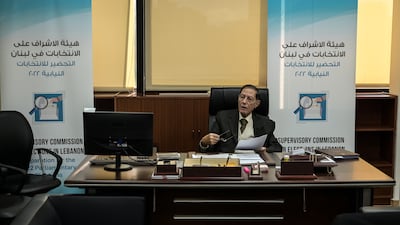
President of Lebanon's supervisory commission for elections, retired judge Nadim Abdelmalak, at his office in Beirut, talks about how current lack of power and funding mean the department is unable to effectively observe the upcoming general election.


It does not have an independent budget and no power to prosecute offenders including media outlets that give more airtime to one candidate over another, or violations of elections expenditure rules.
Mr Abdelmalak can only direct proof of offences to the judiciary, which is widely viewed as slow and politicised. He said that 45 complaints for media violations registered since the last election in 2018 are still pending at the publications court, which deals with all media matters.
“My hands are tied,” he said. “If I take a decision that cannot be executed promptly, there is no meaning to it.”
“I’ll tell you why this commission was created,” he continued. “It’s to satisfy the international community and say that Lebanon is working according to transparency and accountability, but unfortunately that is only in name.”
The cabinet met on Monday for the first time in more than three months and is discussing the 2022 budget this week. The supervisory commission for elections has asked the Interior Ministry to allocate it 5,8 billion Lebanese pounds, or around $250,000 at the market rate, plus $75,000 for technical equipment.
president of the supervisory commission for elections
The commission faces eviction because the Interior Ministry has not paid the rent for its offices for 2021 and 2022 — a total of around $6,000. “I ask any organisation to help us, even if it’s just to pay the rent,” said Mr Abdelmalak.
“The international community always says they’ll support us when I meet them but unfortunately I haven’t seen one penny,” he said. “We want to exercise and achieve our mission completely, but give us work tools.”
George Adwan, the head of parliament’s administration and justice committee, told The National that while he agreed the commission should be given more power, it still had enough leeway to properly supervise the election.
He said that parliament was unable to reform the 2017 electoral law because it was “divided” between “those who wanted a completely new electoral law and those who wanted to keep it with [some] reforms.”
Complaints about a lack of follow-up by the judiciary of elections violations should be addressed in a separate law that pertains to the independence of the judiciary, said Mr Adwan.
But civil society and pro-reform political groups agree with Mr Abdelmalak’s assessment. “There is no political will to empower the SCE,” said Ali Sleem, executive director of the Lebanese Association for Democratic Elections.
Even without its financial difficulties, the commission faces a daunting task this year. Scheduled for May 15, the parliamentary elections will be held amid an unprecedented economic collapse described by the World Bank as among the worst in the world since the mid-19th century.
The elections are widely seen as a test for traditional political parties. Opposition groups are aiming to capitalise on the momentum of the crisis, which is generally blamed on widespread corruption among Lebanon’s main parties.
“After such a catastrophic year and the huge collapse that occurred, this government should have made financing the elections a top priority,” said Hussein Al Achi, Secretary General of Mintashreen, a political party borne from nationwide anti-government protests in 2019.
“The supervisory commission is not able to secure fair elections,” added Mr Al Achi. “We have big anxieties and fears regarding ballot counts.”
Vote tampering and vote buying have reportedly plagued past elections in Lebanon. Asked whether he feared that such illegal practices would increase this year with the crisis, Mr Abdelmalak said that with 70 or 80 per cent of people living in poverty “this is something natural.”
Political infighting has paralysed state decisions and compounded the country’s financial meltdown. The hiatus of cabinet meetings between October 2021 and January had a knock-on effect on the elections’ supervisory commission, as the government did not issue a decree to renew its members six months before the elections as it should have.
In January, the Ministry of Interior decided to keep the previous commission in place. It currently has eight members instead of 11.
“One resigned because he was assigned to the constitutional council, another didn’t show up after the general election in 2018, and one lady went abroad,” said Mr Abdelmalak.
The commission is made up of a mix of judges, lawyers, electoral experts and representatives of civil society and the media. The Interior Ministry did not respond to The National’s requests for comment.
Current members, including its president, have not been paid since 2019. This has created a divide between three of the commission’s clerks, who are UN employees, and the rest of the staff which is paid in Lebanese pounds. The local currency has crashed in the past two years.
Because they are paid in dollars, the clerks' salaries are now worth four times more than Mr Abdelmalak’s normal salary. He said he lives off his monthly pension — now the equivalent of $250.
“I’m sorry to say that I’m paying for the expenses of this office with the aid of some of my colleagues,” he said. “This is a catastrophe.”
The UNDP clarified that the three clerks are not civil servants but were recruited as UN volunteers and deployed to support the supervisory commission for elections in 2017.
The UNDP told The National in an email that it would continue providing advisory and technical assistance to the commission for the forthcoming elections this year.
Mr Abdelmalak and his team have contemplated resigning but he feels morally obligated to stay. Should the commission step down, the constitutional council would nullify electoral results. “If we resign now, there will be no general election,” he said.
“We don’t want to destroy everything.”

