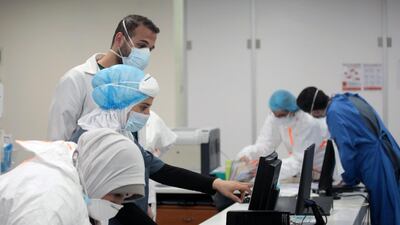
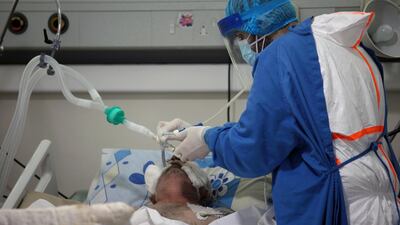
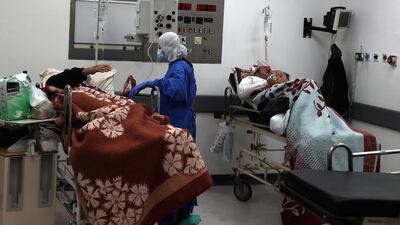
A worker disinfects a room where patients undergo tests for the coronavirus disease at Rafik Hariri University Hospital in Beirut. Reuters

Lebanon: $18m World Bank loan to support crumbling public health sector


Sunniva Rose
  • English
  • Arabic

About $18 million of a World Bank loan will be allocated to Lebanon’s crumbling public health sector in an attempt to reduce inflated bills for vulnerable patients, Health Minister Firass Abiad told The National on Thursday.

Lebanon’s Public Health Ministry normally foots 85 per cent of the bill for hospital patients without private insurance, but this amount has dropped significantly with the massive devaluation of the Lebanese pound in the past two years caused by the country’s economic collapse.

To cover extra costs incurred by the devaluation, hospitals have raised their bills by up to five-fold, pushing a large number of Lebanon’s poorest out of the healthcare system. Mr Abiad estimated that the ministry covers the healthcare costs of more than 40 per cent of the population.

The central bank has not removed the official peg of 1,500 Lebanese pounds to the dollar despite market rates hitting 23,000 Lebanese pounds to the dollar this week. Public bodies such as the Health Ministry, work with an exchange rate that is 15 times lower than the cost of most imported goods, paid for in cash dollars.

In an attempt to bring down hospital costs, as well as the final bill issued to patients, the ministry and the World Bank announced in a joint press conference on Thursday morning the launch of a support programme with a budget of between $16 and $18 million, to be disbursed over the next six to eight months, said Mr Abiad.

“Hospitals are finding it very difficult to retain staff, doctors … due to the financial situation in the country,” World Bank regional director Saroj Kumar Jha said at the press conference.

  • Medical staff members work in an intensive care unit for patients suffering from the coronavirus, at Rafik Hariri University Hospital, in Beirut, Lebanon. Reuters
    Medical staff members work in an intensive care unit for patients suffering from the coronavirus, at Rafik Hariri University Hospital, in Beirut, Lebanon. Reuters
  • A medical worker looks at a Covid-19 patient in the intensive care unit of the Rafik Hariri University Hospital in Beirut, Lebanon. AP
    A medical worker looks at a Covid-19 patient in the intensive care unit of the Rafik Hariri University Hospital in Beirut, Lebanon. AP
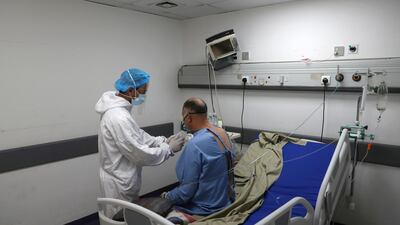
  • A medical worker assists a Covid-19 patient in the intensive care unit of the Rafik Hariri University Hospital in Beirut, Lebanon. AP
    A medical worker assists a Covid-19 patient in the intensive care unit of the Rafik Hariri University Hospital in Beirut, Lebanon. AP
  • A medical worker assists a patient suffering from coronavirus, in an intensive care unit at Rafik Hariri University Hospital, in Beirut, Lebanon. Reuters
    A medical worker assists a patient suffering from coronavirus, in an intensive care unit at Rafik Hariri University Hospital, in Beirut, Lebanon. Reuters
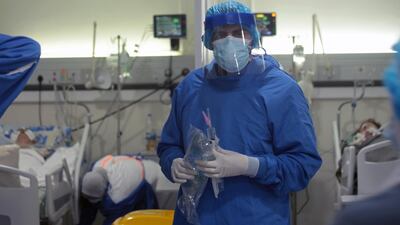
  • Medical staff members work at an intensive care unit for patients suffering from coronavirus, at Rafik Hariri University Hospital, in Beirut, Lebanon. Reuters
    Medical staff members work at an intensive care unit for patients suffering from coronavirus, at Rafik Hariri University Hospital, in Beirut, Lebanon. Reuters
  • A medical staff member assists a patient suffering from coronavirus, in an intensive care unit at Rafik Hariri University Hospital, in Beirut, Lebanon. Reuters
    A medical staff member assists a patient suffering from coronavirus, in an intensive care unit at Rafik Hariri University Hospital, in Beirut, Lebanon. Reuters
  • A medical worker takes care of Covid-19 patients in the intensive care unit of the Rafik Hariri University Hospital in Beirut, Lebanon. AP
    A medical worker takes care of Covid-19 patients in the intensive care unit of the Rafik Hariri University Hospital in Beirut, Lebanon. AP
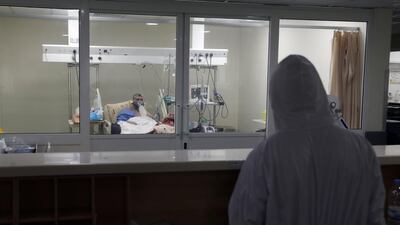
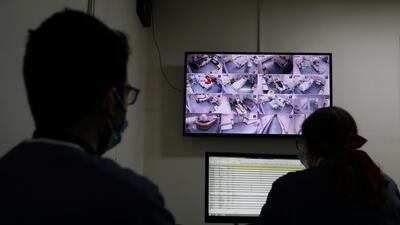
  • Medical staff monitor Covid-19 patients on CCTV screens in the intensive care unit of the Rafik Hariri University Hospital in Beirut, Lebanon. AP
    Medical staff monitor Covid-19 patients on CCTV screens in the intensive care unit of the Rafik Hariri University Hospital in Beirut, Lebanon. AP

The World Bank will tap into a 2017 loan to Lebanon’s health sector of $120 million, nearly half of which has already been disbursed to fight the coronavirus pandemic in Lebanon.

The health ministry plans to reimburse 3.5 times more to hospitals treating patients under its coverage than it used to — still working with the official exchange rate. This will not cover all the extra costs incurred by hospitals but it is expected to partly alleviate their financial burdens.

“It’s very difficult to tell hospitals to not ask patients to pay extra,” said Mr Abiad, who used to direct Lebanon's largest public hospital prior to his ministerial nomination. “A better step is to make sure they receive financial incentives which may act as leverage in future negotiations.”


Haemoglobin disorders explained

Thalassaemia is part of a family of genetic conditions affecting the blood known as haemoglobin disorders.

Haemoglobin is a substance in the red blood cells that carries oxygen and a lack of it triggers anemia, leaving patients very weak, short of breath and pale.

The most severe type of the condition is typically inherited when both parents are carriers. Those patients often require regular blood transfusions - about 450 of the UAE's 2,000 thalassaemia patients - though frequent transfusions can lead to too much iron in the body and heart and liver problems.

The condition mainly affects people of Mediterranean, South Asian, South-East Asian and Middle Eastern origin. Saudi Arabia recorded 45,892 cases of carriers between 2004 and 2014.

A World Health Organisation study estimated that globally there are at least 950,000 'new carrier couples' every year and annually there are 1.33 million at-risk pregnancies.

The burning issue

The internal combustion engine is facing a watershed moment – major manufacturer Volvo is to stop producing petroleum-powered vehicles by 2021 and countries in Europe, including the UK, have vowed to ban their sale before 2040. The National takes a look at the story of one of the most successful technologies of the last 100 years and how it has impacted life in the UAE. 

Read part four: an affection for classic cars lives on

Read part three: the age of the electric vehicle begins

Read part one: how cars came to the UAE


SPECS
%3Cp%3E%3Cstrong%3EEngine%3A%3C%2Fstrong%3E%201.5-litre%204-cylinder%3Cbr%3E%3Cstrong%3EPower%3A%3C%2Fstrong%3E%20101hp%3Cbr%3E%3Cstrong%3ETorque%3A%3C%2Fstrong%3E%20135Nm%3Cbr%3E%3Cstrong%3ETransmission%3C%2Fstrong%3E%3A%20Six-speed%20auto%3Cbr%3E%3Cstrong%3EPrice%3A%3C%2Fstrong%3E%20From%20Dh79%2C900%3Cbr%3E%3Cstrong%3EOn%20sale%3A%3C%2Fstrong%3E%20Now%3C%2Fp%3E%0A
UK-EU trade at a glance

EU fishing vessels guaranteed access to UK waters for 12 years

Co-operation on security initiatives and procurement of defence products

Youth experience scheme to work, study or volunteer in UK and EU countries

Smoother border management with use of e-gates

Cutting red tape on import and export of food

Updated: December 02, 2021, 4:30 PM