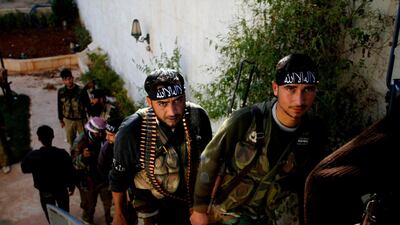
Refugees from Lebanon have gone back home on trips facilitated by local authorities since 2017. AFP

Human Rights Watch: Syrian regime killed, tortured and kidnapped returnees


Aya Iskandarani
  • English
  • Arabic

The Syrian government and affiliated militias tortured, killed and kidnapped Syrian refugees who returned home willingly from Lebanon and Jordan, a Human Rights Watch report has found.

Refugees who attempted to return faced death and torture in regime-held areas, where most of the fighting has stopped after 10 years of war.

Shadi, a 31-year-old disabled man who returned home in 2020, said Syrian soldiers arrested and tortured him on his way from Jordan to a Syrian hospital.

Our neighbour came to our house and told me it was Military Intelligence and it wasn’t just my son, but a lot of men with the FSA were killed by the Military Intelligence
Suad,
Deraa

“Two officers kicked me and used my crutch to beat me. They forced me to crawl on the floor to their car and arrested me,” he said.

Shadi said the officers electrocuted him, then dumped him on the side of the road after his interrogation.

The findings indicate that Syria is not safe for refugees because of government human rights abuses, HRW said, even as the UN and some host countries have encouraged returns.

The head of the UN High Commission for Human Rights Filippo Grandi, during his visit to regime-held Syria on Monday, said that he had discussed “ways to strengthen co-ordination” with the Syrian government to remove obstacles for refugees to return.

The HRW report, titled “Our Lives Are Like Death,” questioned 65 Syrians about their journey back home between 2017 and 2021. It found that Syrian government agents had arbitrarily arrested 21 people, “disappeared” 17 more, and tortured 13 people.

Government agents or affiliated militias killed five of the 65 interviewees, kidnapped three of them and the report found one case of alleged sexual violence.

The Syrian government has regained control of most of the country’s territory after 10 years of war that left half a million people dead.

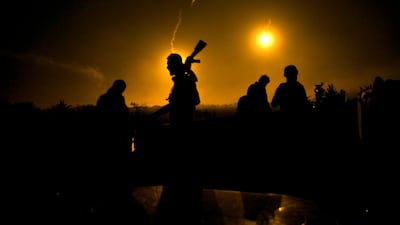
  • US-backed Syrian Democratic Forces watch as rounds light up Baghouz. All photos: AP
    US-backed Syrian Democratic Forces watch as rounds light up Baghouz. All photos: AP
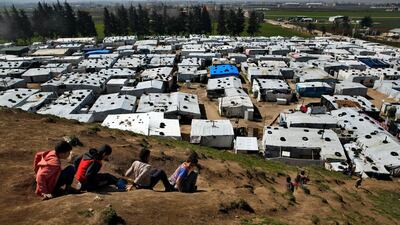
  • Displaced Syrian children slide down a hill, above a refugee camp in the town of Bar Elias, in Bekaa Valley, Lebanon.
    Displaced Syrian children slide down a hill, above a refugee camp in the town of Bar Elias, in Bekaa Valley, Lebanon.
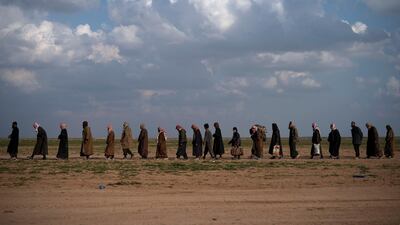
  • Men trudge to be screened after being led from the last territory held by ISIS militants, near Baghouz.
    Men trudge to be screened after being led from the last territory held by ISIS militants, near Baghouz.
  • A man rides his bicycle through rubble in the Yarmouk Palestinian refugee camp, Damascus.
    A man rides his bicycle through rubble in the Yarmouk Palestinian refugee camp, Damascus.
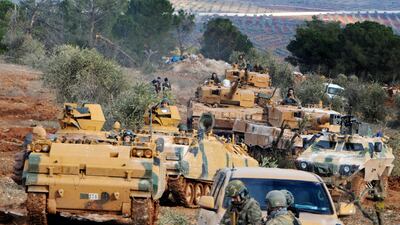
  • Turkish troops take control of Bursayah hill, which separates the Kurdish-held enclave of Afrin from the Turkey-controlled town of Azaz.
    Turkish troops take control of Bursayah hill, which separates the Kurdish-held enclave of Afrin from the Turkey-controlled town of Azaz.
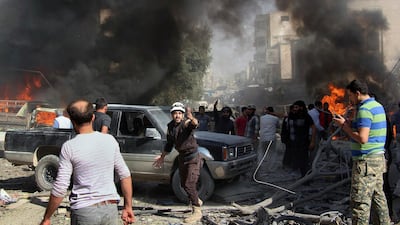
  • Syrian Civil Defence workers and citizens gather after an air strike hit a market in Maaret Al Numan in southern Idlib.
    Syrian Civil Defence workers and citizens gather after an air strike hit a market in Maaret Al Numan in southern Idlib.
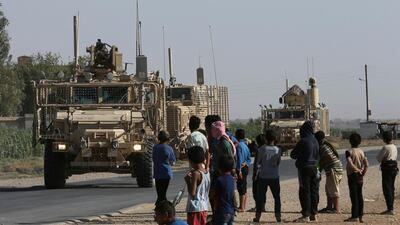
  • Syrians watch a US armoured convoy pass on a road to Raqqa.
    Syrians watch a US armoured convoy pass on a road to Raqqa.
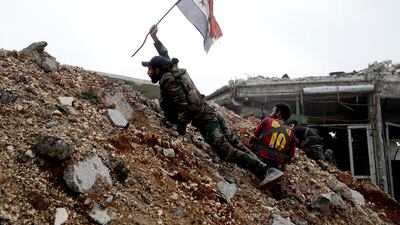
  • An army soldier places a Syrian national flag during a battle with rebel fighters at the Ramouseh front line, east of Aleppo.
    An army soldier places a Syrian national flag during a battle with rebel fighters at the Ramouseh front line, east of Aleppo.
  • Civilians look for their belongings after clashes between opposition fighters and Syrian soldiers loyal to President Bashar Al Assad, in Hejeira, near Damascus.
    Civilians look for their belongings after clashes between opposition fighters and Syrian soldiers loyal to President Bashar Al Assad, in Hejeira, near Damascus.
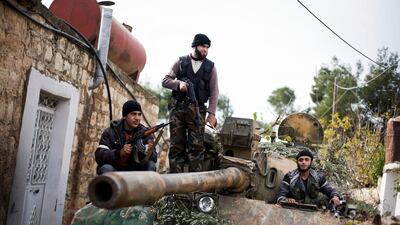
  • Kurdish opposition fighters occupy a tank stolen from the Syrian Army, in Fafeen village, north of Aleppo.
    Kurdish opposition fighters occupy a tank stolen from the Syrian Army, in Fafeen village, north of Aleppo.
  • The Beloved of Allah militia head towards the scene of the battle with government forces on the outskirts of Aleppo.
    The Beloved of Allah militia head towards the scene of the battle with government forces on the outskirts of Aleppo.
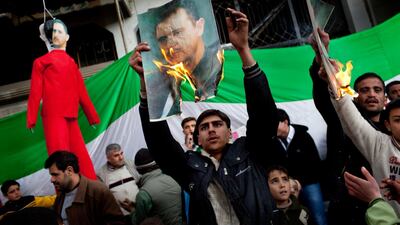
  • People burn portraits of Assad during a demonstration on the outskirts of Idlib.
    People burn portraits of Assad during a demonstration on the outskirts of Idlib.

People affiliated with President Bashar Al Assad’s regime face sanctions for human rights violations by the regime since Washington enforced the Caesar Act last year.

The sanctions law — officially the Caesar Syria Civilian Protection Act — was named after a prison photographer who leaked thousands of images of torture victims and murdered prisoners.

“No one will be safe in Syria until they stop the security agencies from terrorising people,” 38-year-old returnee Halim said.

The new findings are in line with reports from other human rights groups including Amnesty International, which warned about abuses to returnees last month.

Targeting of returnees in Deraa

Interviewees from the province of Deraa said that former rebel fighters and activists returning there face targeted killings and harassment by unknown assailants they say are linked to the Syrian regime.

Deraa is one of the last rebel-held bastions in Syria. The province fell to regime forces last month.

Suad from Deraa said her son was killed by unknown gunmen on a motorcycle upon his return from Jordan in 2020. She said he was murdered because he had worked with the Free Syrian Army for two months in 2013, before fleeing to Jordan.

“After the funeral, our neighbour came to our house and told me it was Military Intelligence and it wasn’t just my son, but a lot of men with the FSA were killed by the Military Intelligence,” she said.

Organised returns

Refugees in Lebanon have gone back home on trips facilitated by local authorities or Iran-backed Hezbollah since at least 2017.

Lebanon’s General Security began facilitating voluntary returns to Syria in 2018 and providing refugees with clearance documents to go home, in co-ordination with Syrian authorities.

But the documents do not always guarantee a safe return for refugees.

A Syrian lawyer told HRW that he believed General Security and Syrian security agencies “behave the same way” and cannot be trusted.

Yasser from Homs said Syrian security forces arrested him and tortured him for four months upon his return, despite his security clearance.

“I had been promised by the Lebanese GSO that no one would be harmed when returning,” the 32 year old said.

“They said the security clearance had been done, so it would be safe for me on return.”

The Lebanese government asked the UN to stop registering Syrians as refugees in 2015, and authorities have encouraged returns for years.

Some Syrians returned from Lebanon following an agreement between Iran-backed Hezbollah and its ally the Syrian regime in 2017.

Zubeida, 20, returned as part of this deal. She said Syria’s elite fourth-armoured division kidnapped her husband two months after their return and she has not heard from him since.

“For months, we tried to find out about my husband. After nine months or maybe one year, we heard he was in Saydnaya prison, but we aren’t sure,” she said.

Returnees said that a lack of job opportunities, poverty and the effects of the Covid-19 pandemic were the main reasons for returning home despite the poor security conditions and Syria’s economic collapse.

At least 282,283 Syrian refugees returned from Egypt, Iraq, Jordan, Lebanon, and Turkey between 2016 and May 2021.

Ten years of conflict have forced more than 13 million Syrians into displacement. About 6.7 million are displaced inside the country while 5.5 million people sought refuge abroad, according to the UN.


The drill

Recharge as needed, says Mat Dryden: “We try to make it a rule that every two to three months, even if it’s for four days, we get away, get some time together, recharge, refresh.” The couple take an hour a day to check into their businesses and that’s it.

Stick to the schedule, says Mike Addo: “We have an entire wall known as ‘The Lab,’ covered with colour-coded Post-it notes dedicated to our joint weekly planner, content board, marketing strategy, trends, ideas and upcoming meetings.”

Be a team, suggests Addo: “When training together, you have to trust in each other’s abilities. Otherwise working out together very quickly becomes one person training the other.”

Pull your weight, says Thuymi Do: “To do what we do, there definitely can be no lazy member of the team.” 

Ten tax points to be aware of in 2026

1. Domestic VAT refund amendments: request your refund within five years

If a business does not apply for the refund on time, they lose their credit.

2. E-invoicing in the UAE

Businesses should continue preparing for the implementation of e-invoicing in the UAE, with 2026 a preparation and transition period ahead of phased mandatory adoption. 

3. More tax audits

Tax authorities are increasingly using data already available across multiple filings to identify audit risks. 

4. More beneficial VAT and excise tax penalty regime

Tax disputes are expected to become more frequent and more structured, with clearer administrative objection and appeal processes. The UAE has adopted a new penalty regime for VAT and excise disputes, which now mirrors the penalty regime for corporate tax.

5. Greater emphasis on statutory audit

There is a greater need for the accuracy of financial statements. The International Financial Reporting Standards standards need to be strictly adhered to and, as a result, the quality of the audits will need to increase.

6. Further transfer pricing enforcement

Transfer pricing enforcement, which refers to the practice of establishing prices for internal transactions between related entities, is expected to broaden in scope. The UAE will shortly open the possibility to negotiate advance pricing agreements, or essentially rulings for transfer pricing purposes. 

7. Limited time periods for audits

Recent amendments also introduce a default five-year limitation period for tax audits and assessments, subject to specific statutory exceptions. While the standard audit and assessment period is five years, this may be extended to up to 15 years in cases involving fraud or tax evasion. 

8. Pillar 2 implementation 

Many multinational groups will begin to feel the practical effect of the Domestic Minimum Top-Up Tax (DMTT), the UAE's implementation of the OECD’s global minimum tax under Pillar 2. While the rules apply for financial years starting on or after January 1, 2025, it is 2026 that marks the transition to an operational phase.

9. Reduced compliance obligations for imported goods and services

Businesses that apply the reverse-charge mechanism for VAT purposes in the UAE may benefit from reduced compliance obligations. 

10. Substance and CbC reporting focus

Tax authorities are expected to continue strengthening the enforcement of economic substance and Country-by-Country (CbC) reporting frameworks. In the UAE, these regimes are increasingly being used as risk-assessment tools, providing tax authorities with a comprehensive view of multinational groups’ global footprints and enabling them to assess whether profits are aligned with real economic activity. 

Contributed by Thomas Vanhee and Hend Rashwan, Aurifer

Small%20Things%20Like%20These
%3Cp%3EDirector%3A%20Tim%20Mielants%3Cbr%3ECast%3A%20Cillian%20Murphy%2C%20Emily%20Watson%2C%20Eileen%20Walsh%3Cbr%3ERating%3A%204%2F5%3C%2Fp%3E%0A
The specs
Engine: 2.4-litre 4-cylinder

Transmission: CVT auto

Power: 181bhp

Torque: 244Nm

Price: Dh122,900 

Director: Laxman Utekar

Cast: Vicky Kaushal, Akshaye Khanna, Diana Penty, Vineet Kumar Singh, Rashmika Mandanna

Rating: 1/5

Infiniti QX80 specs

Engine: twin-turbocharged 3.5-liter V6

Power: 450hp

Torque: 700Nm

Price: From Dh450,000, Autograph model from Dh510,000

Available: Now

SPECS
%3Cp%3EEngine%3A%20Supercharged%203.5-litre%20V6%0D%3Cbr%3EPower%3A%20400hp%0D%3Cbr%3ETorque%3A%20430Nm%0D%3Cbr%3EOn%20sale%3A%20Now%0D%3Cbr%3EPrice%3A%20From%20Dh450%2C000%0D%3Cbr%3E%3C%2Fp%3E%0A
FIGHT CARD


1.           Featherweight 66kg

Ben Lucas (AUS) v Ibrahim Kendil (EGY)

2.           Lightweight 70kg

Mohammed Kareem Aljnan (SYR) v Alphonse Besala (CMR)

3.           Welterweight 77kg

Marcos Costa (BRA) v Abdelhakim Wahid (MAR)

4.           Lightweight 70kg

Omar Ramadan (EGY) v Abdimitalipov Atabek (KGZ)

5.           Featherweight 66kg

Ahmed Al Darmaki (UAE) v Kagimu Kigga (UGA)

6.           Catchweight 85kg

Ibrahim El Sawi (EGY) v Iuri Fraga (BRA)

7.           Featherweight 66kg

Yousef Al Husani (UAE) v Mohamed Allam (EGY)

8.           Catchweight 73kg

Mostafa Radi (PAL) v Abdipatta Abdizhali (KGZ)

9.           Featherweight 66kg

Jaures Dea (CMR) v Andre Pinheiro (BRA)

10.         Catchweight 90kg

Tarek Suleiman (SYR) v Juscelino Ferreira (BRA)

Pad Man

Dir: R Balki

Starring: Akshay Kumar, Sonam Kapoor, Radhika Apte

Three-and-a-half stars

The UN General Assembly President in quotes:

YEMEN: “The developments we have seen are promising. We really hope that the parties are going to respect the agreed ceasefire. I think that the sense of really having the political will to have a peace process is vital. There is a little bit of hope and the role that the UN has played is very important.”

PALESTINE: “There is no easy fix. We need to find the political will and comply with the resolutions that we have agreed upon.”

OMAN: “It is a very important country in our system. They have a very important role to play in terms of the balance and peace process of that particular part of the world, in that their position is neutral. That is why it is very important to have a dialogue with the Omani authorities.”

REFORM OF THE SECURITY COUNCIL: “This is complicated and it requires time. It is dependent on the effort that members want to put into the process. It is a process that has been going on for 25 years. That process is slow but the issue is huge. I really hope we will see some progress during my tenure.”

COMPANY%20PROFILE
%3Cp%3E%3Cstrong%3ECompany%20name%3A%3C%2Fstrong%3E%20Sav%3Cbr%3E%3Cstrong%3EStarted%3A%3C%2Fstrong%3E%202021%3Cbr%3E%3Cstrong%3EFounder%3A%3C%2Fstrong%3E%20Purvi%20Munot%3Cbr%3E%3Cstrong%3EBased%3A%3C%2Fstrong%3E%20Dubai%3Cbr%3E%3Cstrong%3EIndustry%3A%3C%2Fstrong%3E%20FinTech%3Cbr%3E%3Cstrong%3EFunding%3A%3C%2Fstrong%3E%20%24750%2C000%20as%20of%20March%202023%3Cbr%3E%3Cstrong%3EInvestors%3A%3C%2Fstrong%3E%20Angel%20investors%3C%2Fp%3E%0A
New UK refugee system


  • A new “core protection” for refugees moving from permanent to a more basic, temporary protection
  • Shortened leave to remain - refugees will receive 30 months instead of five years
  • A longer path to settlement with no indefinite settled status until a refugee has spent 20 years in Britain
  • To encourage refugees to integrate the government will encourage them to out of the core protection route wherever possible.
  • Under core protection there will be no automatic right to family reunion
  • Refugees will have a reduced right to public funds
COMPANY PROFILE
Company name: BorrowMe (BorrowMe.com)

Date started: August 2021

Founder: Nour Sabri

Based: Dubai, UAE

Sector: E-commerce / Marketplace

Size: Two employees

Funding stage: Seed investment

Initial investment: $200,000

Investors: Amr Manaa (director, PwC Middle East) 

Updated: October 20, 2021, 3:01 AM