• Lebanese soldiers take up position in Khalde after a gun attack on a Hezbollah funeral.
    Lebanese soldiers take up position in Khalde after a gun attack on a Hezbollah funeral.
  • Lebanese soldiers take up position in Khalde, 12km south of Beirut, after a gun attack on a Hezbollah funeral on Sunday.
    Lebanese soldiers take up position in Khalde, 12km south of Beirut, after a gun attack on a Hezbollah funeral on Sunday.
  • Lebanese soldiers take up position in Khalde, south of Beirut, after a gun attack on a Hezbollah funeral.
    Lebanese soldiers take up position in Khalde, south of Beirut, after a gun attack on a Hezbollah funeral.
  • A burnt car is seen after an ambush on a Hezbollah funeral procession in Khalde, Lebanon.
    A burnt car is seen after an ambush on a Hezbollah funeral procession in Khalde, Lebanon.
  • Men drive past a vehicle following clashes in the Khalde area, south of Beirut.
    Men drive past a vehicle following clashes in the Khalde area, south of Beirut.
  • Hezbollah supporters drive past Lebanese soldiers as the army takes up positions amid clashes in the Khalde area, south of Beirut.
    Hezbollah supporters drive past Lebanese soldiers as the army takes up positions amid clashes in the Khalde area, south of Beirut.
  • Flames engulf a vehicle following clashes in the Khalde area, south of the Lebanese capital.
    Flames engulf a vehicle following clashes in the Khalde area, south of the Lebanese capital.

'A declaration of war': tensions in Lebanon's Khalde after Hezbollah clashes


Aya Iskandarani
  • English
  • Arabic

A military checkpoint and five armoured vehicles guarded Khalde, a residential suburb south of Beirut on Monday morning, where gunmen opened fire on a Hezbollah funeral procession the day before in a deadly vendetta.

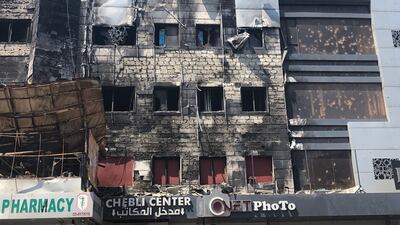
The soldiers stood on a dormant front line, with the Chebli Centre — a burnt-out building riddled with bullet holes and a Hezbollah flag — behind them.

A few metres away are the homes of the group's sworn enemies: the Sunni Arab clansmen of Khalde.

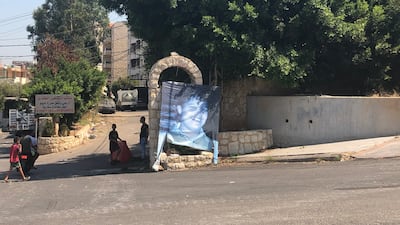
Close to the Chebli Centre, the Arabs have erected a huge photograph of a young man killed last August in a turf battle between the two groups.

The revenge killing of Hassan Ghosn’s alleged murderer on Saturday, whose funeral procession was the target of violence on Sunday, reignited tensions between local Sunni Arab clansmen and Shiite supporters of the Iran-backed group.

Khalde residents now fear renewed sectarian violence in a country already struck by political paralysis and economic collapse.

“We are preparing for the worst. We told our women and children to stay indoors,” Lawrence Chahine, an Arab clan member said from his family home, metres away from the scene of the fighting.

“If Hezbollah decides to have another big procession for those who died yesterday we will consider it a declaration of war.

It is going to be a massacre.”

Sunni Arab clansmen said that one their own killed Ali Chebli, the Hezbollah member whose procession was attacked, to avenge the killing of the Sunni boy, Hassan Ghosn, last year.

Chebli’s funeral procession ended in bloodshed.

As many as four people are believed to have been killed. Hezbollah confirmed that two people were dead. The Red Cross, which was deployed at the scene, said it will not release a death toll.

Mr Chahine, a cafe owner in his 50s, said the clansmen attacked Chibli’s procession because some people attempted to tear away the image of Ghosn and fired in the direction of the photograph.

He also said that the sight of a huge convoy waving Hezbollah flags and chanting Shiite slogans was a provocation to local clansmen, many of whom live at the corner between the picture and Chebli’s villa.

“When I saw the convoy, I knew there was going to be blood,” he said.

Hezbollah said on Sunday that the procession was “ambushed” by local gunmen and denies wrongdoing.

  • An image depicting slain boy Hassan Ghosn in Khalde, 12km south of Beirut.
    An image depicting slain boy Hassan Ghosn in Khalde, 12km south of Beirut.
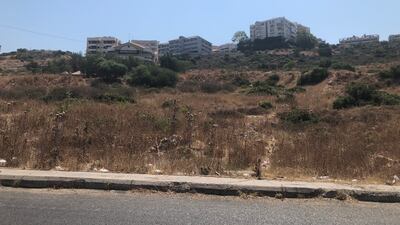
  • The house of slain Hezbollah member Ali Chebli. His funeral procession was on its way to the house when it was fired upon.
    The house of slain Hezbollah member Ali Chebli. His funeral procession was on its way to the house when it was fired upon.
  • The Chibli Centre and its surroundings. The Hezbollah building was burnt during clashes last year.
    The Chibli Centre and its surroundings. The Hezbollah building was burnt during clashes last year.
  • The Chibli Centre and its surroundings. The Hezbollah building was burnt during clashes last year.
    The Chibli Centre and its surroundings. The Hezbollah building was burnt during clashes last year.

Khalde is located south of Hezbollah's security complex in the southern suburbs of Beirut.

Banners of the slain Iranian commander Qassem Suleimani line the Beirut motorway to Khalde.

The coastal town separates Hezbollah's Beirut stronghold from south Lebanon, where the armed group holds great influence.

Mr Chahine traces enmities between clan members and the Shiite group back to the killing of former prime minister Rafik Hariri in 2005. An international court found last year that Hariri was killed by a Hezbollah operative.

“Wherever there is a force standing in their way they will strike,” Mr Chahine said, accusing the group of “waging war on Sunnis".

Lebanon was at war with itself for 15 years as sect leaders competed for territorial control. An arrangement dividing political portfolios by sect ended the war in 1990.

Lebanon’s sect leaders called for calm on Sunday after the clashes in a rare show of unity.

Blood begets blood. My brother was shot dead last year in Syria. If we had killed his killer, there would be endless bloodshed
Syrian resident of Khalde

They have been embroiled in a year-long fight over their share of ministerial portfolios in the next government. The Cabinet of premier Hassan Diab resigned last August after the devastating blast at Beirut's port.

President Michel Aoun called on “all sides to co-operate” to restore calm to Khalde.

An army spokesperson told The National that military intelligence arrested a local salafist clergyman and his son on suspicion that he "incited the men to shoot at the procession."

The army said on Monday it had also arrested one gunman who shot at Chibli’s procession and that Khalde had returned to normal.

Alone in his empty decor shop by the sea, a local resident said he still fears for his business and his life.

“I am against all forms of violence, especially during a funeral procession. This is simply not right”, Omar, 24, said in a low soft voice.

The Syrian man said that so long as the vendetta remains unresolved bloodshed was inevitable.

“Blood begets blood. My brother was shot dead last year in Syria. If we had killed his killer, there would be endless bloodshed.”


UAE v Gibraltar

What: International friendly

When: 7pm kick off

Where: Rugby Park, Dubai Sports City

Admission: Free

Online: The match will be broadcast live on Dubai Exiles’ Facebook page

UAE squad: Lucas Waddington (Dubai Exiles), Gio Fourie (Exiles), Craig Nutt (Abu Dhabi Harlequins), Phil Brady (Harlequins), Daniel Perry (Dubai Hurricanes), Esekaia Dranibota (Harlequins), Matt Mills (Exiles), Jaen Botes (Exiles), Kristian Stinson (Exiles), Murray Reason (Abu Dhabi Saracens), Dave Knight (Hurricanes), Ross Samson (Jebel Ali Dragons), DuRandt Gerber (Exiles), Saki Naisau (Dragons), Andrew Powell (Hurricanes), Emosi Vacanau (Harlequins), Niko Volavola (Dragons), Matt Richards (Dragons), Luke Stevenson (Harlequins), Josh Ives (Dubai Sports City Eagles), Sean Stevens (Saracens), Thinus Steyn (Exiles)

2025 Fifa Club World Cup groups

Group A: Palmeiras, Porto, Al Ahly, Inter Miami.

Group B: Paris Saint-Germain, Atletico Madrid, Botafogo, Seattle.

Group C: Bayern Munich, Auckland City, Boca Juniors, Benfica.

Group D: Flamengo, ES Tunis, Chelsea, Leon.

Group E: River Plate, Urawa, Monterrey, Inter Milan.

Group F: Fluminense, Borussia Dortmund, Ulsan, Mamelodi Sundowns.

Group G: Manchester City, Wydad, Al Ain, Juventus.

Group H: Real Madrid, Al Hilal, Pachuca, Salzburg.

At a glance

Global events: Much of the UK’s economic woes were blamed on “increased global uncertainty”, which can be interpreted as the economic impact of the Ukraine war and the uncertainty over Donald Trump’s tariffs.


Growth forecasts: Cut for 2025 from 2 per cent to 1 per cent. The OBR watchdog also estimated inflation will average 3.2 per cent this year


Welfare: Universal credit health element cut by 50 per cent and frozen for new claimants, building on cuts to the disability and incapacity bill set out earlier this month


Spending cuts: Overall day-to day-spending across government cut by £6.1bn in 2029-30 


Tax evasion: Steps to crack down on tax evasion to raise “£6.5bn per year” for the public purse


Defence: New high-tech weaponry, upgrading HM Naval Base in Portsmouth


Housing: Housebuilding to reach its highest in 40 years, with planning reforms helping generate an extra £3.4bn for public finances

Who is Tim-Berners Lee?

Sir Tim Berners-Lee was born in London in a household of mathematicians and computer scientists. Both his mother, Mary Lee, and father, Conway, were early computer scientists who worked on the Ferranti 1 - the world's first commercially-available, general purpose digital computer. Sir Tim studied Physics at the University of Oxford and held a series of roles developing code and building software before moving to Switzerland to work for Cern, the European Particle Physics laboratory. He developed the worldwide web code as a side project in 1989 as a global information-sharing system. After releasing the first web code in 1991, Cern made it open and free for all to use. Sir Tim now campaigns for initiatives to make sure the web remains open and accessible to all.

What is hepatitis?

Hepatitis is an inflammation of the liver, which can lead to fibrosis (scarring), cirrhosis or liver cancer.

There are 5 main hepatitis viruses, referred to as types A, B, C, D and E.

Hepatitis C is mostly transmitted through exposure to infective blood. This can occur through blood transfusions, contaminated injections during medical procedures, and through injecting drugs. Sexual transmission is also possible, but is much less common.

People infected with hepatitis C experience few or no symptoms, meaning they can live with the virus for years without being diagnosed. This delay in treatment can increase the risk of significant liver damage.

There are an estimated 170 million carriers of Hepatitis C around the world.

The virus causes approximately 399,000 fatalities each year worldwide, according to WHO.


SPECS
%3Cp%3E%3Cstrong%3EEngine%3A%3C%2Fstrong%3E%202-litre%204-cylinder%20turbo%20and%203.6-litre%20V6%0D%3Cbr%3E%3Cstrong%3ETransmission%3A%20%3C%2Fstrong%3ESeven-speed%20automatic%0D%3Cbr%3E%3Cstrong%3EPower%3A%3C%2Fstrong%3E%20235hp%20and%20310hp%0D%3Cbr%3E%3Cstrong%3ETorque%3A%20%3C%2Fstrong%3E258Nm%20and%20271Nm%0D%3Cbr%3E%3Cstrong%3EPrice%3A%3C%2Fstrong%3E%20From%20Dh185%2C100%0D%3Cbr%3E%3C%2Fp%3E%0A

The Lost Letters of William Woolf
Helen Cullen, Graydon House 

ENGLAND SQUAD

Goalkeepers: Jack Butland, Jordan Pickford, Nick Pope 
Defenders: John Stones, Harry Maguire, Phil Jones, Kyle Walker, Kieran Trippier, Gary Cahill, Ashley Young, Danny Rose, Trent Alexander-Arnold 
Midfielders: Eric Dier, Jordan Henderson, Dele Alli, Jesse Lingard, Raheem Sterling, Ruben Loftus-Cheek, Fabian Delph 
Forwards: Harry Kane, Jamie Vardy, Marcus Rashford, Danny Welbeck

Updated: August 02, 2021, 5:00 PM