
There was renewed uncertainty among Jordanian businesses this week after the authorities hesitated about locking down in response to record increases in coronavirus infections and deaths and deepened a crackdown on a relatively small protest movement demanding downfall of the government.
Security forces arrested dozens of young people in Amman and several cities across Jordan overnight, residents said.
It was in the second wave of arrests against people who took to streets this week after negligence at a government hospital in the city of Al Salt was blamed for the death of nine coronavirus patients.
The fiasco promoted calls for the removal of the government, Jordan's 12th in the last 20 years. King Abdullah appointed it amid a virus surge in October last year.
Abu Raed, a veteran mechanic, said the increased security presence in Amman this week contributed to scaring away customers.
“No customers were coming any way and I am having to close at 5pm to be able to make it home before the curfew,” he said at his garage in the Al Mahata district, near a main stop on the old Hijaz railway to Medina.
In a good month before the coronavirus, he used make around $600, compared with $100 to $200 a month since December.
Jordan's business sector, strengthened by Levantine merchant companies established since the 1920s, mostly maintained its supply chains during the pandemic.
No significant shortages occurred. But hoarding and panic buying were a hallmark of consumer behaviour in the country during the pandemic, indicating lack of trust in the system.
A recession officially started last year, after a decade of stagnation, rising poverty and record 24 per cent unemployment, worsened by the coronavirus.
After official data last week showed daily deaths nearing 100 and infections rising by more than 9,000 a day, government spokesman Sakher Dudin said a prolonged lockdown might be needed.
King Abdullah II, who replaced the interior, justice and health ministers in recent months – the main officials in charge of virus response – after virus debacles lamented how the country found itself in this situation.
“We started the coronavirus year as one of the better countries in the world. Negligence got us into the style we are in today,” the king said last week.
“The numbers are scary,” he said, predicting that Jordan’s economy will rebound but ruling out any change in the government.
Customers jammed the narrow alleys of a supermarket on a main road in an affluent western sector of Amman on Wednesday.
“People are buying everything they can get their hands on because they don’t know if shops will remain open tomorrow,” said floor manager Mutasem Idris.
“They are even stocking up on deli meat, although it is perishable,” he said.
-

Taxi driver Razwan Najjar says his daily earnings go towards gas and car rental. Amy McConaghy / The National -
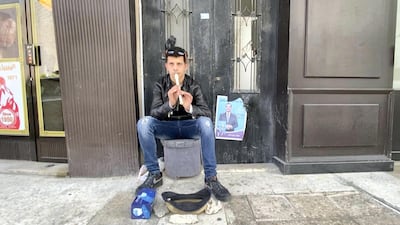
A young man busks for money in Jabal al Weibdeh, Jordan. Amy McConaghy / The National -

A local resturant in Jordan’s Jabal AL Weibdeh neighbourhood. Amy McConaghy / The National -

Arabic teacher Ana with a student at the Misbah Centre. Amy McConaghy / The National -

Falafel sandwiches being prepared at Abu Mahjoub, in Jabal Al Weibdeh. Amy McConaghy / The National -

Small businesses have felt the effects of Jordan’s new 7pm curfew. Amy McConaghy / The National -

Coffee shops remain busy though the day in Amman, Jordan. Amy McConaghy / The National -

In Jordan, falafel continues to be a staple food, no matter the economic situation. Amy McConaghy / The National -

Laith Tantawi, an Arabic teacher at the Misbah Centre, says less students are travelling to Jordan to learn Arabic. Amy McConaghy / The National -

Abduolah Taher, manager and co-owner of Abu Mahjoub, works behind the counter. Amy McConaghy / The National -

Arabic teachers discuss work at the Misbah Centre in Jabal Al Weibdeh. Amy McConaghy / The National


A specialist panel recommended several weeks of lockdown, but Prime Minister Bisher Al Khasawneh told business owners on Monday that the government was unlikely to listen to the recommendation.
The government is trying to avoid a full lockdown because of its “economic and psychological repercussions”, Mr Al Khasawneh said.
The country has for weeks been under a Friday curfew and no one is allowed on the streets from 7pm to 6am during the rest of the week in an effort to try to stem the virus's spread.
The owner of a kitchen shop in west Amman said that expensive bread-making machines he had been unable to sell for years were bought in the past two weeks.
“No one was interested in buying these things before. People are afraid that bread will run out,” he said.
Other businesses are being harmed by lack of demand.
Sales at Abu Mahjoub, a falafel shop in Al Weibdeh hill in Amman, fell by at least a third since curfew hours were extended a few weeks ago, owner Abdullah Taher said.
“We lost two of our best hours and also because schools have been closed and a lot of offices in the neighbourhood are shut, we lost a lot of business,” he said.
Mr Taher is a one of a generation of young entrepreneurs trying to revive businesses in Al Weibdeh.
The district has residential buildings from the 1960s and 1970s that are still intact and, unlike the rest of arid Amman, some old trees.

Amman, and Weibdeh in particular, became popular with foreign students studying Arabic in the last decade after the revolt against Assad family rule broke out in Syria, which was the main destination in the region for the study of Arabic.
As a result of coronavirus restrictions, customers pay for their falafel outside the shop.
Although the number of foreigners in Weibdeh has declined since the pandemic began last March and locals are buying less, Mr Taher still “counts his blessings”.
“We are lucky,” he said. “At the end of the day, people want falafel. They need falafel. It is a staple food.”
Across from Abu Mahjoub, the number of mostly western students attending the Misbah Arabic language teaching centre dropped from 100 to six over the past year.

Instructor Laith Tantaqi is one of the teachers at the centre who kept his job.
He said alternating curfew decisions by the government were undermining chances for those who consider even short courses in Arabic to go to Jordan.
“We still have the passion as before to share our culture with the world and to teach our language,” he said.
Under the curfew all businesses are required to close by 6pm, which contributes to huge traffic jams in the streets throughout the afternoon.
Taxi driver Razwan Najjar said the money he has been making from reduced customer numbers barely covers the cost of fuel and the rental he has to pay the owner of the car.
“From 6pm to 7pm you can’t imagine the jam,” he said, adding that he has been living by borrowing money from friends and relatives.

