


Hunters living 9,000 years ago made children's toys and etched human faces in stone between hunting trips in the Arabian Desert, an international archaeological team said on Tuesday, announcing a major find in Jordan that could change perceptions of early human civilisation in the Middle East.
The hunters were using kites — huge stone enclosures used to trap wild animals en masse, which have previously been discovered in the kingdom. A site near one of the kites, thought to be a shrine, contained objects the experts believe to be related to ancient rituals.
These were some of the findings of an international archaeological undertaking sponsored by France. The mission has been working since 2013 in Jabal Khashabiyeh, a desert plateau in southern Jordan, and consists of French, American, German and Jordanian specialists.
In pictures: archaeology in Jordan
-
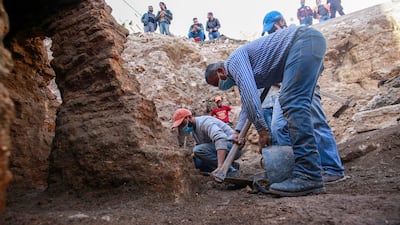
The ruins of a recently discovered Roman archaeological site in Amman, the capital of Jordan, are uncovered on the site of a water drainage system. AFP -
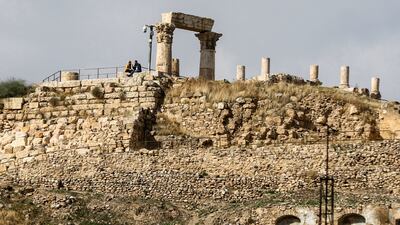
The Temple of Hercules at the Amman Citadel, where archaeological teams are looking learn more about the Jordanian capital's history. AFP -
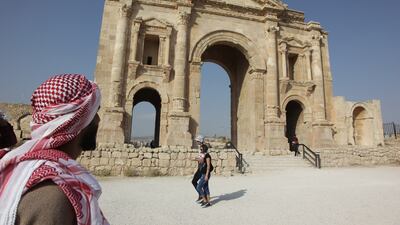
A Jordanian keffiyeh seller trades by a gate at the ancient Roman city of Jerash, a tourist attraction about 50 kilometres from Amman. AFP -
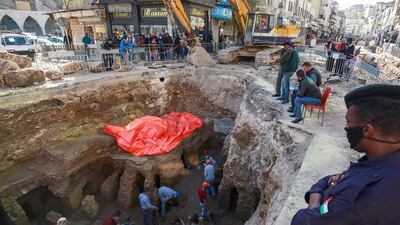
The ruins of a recently discovered Roman archaeological site in Amman, the capital of Jordan, are uncovered on the site of a water drainage system. AFP -
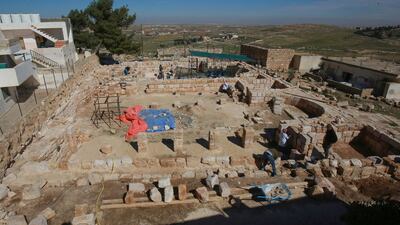
Workers employed by a Unesco pilot project restore a stone wall at an ancient church complex in the town of Rihab,about 70 kilometres north of Amman. AFP -
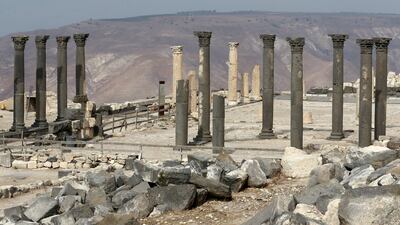
The ancient Roman Decapolis city of Gadara, near the Jordanian town of Umm Quais. AFP -
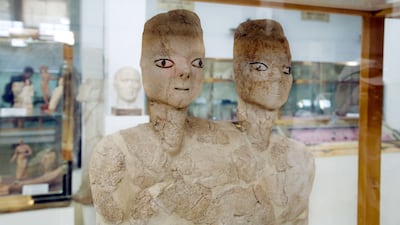
The two-headed Neolithic Ain Ghazal statue dating from between 8000BC to 6000BC in the Jordan Archaeological Museum, Amman. Alamy -

A team of Jordanian and French archaeologists said they found a 9,000-year-old shrine at a Neolithic campsite near large structures known as 'kites' in Jordan's Eastern Desert. AP -
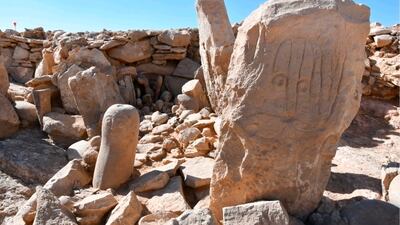
A team of Jordanian and French archaeologists said they found a 9,000-year-old shrine at a Neolithic campsite near large structures known as 'kites' in Jordan's Eastern Desert. AP -
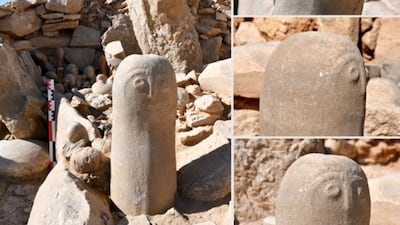
The Jordanian Antiquities Authority announced that antiquities linked to hunter-gatherers and dating to the Neolithic era (4500BC to 9000 BC) were discovered in Badia, in south-east of the kingdom. AFP


At a presentation at the Jordanian Antiquities Department on Tuesday, mission officials announced the discovery of eight traps stretching along a 20km south to north axis near the border with Saudi Arabia, and signs of early cultural development scattered in the earth nearby.
“They’re the oldest huge human structures known to date,” said archaeologist Wael Abu Aziza.
The findings shed light on little-known hunting communities in the Middle East that lived away from the centre of development in the Fertile Crescent, the area constituting parts of Iraq, Syria, Lebanon Palestine, Israel, Jordan and Egypt today.
The Fertile Crescent was a centre of innovation in the ancient world, making crucial contributions to farming, the establishment of cities, legal systems and the social contract.
During the Bronze Age Akkadian and Assyrian empire periods, for example, the world's largest city was built in Babylon, in modern-day Iraq more than four thousand years ago.
Archaeologists said the Jabal Khashabiyeh discoveries show how hunting communities, that predate the Assyrians by several thousand years and were far less developed, were displaying signs of what we now see as civilisation.
The traps — comprising stone walls and deep holes — have been known as ‘desert kites’ since their discovery from the air in the early 20th century in the Levant and other parts of Asia.
However, the first discovered kites date back to between 4,000 and 3,000BC, later than the 7,000 BC desert kites the mission is working on in southern Jordan, Mr Abu Aziza said.
The desert kites were open from one side to catch animals usually coming from the east. Hunters would then surround the animals and push them into the holes.
The hunters lived in semi-circular rooms in camps next to the traps, and exported their output to western regions in the Fertile Crescent.
They appear to have worked hard, carefully planning and designing the traps. Flint tools and large amounts of gazelle bone were found at one camp, as well as a sketch of desert kites etched on stone, and a stone model of it.
“The bones were leftovers from processing the prey,” said Mohammad Tarawneh, another mission archaeologist.
But the inhabitants of Jabal Khashabiyeh sought variation in their lives, and might have only lived in the camps on seasonal bases.
Among the artefacts brought from the site to Amman were four stone toys and two stone faces.
One of the faces was etched into a rectangular stone and has large eyes and vertical lines on its forehead. The other face is carved on a cylindrical stone.
Rituals were also performed, although their nature is not known.
Almost 150 snail-shaped marine fossils were found in the middle of the stone floor of the camp, next to what may have been an altar.
“They were arranged vertically and very carefully in a certain direction,” Mr Tarawneh said.
Jordan is more famous for its Roman and Nabataean ruins, such as Petra in the south and Jerash in the north, than prehistorical sites.
But Jabal Khashabiyeh shows the “unique cultural and historical richness of Jordan and remind us, if need be, that so much is yet to be discovered,” said French ambassador Veronique Vouland-Aneini.
Most of the area occupying the modern-day kingdom was on the periphery of the advanced economies of the Fertile Crescent.
Ammar Khammash, a prominent Jordanian architect, said significant hunting economies in the Middle East have been ignored compared to the Fertile Crescent, where agriculture was practically invented on what is now the flood plains of the Tigris and Euphrates.
“We usually time the start of architecture with agriculture,” Mr Khammash said. “Here we have architecture tied with hunting.”

