Sunniva Rose in Beirut, Hamza Hendawi in Cairo, Sinan Mahmoud in Baghdad, Khaled Yacoub Oweis, Nada AlTaher, Olivia Cuthbert and James Haines-Young
As vice president, Joe Biden was part of Barack Obama’s ill-fated 2012 “pivot towards Asia” and away from the Middle East as the outbreak of the Arab uprisings drew Washington’s attention firmly back to the Middle East.
Eight years later, President Biden will come into a region still in flux, with some countries beset by conflict, sectarianism and division, and others forging their own path forward. He will also be stepping in at a time when the US has retreated politically from the region when it comes to the conflicts in Syria, Libya and Yemen. On Iran, President Donald Trump has left the new administration with a network of tough sanctions and close ties with countries that share the view that Iran is a destabilising force in the region. But, it remains to be seen if Mr Biden will maintain this or work to unravel the web of measures.
Here is a rundown of some of the core issues that a Biden administration will have to work on in the Middle East after January 20:
Iran: sanctions and the JCPOA
Joe Biden has already indicated that US foreign policy on Iran under him will shift from Donald Trump’s “maximum pressure” campaign, which has contributed to an escalation of tension between the two countries.
Mr Trump’s unilateral withdrawal from the 2015 Joint Comprehensive Plan of Action (JCPOA), known as the Iran nuclear deal – forged during Barack Obama’s presidency – was opposed by other signatories including Germany, France the UK and Russia.
Compounding the strained diplomatic ties with Iran, which peaked following the assassination of senior Iranian general and Quds Force commander Qassem Suleimani in a US drone strike in January, the Trump administration has imposed an ongoing series of sanctions, placing Iran’s struggling economy under further strain.
Ahead of the November 3 US Presidential election, the US Treasury imposed counterterrorism sanctions on key players in Iran's oil sector for supporting the Quds Force, in what analysts said was a move by the Trump administration to make it harder to lift sanctions if Mr Biden won the White House.
This approach may ease under Mr Biden, who has said he would rejoin the JCPOA if Iran reverses the nuclear enrichment it had done outside the framework of the agreement. It remains unclear if this will happen and Iran has already signalled that is not interested in new negotiations.
-
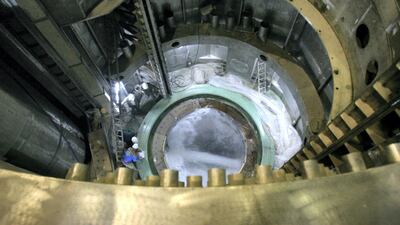
Russian contractors work at the Bushehr nuclear reactor site in 2007. The plant opened four years later. Bloomberg -
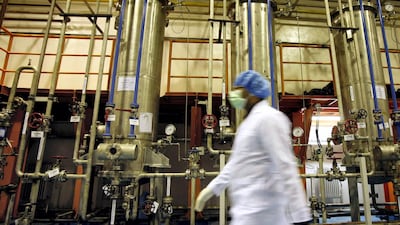
An Iranian technician at the International Atomic Energy Agency inspects the country's Isfahan plant in 2007. Tehran is no longer co-operating with the agency at nuclear sites across the country. EPA -

Workers wait to begin constructing a second reactor at the Bushehr nuclear power plant in 2019. AFP -
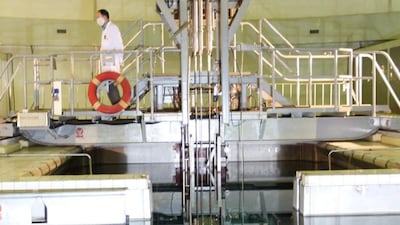
A metal-encased rod with 20 per cent enriched nuclear fuel is inserted into a reactor in Tehran in 2012. AFP -
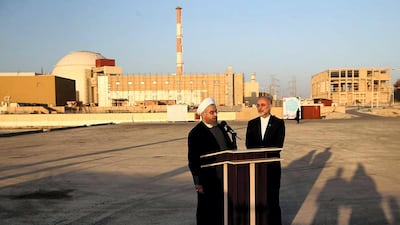
Fomer Iranian President Hassan Rouhani and the country's Atomic Energy Organisation chief Ali Akbar Salehi speak at the Bushehr nuclear site in 2015. AFP -
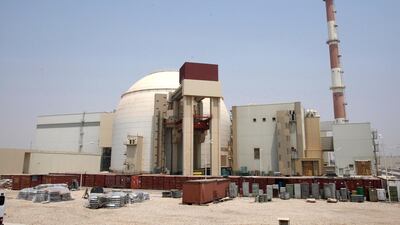
Iran's Bushehr nuclear plant has been restarted. EPA -
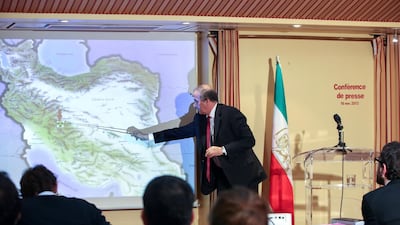
Mehdi Abrichamtchi, chairman of the Peace and Security Committee at the National Council of Resistance of Iran, shows journalists the location of a secret nuclear site in Iran in 2013. AFP -
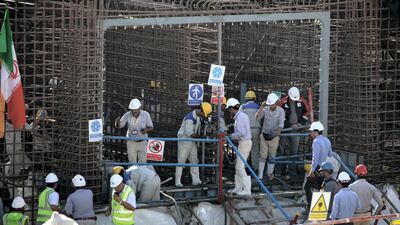
Workers prepare to begin the construction of a second reactor at the Bushehr site. AFP


Iran too has repeatedly said that its ballistic missile system is a non-negotiable “red line” so the pressure on Mr Biden to find a middle ground that satisfies both parties will be challenging.
The existing sanctions may provide some leverage for the president-elect to restore the terms of the deal.
But with Iranian presidential elections in early 2021, and hardliners hoping to build on their gains in the parliamentary elections last Spring, the time frame is short for Mr Biden and his team to convince Iran that they would be a more reliable partner within the agreement than Mr Trump.
Lebanon: Hezbollah and corruption
The results of the US elections have been closely scrutinised in Lebanon, where Prime Minister-designate Saad Hariri is preparing his return to office for the fourth time. As politicians bicker among themselves, Lebanon sinks deeper into its worst-ever economic and financial crisis that has already pushed over half the population into poverty.
The US has complicated and long-standing ties with Lebanon. It is the top donor to the Lebanese army, investing over $1.82 billion in training and equipment between 2010 and 2019. At the same time, US sanctions against Iran-backed Hezbollah have a far-reaching impact on local politics.
Sanctions have increased under Mr Trump’s presidency and were widened to include Hezbollah’s political allies. Hezbollah’s biggest Christian ally and a son-in-law of the president, Gebran Bassil – one of Lebanon’s most unpopular politicians – was targeted for corruption in early November.
Hezbollah and its partners hope that Mr Biden will adopt a more lenient approach because Democrats are historically more open to compromise in the region than Republicans.
The US has also been a key player in bringing Lebanon and Israel to the table to delineate their disputed maritime border on October 14 after nearly a decade of negotiations. An 860 square kilometre stretch of the Mediterranean Sea is at the centre of the dispute between the two countries. Four meetings have taken place so far and they are expected to continue under Mr Biden's administration.
Lebanon officially hosts close to a million Syrian refugees, representing roughly one-quarter of its population. Syrian President Bashar Al Assad's ally Russia has been pushing for a massive return of refugees, which has failed up to now mostly because those displaced peoples fear punitive measures upon their return.
Part of the fate of Syrian refugees depends on Mr Biden's attitude towards Russia. It remains likely that Mr Biden's administration will keep demanding Mr Al Assad's departure before financing the reconstruction of the Syrian economy or supporting the return of refugees.
-
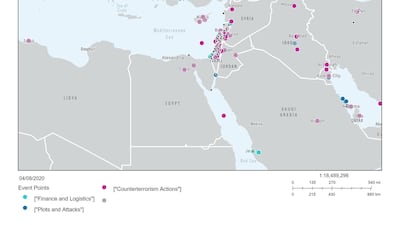
The map details Hezbollah activity in the Middle East. Courtesy of The Washington Institute for Near East Policy -

Extensive activies were also recorded in Latin America. Courtesy of The Washington Institute for Near East Policy -
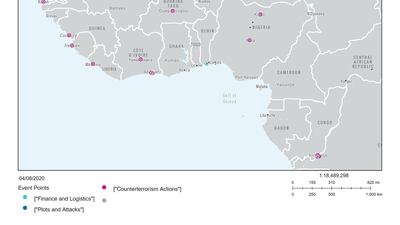
The group is also active in West Africa. Courtesy of The Washington Institute for Near East Policy -

The map reveals extensive funding operations centred on Europe. Courtesy of The Washington Institute for Near East Policy -
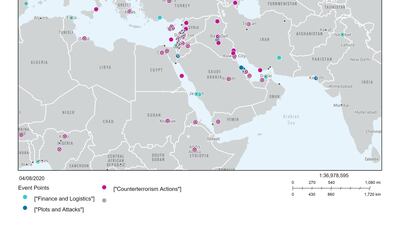
The new map details Hezbollah activity in the Middle East. Courtesy of The Washington Institute for Near East Policy


Iraq: Iranian influence and US troops
A complex political landscape awaits the president-elect of the United States in war-ravaged Iraq, a country caught in the middle of US-Iran tensions and gripped by complex security, economic and social woes.
But, this is familiar terrain for Mr Biden, who was overseeing the Iraq portfolio during the Obama administration. He oversaw the withdrawal of 150,000 US forces from Iraq by the end of 2011 – fulfilling one of Mr Obama’s campaign promises to end the war.
As a senator, Mr Biden was one of the many high-profile Democrats who voted to authorise the Iraq war after the 9/11 attacks.
Among Iraqis, he is best known for his plan in the aftermath of the war to decentralise Iraq by splitting it crudely along ethnic and religious lines, creating two separate regions for the majority Shiite and minority Sunni population in addition to the existing Kurdish one in the north.
In the four years since Mr Obama left the White House, the existing divisions have become more entrenched, deepened by the rise and fall of ISIS, foreign interference, widespread anti-government protests and the impact of Covid-19.
Previous US administrations have failed to contain Iran’s mounting interference in Iraq. In January, tensions between the two countries spiked after a US drone strike killed Suleimani, Iran’s top military commander, along with senior Iraqi militia leader Abu Mahdi Al Muhandis at Baghdad Airport.
Iran-backed Shiite political parties and militias have since increased their call for US troops to withdraw from the country.
During his presidential campaign, Mr Biden has supported reducing the presence of US troops in the Middle East, including Iraq, but said he would keep a small force to prevent extremists from posing a threat to the US and its allies.
He now faces a difficult balancing act in steering the US relationship with Iraq while navigating Iran’s extensive influence in the country at a time when US-Iran relations have soured significantly under the Trump administration.
He has long said he is a strong supporter of the Kurds. He described long-time president of the Kurdish region of Iraq, Masoud Barzani, as “a good friend of mine”.
Syria: Assad, Kurdish militia and US sanctions
The US alliance with the Kurdish militia that now rules large parts of eastern Syria, the centre of the country’s oil production, started when Mr Biden was vice president in the Obama administration.
Wavering by President Donald Trump on whether to keep US forces deployed in the region contributed to the strengthening of ties between the militia, under the umbrella of the Syrian Democratic Forces but dominated by a group known as the People Protection Units (YPG), and the Assad regime and Russia.
-
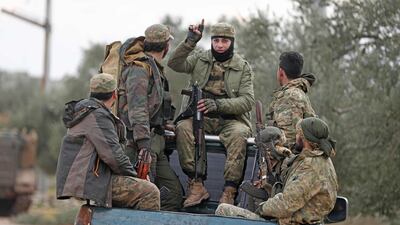
Turkish-backed Syrian fighters ride in the back of a pickup truck in the town of Sarmin, about 8 kilometres southeast of the city of Idlib in northwestern Syria. AFP -
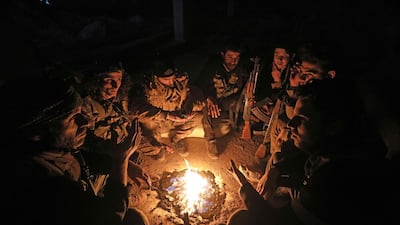
Turkish-backed Syrian fighters gather around fire in the town of Sarmin, about 8 kilometres southeast of the city of Idlib in northwestern Syria. AFP -
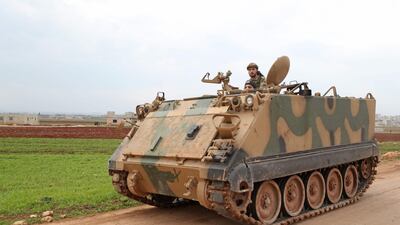
Turkish-backed Syrian fighters ride atop an armoured personnel carrier in the town of Sarmin, about 8 kilometres southeast of the city of Idlib in northwestern Syria. AFP -
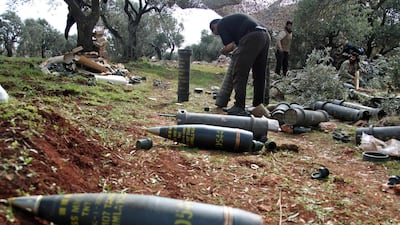
Turkish-backed Syrian fighters prepare to fire shells at a position near the village of al-Nayrab, about 14 kilometres southeast of the city of Idlib in northwestern Syria, amid clashes with government forces. AFP -
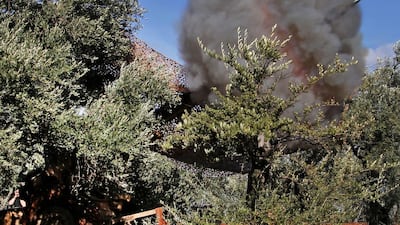
Turkish-backed Syrian fighters fire a shell at position near the village of al-Nayrab, about 14 kilometres southeast of the city of Idlib in northwestern Syria, amid clashes with government forces. AFP -
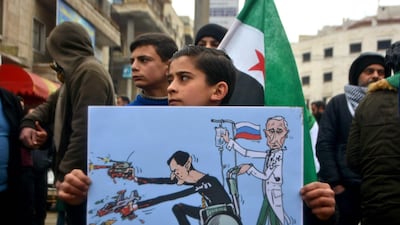
A young Syrian holds a caricature representing Syrian President Bashar al-Assad and Russian President Vladimir Putin as he takes part in a demonstration to protest against the continuing assault by the Syrian regime and Russian forces on the last rebel-held pockets in the northern Idlib province, in the city of Idlib. AFP -

A picture taken from the town of Sarmin in northwestern Syria shows smoke billowing over the village of Qaminas, about 6 kilometres southeast of Idlib city, following reported Syrian air strikes. AFP -
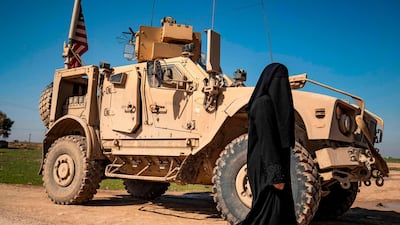
A US military armoured vehicle patrols on the outskirts of Tal Tamr town along the M4 highway in the northeastern Syrian Hasakeh province, near the border with Turkey. AFP -
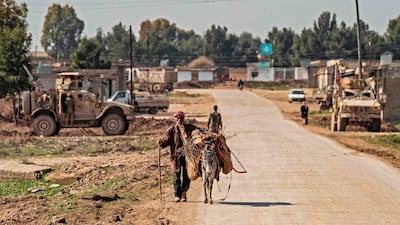
US military armoured vehicles patrol on the outskirts of Tal Tamr town along the M4 highway in the northeastern Syrian Hasakeh province, near the border with Turkey. AFP -
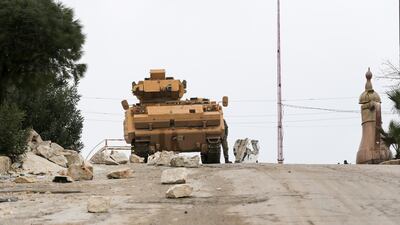
Turkish soldiers and a tank at the Ad Dana district of north-east Idlib, Syria. EPA -

A US soldier rides atop a military armoured vehicle on the outskirts of Tal Tamr town along the M4 highway in the northeastern Syrian Hasakeh province, near the border with Turkey. AFP


Mr Biden is seen as a more reliable ally by the YPG, especially since he has taken a hard line in the campaign against President Tayyip Erdogan, who received a tacit go-ahead from President Trump to launch a military operation against Kurdish fighters in northeast Syria last year.
In the northwest, the Al Qaeda-linked Hayat Tahrir Al Sham (HTS) remains in control of most of the opposition areas around Idlib on the border with Turkey. The US-led international coalition largely destroyed ISIS in Syria and Iraq but has been conducting strikes against HTS and its allies for years.
The US continues to place pressure on Mr Al Assad and his ruling elite. Late last year the US Congress imposed toughened sanctions on the Syrian regime in the form of the Caesar Act, which future administrations, including that of Joe Biden, will be bound by.
Mr Biden has made it clear that he would re-enter the 2015 nuclear accord with Iran, a main backer of Syrian President Bashar Al Assad. A lessening of US sanctions on Iran could allow more resources to be sent to back Mr Al Assad and other regional allies. A key criticism of the 2015 deal is that it did not address Iran’s regional destabilisation.
Palestine: renewed engagement and Israel relations
Mr Biden’s US election victory is unlikely to see any dramatic changes on the Israel-Palestinian conflict – he has said would likely leave the US embassy that Mr Trump moved to Jerusalem as it is. He is also unlikely to stop the traditional US veto at the UN Security Council of resolutions critical of illegal settlements and other issues.
On the peace process, Mr Biden will likely return to multilateral diplomacy, the Quartet and UN mediation. While it paves the way for renewed engagement between Washington and the Palestinians, the multilateral system has failed to achieve tangible results since the Oslo Accords in the 1990s. It remains unclear to what extent Mr Biden will push the issue given the seemingly intractable nature of the conflict.
On Sunday, Palestinian President Mahmoud Abbas showed his willingness to work with the incoming president after severing ties with the Trump administration. In a statement congratulating Mr Biden, he called on the president-elect to "to strengthen the Palestinian-American relationship," and to strive for Middle East "peace, stability and security."
As a strong supporter of Israel, Mr Biden is unlikely to oversee a departure from the traditional US role as protector of Israel in the region. In a 2015 speech, while serving as Barack Obama's vice president, Mr Biden said the United States was wedded to a "sacred promise to protect the homeland of the Jewish people". Under the Obama-Biden administration, the US signed a $38 billion military aid pact with Israel – the biggest pledge of bilateral military assistance in America’s history.
However, he is expected to take a more even-handed approach towards the Palestine and re-establish ties with the Palestinian Authority.
But the election could be a setback for Prime Minister Benjamin Netanyahu – a close ally of the outgoing US president – despite Mr Biden’s close ties to the Israeli leader.
After taking office, Mr Trump drew praise from the Israeli premier by unilaterally withdrawing from the 2015 Iran nuclear deal and moving the US Embassy to Jerusalem, recognising the city as Israel’s capital and prompting the Palestinians to sever ties with the US.
Mr Trump's Middle East peace plan, unveiled last January, was rejected outright by the Palestinians who were not involved in negotiations.
Mr Biden has expressed opposition to Israeli settlements in the West Bank, which Mr Trump avoided criticising. The last four years have seen some of the fastest and largest expansions of settlement building in decades, monitors say, but it is unclear how tough a line on this Mr Biden will take.
The president-elect's long-standing ties with Mr Netanyahu could also be shaken if Mr Biden follows through on his promise to re-enter the Iran nuclear deal.
Israeli protesters calling for Mr Netanyahu's resignation at weekly demonstrations last Saturday over his handling of the coronavirus crisis and ongoing corruption charges expressed hope that Mr Trump's defeat would spell trouble for the right-wing leader, holding banners that read "Trump Down, Bibi to go" and "Netanyahu, You're Next" following Mr Biden's victory.
Egypt: Nile Dam negotiations and East Mediterranean gas
Pro-government Egyptian media was hostile towards Mr Biden during the election campaign and instead voiced support for US President Donald Trump, who has forged close ties with Egyptian leader Abdel Fattah El Sisi during his four years in office. Egypt, which has long been among Washington’s closest Arab allies, has received billions of dollars’ worth of US military aid over the decades. It will be looking to continue this arrangement, which underpins its peace deal with Israel, under the Biden administration.
While Mr Trump was accused of being soft on human rights violations in the Middle East, and was criticised by rights groups and UN agencies for it, Mr Biden has stated that it would be central to his Middle East agenda.
Mr Biden is also expected to restore the US position as a neutral mediator in the Grand Ethiopian Renaissance Dam talks after Mr Trump’s recent outburst that Cairo “will end up blowing up the dam” if negotiations continue to be fruitless as he appeared to back Egypt’s position. Cairo has remained publicly silent on the remark.
-
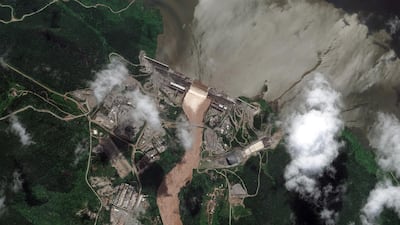
A satellite image shows the Grand Ethiopian Renaissance Dam on the Blue Nile river in the Benishangul-Gumuz region of Ethiopia on Tuesday, July 28, 2020. Maxar Technologies via AP -
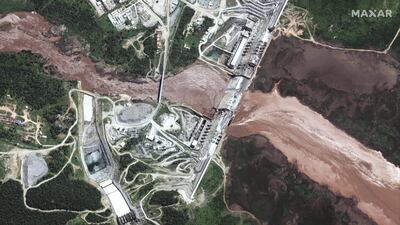
A satellite image of the Grand Ethiopian Renaissance Dam and reservoir behind it on June 26, 2020. Maxar Technologies via Reuters -
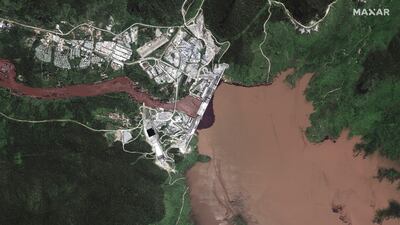
A satellite image of the Grand Ethiopian Renaissance Dam and reservoir behind it 16 days later on July 12, 2020. Maxar Technologies via Reuters -
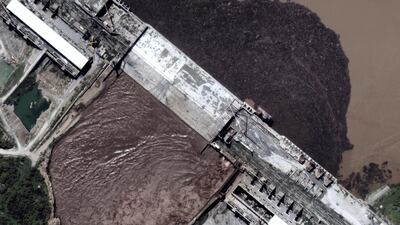
The Grand Ethiopian Renaissance Dam and the Blue Nile River in Ethiopia on July 12, 2020. Maxar Technologies via Reuters -
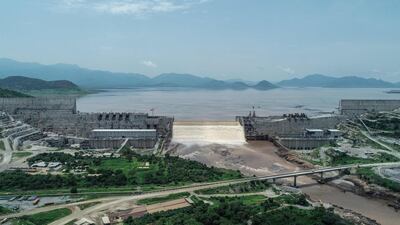
An aerial view Grand Ethiopian Renaissance Dam on the Blue Nile River in Guba, northwest Ethiopia, on the 20th July. AFP -
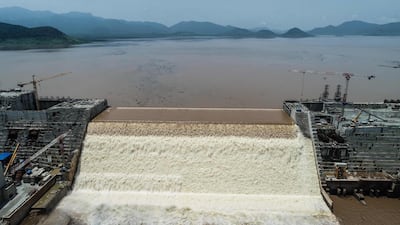
An aerial view Grand Ethiopian Renaissance Dam on the Blue Nile River in Guba, northwest Ethiopia, on the 20th July. AFP -
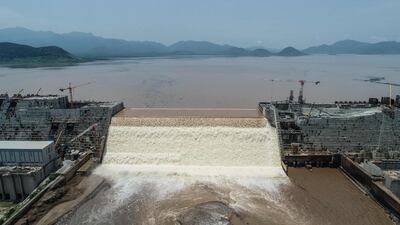
An aerial view Grand Ethiopian Renaissance Dam on the Blue Nile River in Guba, northwest Ethiopia, on the 20th July. AFP


In the Eastern Mediterranean, Cairo hopes Mr Biden will help deter Turkey’s attempts to muscle in on joint efforts by Egypt, Cyprus and Greece to turn the region into a major energy hub following the discovery of massive natural gas reserves. Mr Biden, Cairo hopes, would help restrain Ankara and dissuade it from illegal exploration for gas off the shores of Cyprus and in Greece’s Free Economic Zone.
Greek Prime Minister Kyriakos Mitsotakis said on Wednesday during a meeting with Mr El Sisi that both countries will welcome more decisive US involvement in the region and the Eastern Mediterranean under Mr Biden.
Mr Biden has long criticised Turkey’s role in the region over interventions in Iraq, Syria and Libya, as well as President Recep Tayyip Erdogan for being increasingly authoritarian and for the key Nato ally’s strengthening ties with Russia.
Egypt has publicly given Mr Trump’s Middle East plan to resolve the Palestinian-Israeli conflict lukewarm support while repeating that it supports a peace plan that includes the Palestinians.
While Mr Biden has a track record of firm support for Israel, Egypt anticipates a more balanced approach from a Biden administration to finding a resolution to the Israel-Palestine conflict, which Cairo has long viewed as a source of many of the troubles plaguing the Middle East.

