Dawn on Thursday will see Sunnis and some Shiites across Iraq begin to mark the Eid holiday that brings Ramadan to a close.
With no moon visible on Tuesday after Maghreb prayers, Wednesday was marked as the 30th day of Ramadan.
The people are fed up and that they want to buy new clothing and to have some joy, even if they spend Eid at home
Despite Iraqi authorities announcing a 10-day Covid-19 lockdown from May 12 that runs straight through a holiday usually marked by mass gatherings and shopping trips, many said they would still enjoy the occasion.
Shopping malls, restaurants, cafes, cinemas, parks, swimming pools and gyms are all closed, according to the country’s Higher Committee for Health and Public Safety said. Social events, such as wedding parties or funerals, cannot be held.
But pharmacies, bakeries, supermarkets and groceries are exempt from the lockdown and restaurants can make food deliveries.
During Ramadan, authorities imposed a nightly lockdown from 8pm to 5am, and a 24-hour lockdown applied on Fridays and Saturdays.
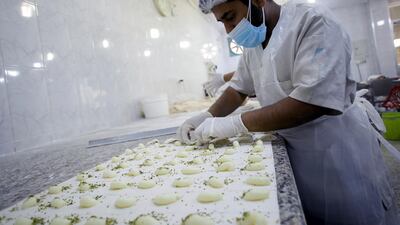
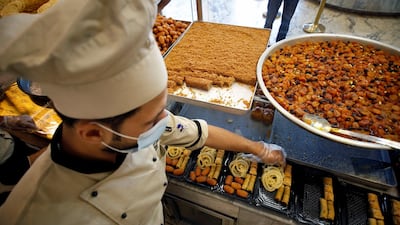
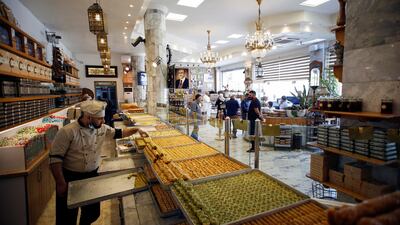
Despite the rules, hundreds have still flocked to the markets every day to buy new clothing and sweets.
"Although the new measures have affected our mood, but we will celebrate," Thurya Jabir, a 44-year-old housewife told The National.
The mother of three was in Bagdad’s upscale Mansour commercial district, shopping for the holiday along with her daughter-in-law.
“We are looking for clothing for home such as tracksuits since we are going to spend the holiday in house,” added Ms Jabir, laughing.
But she said her family will not give up on Eid Al Fitr traditions.
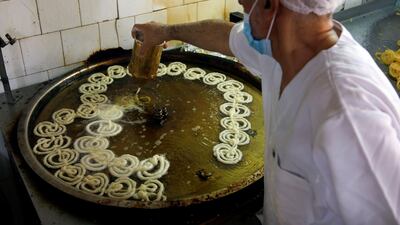
They have still prepared Kleicha, an Iraqi date cookie, and plan to cook “our special and tasty dishes” such as Quzi, lamb and rice, Dolma, meat and rice stuffed grape leaves, and Biryani, she said.
Undeterred by the lockdown, she said they still plan to meet up with family.
“We will exchange visits with relatives whenever we can and throw a banquet to celebrate my grandson's birthday,” she added.
The sentiment has given hope to shop owners who have stack up on goods for the holiday.
“The turnout is good nowadays,” said Abdullah Wisam as he stood outside his women’s clothing shop.
“The people are fed up and that they want to buy new clothing and to have some joy, even if they spend Eid at home,” Mr Wisam, 23, said.
He said he imported $38,000 worth of goods from Turkey before the holiday.
“Sales have decreased by nearly 30 per cent compare to last year, but people are still coming and get money out of their pockets and that’s encouraging,” he said.
He and other shop owners are also encouraged by the help of the security forces, allowing them to stay late despite the partial lockdown as some shoppers show up during the night.
The nation of 40 million people is withering a severe financial crisis resulting from the impact of plummeting oil prices on its oil-dependent economy and Covid-19 measures that have affected businesses.
To cope with the acute economic crisis, the government devalued the currency in December, pushing up prices by at least 25 per cent as Iraq depends heavily on imported goods and raw materials.
The pandemic and austerity measures pushed the national poverty rate last year to 31.7 per cent, up from 20 per cent in 2018.
Together with the deteriorated security situation – mainly because of a recent ISIS resurgence and assassinations of pro-reform activists – and the country’s political wrangling have left some Iraqis with no mood to celebrate.
“There is no Eid in Iraq for more than 30 years now,” said retired teacher Azhar Sadiq, 65.
“We have only wars, killings, kidnappings, chaos and lack of security,” she said. “It’s hard to find joy in the current situation. Eid and its festive atmosphere are gone a long time ago.”
Her family planned to spend the holiday in the northern self-ruled Kurdish region, but called off the trip due to the full lockdown.
She said she wasn’t in the mood to buy new clothing and didn’t even make Kleicha and instead bought them from bakeries.
“What we have now is only the name of Eid,” she laments.

About Housecall
Date started: July 2020
Founders: Omar and Humaid Alzaabi
Based: Abu Dhabi
Sector: HealthTech
# of staff: 10
Funding to date: Self-funded
Ten tax points to be aware of in 2026
1. Domestic VAT refund amendments: request your refund within five years
If a business does not apply for the refund on time, they lose their credit.
2. E-invoicing in the UAE
Businesses should continue preparing for the implementation of e-invoicing in the UAE, with 2026 a preparation and transition period ahead of phased mandatory adoption.
3. More tax audits
Tax authorities are increasingly using data already available across multiple filings to identify audit risks.
4. More beneficial VAT and excise tax penalty regime
Tax disputes are expected to become more frequent and more structured, with clearer administrative objection and appeal processes. The UAE has adopted a new penalty regime for VAT and excise disputes, which now mirrors the penalty regime for corporate tax.
5. Greater emphasis on statutory audit
There is a greater need for the accuracy of financial statements. The International Financial Reporting Standards standards need to be strictly adhered to and, as a result, the quality of the audits will need to increase.
6. Further transfer pricing enforcement
Transfer pricing enforcement, which refers to the practice of establishing prices for internal transactions between related entities, is expected to broaden in scope. The UAE will shortly open the possibility to negotiate advance pricing agreements, or essentially rulings for transfer pricing purposes.
7. Limited time periods for audits
Recent amendments also introduce a default five-year limitation period for tax audits and assessments, subject to specific statutory exceptions. While the standard audit and assessment period is five years, this may be extended to up to 15 years in cases involving fraud or tax evasion.
8. Pillar 2 implementation
Many multinational groups will begin to feel the practical effect of the Domestic Minimum Top-Up Tax (DMTT), the UAE's implementation of the OECD’s global minimum tax under Pillar 2. While the rules apply for financial years starting on or after January 1, 2025, it is 2026 that marks the transition to an operational phase.
9. Reduced compliance obligations for imported goods and services
Businesses that apply the reverse-charge mechanism for VAT purposes in the UAE may benefit from reduced compliance obligations.
10. Substance and CbC reporting focus
Tax authorities are expected to continue strengthening the enforcement of economic substance and Country-by-Country (CbC) reporting frameworks. In the UAE, these regimes are increasingly being used as risk-assessment tools, providing tax authorities with a comprehensive view of multinational groups’ global footprints and enabling them to assess whether profits are aligned with real economic activity.
Contributed by Thomas Vanhee and Hend Rashwan, Aurifer
COMPANY%20PROFILE
%3Cp%3E%3Cstrong%3EName%3A%20%3C%2Fstrong%3EKinetic%207%3Cbr%3E%3Cstrong%3EStarted%3A%3C%2Fstrong%3E%202018%3Cbr%3E%3Cstrong%3EFounder%3A%3C%2Fstrong%3E%20Rick%20Parish%3Cbr%3E%3Cstrong%3EBased%3A%3C%2Fstrong%3E%20Abu%20Dhabi%2C%20UAE%3Cbr%3E%3Cstrong%3EIndustry%3A%3C%2Fstrong%3E%20Clean%20cooking%3Cbr%3E%3Cstrong%3EFunding%3A%3C%2Fstrong%3E%20%2410%20million%3Cbr%3E%3Cstrong%3EInvestors%3A%3C%2Fstrong%3E%20Self-funded%3C%2Fp%3E%0A
More from Neighbourhood Watch:
Citadel: Honey Bunny first episode
Directors: Raj & DK
Stars: Varun Dhawan, Samantha Ruth Prabhu, Kashvi Majmundar, Kay Kay Menon
Rating: 4/5
Killing of Qassem Suleimani
Key figures in the life of the fort
Sheikh Dhiyab bin Isa (ruled 1761-1793) Built Qasr Al Hosn as a watchtower to guard over the only freshwater well on Abu Dhabi island.
Sheikh Shakhbut bin Dhiyab (ruled 1793-1816) Expanded the tower into a small fort and transferred his ruling place of residence from Liwa Oasis to the fort on the island.
Sheikh Tahnoon bin Shakhbut (ruled 1818-1833) Expanded Qasr Al Hosn further as Abu Dhabi grew from a small village of palm huts to a town of more than 5,000 inhabitants.
Sheikh Khalifa bin Shakhbut (ruled 1833-1845) Repaired and fortified the fort.
Sheikh Saeed bin Tahnoon (ruled 1845-1855) Turned Qasr Al Hosn into a strong two-storied structure.
Sheikh Zayed bin Khalifa (ruled 1855-1909) Expanded Qasr Al Hosn further to reflect the emirate's increasing prominence.
Sheikh Shakhbut bin Sultan (ruled 1928-1966) Renovated and enlarged Qasr Al Hosn, adding a decorative arch and two new villas.
Sheikh Zayed bin Sultan (ruled 1966-2004) Moved the royal residence to Al Manhal palace and kept his diwan at Qasr Al Hosn.
Sources: Jayanti Maitra, www.adach.ae
Our legal consultant
Name: Dr Hassan Mohsen Elhais
Position: legal consultant with Al Rowaad Advocates and Legal Consultants.
Tori Amos
Native Invader
Decca
COMPANY%20PROFILE
%3Cp%3E%3Cstrong%3EName%3A%3C%2Fstrong%3E%20Floward%0D%3Cbr%3E%3Cstrong%3EBased%3A%20%3C%2Fstrong%3ERiyadh%2C%20Saudi%20Arabia%0D%3Cbr%3E%3Cstrong%3EFounders%3A%20%3C%2Fstrong%3EAbdulaziz%20Al%20Loughani%20and%20Mohamed%20Al%20Arifi%0D%3Cbr%3E%3Cstrong%3ESector%3A%20%3C%2Fstrong%3EE-commerce%0D%3Cbr%3E%3Cstrong%3ETotal%20funding%3A%20%3C%2Fstrong%3EAbout%20%24200%20million%0D%3Cbr%3E%3Cstrong%3EInvestors%3A%20%3C%2Fstrong%3EAljazira%20Capital%2C%20Rainwater%20Partners%2C%20STV%20and%20Impact46%0D%3Cbr%3E%3Cstrong%3ENumber%20of%20employees%3A%20%3C%2Fstrong%3E1%2C200%3C%2Fp%3E%0A
Haemoglobin disorders explained
Thalassaemia is part of a family of genetic conditions affecting the blood known as haemoglobin disorders.
Haemoglobin is a substance in the red blood cells that carries oxygen and a lack of it triggers anemia, leaving patients very weak, short of breath and pale.
The most severe type of the condition is typically inherited when both parents are carriers. Those patients often require regular blood transfusions - about 450 of the UAE's 2,000 thalassaemia patients - though frequent transfusions can lead to too much iron in the body and heart and liver problems.
The condition mainly affects people of Mediterranean, South Asian, South-East Asian and Middle Eastern origin. Saudi Arabia recorded 45,892 cases of carriers between 2004 and 2014.
A World Health Organisation study estimated that globally there are at least 950,000 'new carrier couples' every year and annually there are 1.33 million at-risk pregnancies.
500 People from Gaza enter France
115 Special programme for artists
25 Evacuation of injured and sick
The specs
- Engine: 3.9-litre twin-turbo V8
- Power: 640hp
- Torque: 760nm
- On sale: 2026
- Price: Not announced yet
Infiniti QX80 specs
Engine: twin-turbocharged 3.5-liter V6
Power: 450hp
Torque: 700Nm
Price: From Dh450,000, Autograph model from Dh510,000
Available: Now
SCHEDULE
Saturday, April 20: 11am to 7pm - Abu Dhabi World Jiu-Jitsu Festival and Para jiu-jitsu.
Sunday, April 21: 11am to 6pm - Abu Dhabi World Youth (female) Jiu-Jitsu Championship.
Monday, April 22: 11am to 6pm - Abu Dhabi World Youth (male) Jiu-Jitsu Championship.
Tuesday, April 23: 11am-6pm Abu Dhabi World Masters Jiu-Jitsu Championship.
Wednesday, April 24: 11am-6pm Abu Dhabi World Professional Jiu-Jitsu Championship.
Thursday, April 25: 11am-5pm Abu Dhabi World Professional Jiu-Jitsu Championship.
Friday, April 26: 3pm to 6pm Finals of the Abu Dhabi World Professional Jiu-Jitsu Championship.
Saturday, April 27: 4pm and 8pm awards ceremony.
Avatar: Fire and Ash
Director: James Cameron
Starring: Sam Worthington, Sigourney Weaver, Zoe Saldana
Rating: 4.5/5
The five pillars of Islam
The Uefa Awards winners
Uefa Men's Player of the Year: Virgil van Dijk (Liverpool)
Uefa Women's Player of the Year: Lucy Bronze (Lyon)
Best players of the 2018/19 Uefa Champions League
Goalkeeper: Alisson (Liverpool)
Defender: Virgil van Dijk (Liverpool)
Midfielder: Frenkie de Jong (Ajax)
Forward: Lionel Messi (Barcelona)
Uefa President's Award: Eric Cantona
VEZEETA PROFILE
Date started: 2012
Founder: Amir Barsoum
Based: Dubai, UAE
Sector: HealthTech / MedTech
Size: 300 employees
Funding: $22.6 million (as of September 2018)
Investors: Technology Development Fund, Silicon Badia, Beco Capital, Vostok New Ventures, Endeavour Catalyst, Crescent Enterprises’ CE-Ventures, Saudi Technology Ventures and IFC
Jeff Buckley: From Hallelujah To The Last Goodbye
By Dave Lory with Jim Irvin
%20Ramez%20Gab%20Min%20El%20Akher
%3Cp%3E%3Cstrong%3ECreator%3A%3C%2Fstrong%3E%20Ramez%20Galal%3C%2Fp%3E%0A%3Cp%3E%3Cstrong%3EStarring%3A%3C%2Fstrong%3E%20Ramez%20Galal%3C%2Fp%3E%0A%3Cp%3E%3Cstrong%3EStreaming%20on%3A%20%3C%2Fstrong%3EMBC%20Shahid%3C%2Fp%3E%0A%3Cp%3E%3Cstrong%3ERating%3A%20%3C%2Fstrong%3E2.5%2F5%3C%2Fp%3E%0A
What the law says
Micro-retirement is not a recognised concept or employment status under Federal Decree Law No. 33 of 2021 on the Regulation of Labour Relations (as amended) (UAE Labour Law). As such, it reflects a voluntary work-life balance practice, rather than a recognised legal employment category, according to Dilini Loku, senior associate for law firm Gateley Middle East.
“Some companies may offer formal sabbatical policies or career break programmes; however, beyond such arrangements, there is no automatic right or statutory entitlement to extended breaks,” she explains.
“Any leave taken beyond statutory entitlements, such as annual leave, is typically regarded as unpaid leave in accordance with Article 33 of the UAE Labour Law. While employees may legally take unpaid leave, such requests are subject to the employer’s discretion and require approval.”
If an employee resigns to pursue micro-retirement, the employment contract is terminated, and the employer is under no legal obligation to rehire the employee in the future unless specific contractual agreements are in place (such as return-to-work arrangements), which are generally uncommon, Ms Loku adds.
Paatal Lok season two
Directors: Avinash Arun, Prosit Roy
Stars: Jaideep Ahlawat, Ishwak Singh, Lc Sekhose, Merenla Imsong
Rating: 4.5/5
More from Rashmee Roshan Lall
More from Neighbourhood Watch: