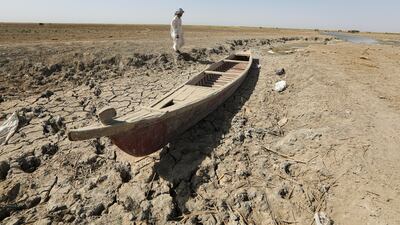
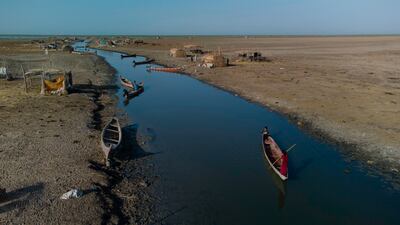
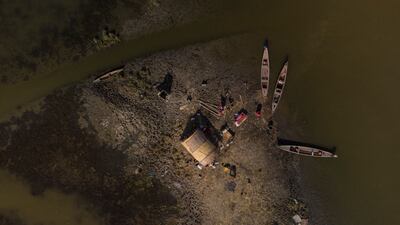
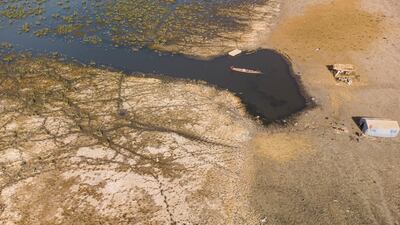
A report has shed light on the grim water situation across Iraq, 20 years after the US-led invasion toppled Saddam Hussein’s Baath regime.
Sewage and petrochemical pollution still contaminates domestic supply in major cities such as Basra, scene of a wave of protests in 2018 after more than 120,000 people were sickened by poor quality water.
The Iraqi Observatory for Human Rights on Thursday said “oil, medical waste and wastewater” was poured into Iraq’s rivers, the country’s main source of freshwater.
The situation made international headlines in 2018 when a sudden drop in the level of the Tigris and Euphrates allowed seawater to encroach waterways in the port city of Basra, where the two rivers form a third called the Shatt Al Arab.
That summer, Turkey had begun filling the Ilisu, the largest dam on the Tigris, which can hold up to 10 billion cubic metres of water. About 90 per cent of the Tigris’s annual flow originates in Turkey.
The Shatt Al Arab became highly saline, preventing the effective functioning of water treatment plants. An investigation by Human Rights Watch also highlighted petroleum and oil pollution in the city’s waterways, a problem affecting many communities across Iraq.
On Wednesday, Turkey’s President Recep Tayyip Erdogan met Iraqi Prime Minister Mohammed Shia Al Sudani and promised to release more water from Turkish dams. Iran also dams key tributaries of the Tigris, including the Zaab and Diyala rivers.
Water brought in
Many Iraqis now rely on water being transported in, but even this can be contaminated with pollutants, the report said. The authors spoke to a family in Basra that pay $7 for a tonne of water, or about 1,000 litres, enough to last a week but at a prohibitive cost for many in Iraq. The water is not fit for drinking but the family said it was adequate for personal hygiene.
Its report highlights similar challenges, not only in Basra but also in Kirkuk in northern Iraq, Dohuk, in the semi-autonomous Kurdish region of Iraq and Diyala, a province in neighbouring Iran.
Officials, activists and Iraqi Ministry of Water Resources staff members interviewed by the report authors said oil was contaminating irrigation water around Kirkuk, home to the oldest oilfield in Iraq, while Diyala, home to a river of the same name, had seen incidents of mass fish death because of pollution.
Vulnerable freshwater
Last month, a UN official told The National that about half of Iraq’s schools lacked basic water, sanitation and hygiene, putting at least 7.25 million Iraqi pupils at risk of disease.
Wednesday's report said the Iraqi government was aware of the issue, noting the Environment Ministry had commented on water pollution early this month, telling the Iraqiya news network that “the main reason causing water pollution is that most sewage wastewater pours into rivers without treatment”.
The ministry said water treatment works in Baghdad were overwhelmed and could only meet the needs of five million of the capital city’s eight million residents.
Despite record oil revenue this year, with monthly state profits frequently surpassing $10 billion, Iraq often fails to invest in critical infrastructure. Ministries instead prioritise salaries, hiring increasing numbers of staff.
As a result, when oil prices fall there is often no budget left for capital expenditure, as happened in 2014 and during the 2020 Covid-19 crisis.
Much critical water infrastructure in Iraq has subsequently been built with aid funding.
On the outskirts of Basra, a large $200 million water desalination plant was recently completed after years of delays, funded largely by Japan and intended to supply water for 400,000 residents in the city of 1.5 million.
The UN Development Project led reconstruction of most of Mosul’s water infrastructure, while in Basra, after Covid-19 had crushed Iraq's oil revenue, the US Agency for International Development restored water infrastructure for up to 650,000 people.
Along with support from the Netherlands, about one million people have benefitted from aid in Basra’s water sector, the UN project said.
The fragile situation Iraq now faces — after 20 years of conflict and several hundred billion dollars of oil revenue and reconstruction funds — is not dissimilar to the harsh conditions before the 2003 US-led invasion.
In January 2003, an international team of researchers from 20 NGOs conducted a nationwide study of water quality in Iraq and warned that 60 per cent of the population was at risk from nearly 500,000 tonnes of raw sewage pumped into Iraq’s waterways.
The report said inadequate power supply, from which Iraq still suffers, was one reason for the failure to treat the sewage.

Brief scores
Barcelona 2
Pique 36', Alena 87'
Villarreal 0
Tightening the screw on rogue recruiters
The UAE overhauled the procedure to recruit housemaids and domestic workers with a law in 2017 to protect low-income labour from being exploited.
Only recruitment companies authorised by the government are permitted as part of Tadbeer, a network of labour ministry-regulated centres.
A contract must be drawn up for domestic workers, the wages and job offer clearly stating the nature of work.
The contract stating the wages, work entailed and accommodation must be sent to the employee in their home country before they depart for the UAE.
The contract will be signed by the employer and employee when the domestic worker arrives in the UAE.
Only recruitment agencies registered with the ministry can undertake recruitment and employment applications for domestic workers.
Penalties for illegal recruitment in the UAE include fines of up to Dh100,000 and imprisonment
But agents not authorised by the government sidestep the law by illegally getting women into the country on visit visas.
Racecard
5pm: Al Maha Stables – Maiden (PA) Dh80,000 (Turf) 1,600m
5.30pm: Wathba Stallions Cup – Maiden (PA) Dh70,000 (T) 1,600m
6pm: Emirates Fillies Classic – Prestige (PA) Dh100,000 (T) 1,600m
6.30pm: Emirates Colts Classic – Prestige (PA) Dh100,000 (T) 1,600m
7pm: The President’s Cup – Group 1 (PA) Dh2,500,000 (T) 2,200m
7.30pm: The President’s Cup – Listed (TB) Dh380,000 (T) 1,400m
What is Reform?
Reform is a right-wing, populist party led by Nigel Farage, a former MEP who won a seat in the House of Commons last year at his eighth attempt and a prominent figure in the campaign for the UK to leave the European Union.
It was founded in 2018 and originally called the Brexit Party.
Many of its members previously belonged to UKIP or the mainstream Conservatives.
After Brexit took place, the party focused on the reformation of British democracy.
Former Tory deputy chairman Lee Anderson became its first MP after defecting in March 2024.
The party gained support from Elon Musk, and had hoped the tech billionaire would make a £100m donation. However, Mr Musk changed his mind and called for Mr Farage to step down as leader in a row involving the US tycoon's support for far-right figurehead Tommy Robinson who is in prison for contempt of court.
Tips for used car buyers
- Choose cars with GCC specifications
- Get a service history for cars less than five years old
- Don’t go cheap on the inspection
- Check for oil leaks
- Do a Google search on the standard problems for your car model
- Do your due diligence. Get a transfer of ownership done at an official RTA centre
- Check the vehicle’s condition. You don’t want to buy a car that’s a good deal but ends up costing you Dh10,000 in repairs every month
- Validate warranty and service contracts with the relevant agency and and make sure they are valid when ownership is transferred
- If you are planning to sell the car soon, buy one with a good resale value. The two most popular cars in the UAE are black or white in colour and other colours are harder to sell
Tarek Kabrit, chief executive of Seez, and Imad Hammad, chief executive and co-founder of CarSwitch.com
Avatar: Fire and Ash
Director: James Cameron
Starring: Sam Worthington, Sigourney Weaver, Zoe Saldana
Rating: 4.5/5
The Case For Trump
By Victor Davis Hanson
UAE squad
Humaira Tasneem (c), Chamani Senevirathne (vc), Subha Srinivasan, NIsha Ali, Udeni Kuruppuarachchi, Chaya Mughal, Roopa Nagraj, Esha Oza, Ishani Senevirathne, Heena Hotchandani, Keveesha Kumari, Judith Cleetus, Chavi Bhatt, Namita D’Souza.
BEETLEJUICE BEETLEJUICE
Starring: Winona Ryder, Michael Keaton, Jenny Ortega
Director: Tim Burton
Rating: 3/5
Fifa Club World Cup:
When: December 6-16
Where: Games to take place at Zayed Sports City in Abu Dhabi and Hazza bin Zayed Stadium in Al Ain
Defending champions: Real Madrid
Tree of Hell
Starring: Raed Zeno, Hadi Awada, Dr Mohammad Abdalla
Director: Raed Zeno
Rating: 4/5
ULTRA PROCESSED FOODS
- Carbonated drinks, sweet or savoury packaged snacks, confectionery, mass-produced packaged breads and buns
- Margarines and spreads; cookies, biscuits, pastries, cakes, and cake mixes, breakfast cereals, cereal and energy bars
- Energy drinks, milk drinks, fruit yoghurts and fruit drinks, cocoa drinks, meat and chicken extracts and instant sauces
- Infant formulas and follow-on milks, health and slimming products such as powdered or fortified meal and dish substitutes
- Many ready-to-heat products including pre-prepared pies and pasta and pizza dishes, poultry and fish nuggets and sticks, sausages, burgers, hot dogs, and other reconstituted meat products, powdered and packaged instant soups, noodles and desserts
Francesco Totti's bio
Born September 27, 1976
Position Attacking midifelder
Clubs played for (1) - Roma
Total seasons 24
First season 1992/93
Last season 2016/17
Appearances 786
Goals 307
Titles (5) - Serie A 1; Italian Cup 2; Italian Supercup 2
Ferrari 12Cilindri specs
Engine: naturally aspirated 6.5-liter V12
Power: 819hp
Torque: 678Nm at 7,250rpm
Price: From Dh1,700,000
Available: Now
MATCH INFO
Rugby World Cup (all times UAE)
Final: England v South Africa, Saturday, 1pm
Mercer, the investment consulting arm of US services company Marsh & McLennan, expects its wealth division to at least double its assets under management (AUM) in the Middle East as wealth in the region continues to grow despite economic headwinds, a company official said.
Mercer Wealth, which globally has $160 billion in AUM, plans to boost its AUM in the region to $2-$3bn in the next 2-3 years from the present $1bn, said Yasir AbuShaban, a Dubai-based principal with Mercer Wealth.
“Within the next two to three years, we are looking at reaching $2 to $3 billion as a conservative estimate and we do see an opportunity to do so,” said Mr AbuShaban.
Mercer does not directly make investments, but allocates clients’ money they have discretion to, to professional asset managers. They also provide advice to clients.
“We have buying power. We can negotiate on their (client’s) behalf with asset managers to provide them lower fees than they otherwise would have to get on their own,” he added.
Mercer Wealth’s clients include sovereign wealth funds, family offices, and insurance companies among others.
From its office in Dubai, Mercer also looks after Africa, India and Turkey, where they also see opportunity for growth.
Wealth creation in Middle East and Africa (MEA) grew 8.5 per cent to $8.1 trillion last year from $7.5tn in 2015, higher than last year’s global average of 6 per cent and the second-highest growth in a region after Asia-Pacific which grew 9.9 per cent, according to consultancy Boston Consulting Group (BCG). In the region, where wealth grew just 1.9 per cent in 2015 compared with 2014, a pickup in oil prices has helped in wealth generation.
BCG is forecasting MEA wealth will rise to $12tn by 2021, growing at an annual average of 8 per cent.
Drivers of wealth generation in the region will be split evenly between new wealth creation and growth of performance of existing assets, according to BCG.
Another general trend in the region is clients’ looking for a comprehensive approach to investing, according to Mr AbuShaban.
“Institutional investors or some of the families are seeing a slowdown in the available capital they have to invest and in that sense they are looking at optimizing the way they manage their portfolios and making sure they are not investing haphazardly and different parts of their investment are working together,” said Mr AbuShaban.
Some clients also have a higher appetite for risk, given the low interest-rate environment that does not provide enough yield for some institutional investors. These clients are keen to invest in illiquid assets, such as private equity and infrastructure.
“What we have seen is a desire for higher returns in what has been a low-return environment specifically in various fixed income or bonds,” he said.
“In this environment, we have seen a de facto increase in the risk that clients are taking in things like illiquid investments, private equity investments, infrastructure and private debt, those kind of investments were higher illiquidity results in incrementally higher returns.”
The Abu Dhabi Investment Authority, one of the largest sovereign wealth funds, said in its 2016 report that has gradually increased its exposure in direct private equity and private credit transactions, mainly in Asian markets and especially in China and India. The authority’s private equity department focused on structured equities owing to “their defensive characteristics.”
How to apply for a drone permit
- Individuals must register on UAE Drone app or website using their UAE Pass
- Add all their personal details, including name, nationality, passport number, Emiratis ID, email and phone number
- Upload the training certificate from a centre accredited by the GCAA
- Submit their request
What are the regulations?
- Fly it within visual line of sight
- Never over populated areas
- Ensure maximum flying height of 400 feet (122 metres) above ground level is not crossed
- Users must avoid flying over restricted areas listed on the UAE Drone app
- Only fly the drone during the day, and never at night
- Should have a live feed of the drone flight
- Drones must weigh 5 kg or less
MATCH INFO
What: 2006 World Cup quarter-final
When: July 1
Where: Gelsenkirchen Stadium, Gelsenkirchen, Germany
Result:
England 0 Portugal 0
(Portugal win 3-1 on penalties)
More on animal trafficking
'Champions'
Director: Manuel Calvo
Stars: Yassir Al Saggaf and Fatima Al Banawi
Rating: 2/5
Armies of Sand
By Kenneth Pollack (Oxford University Press)
COMPANY%20PROFILE
%3Cp%3E%3Cstrong%3ECompany%20name%3A%3C%2Fstrong%3E%20Silkhaus%3C%2Fp%3E%0A%3Cp%3E%3Cstrong%3EStarted%3A%3C%2Fstrong%3E%202021%3C%2Fp%3E%0A%3Cp%3E%3Cstrong%3EFounders%3A%3C%2Fstrong%3E%20Aahan%20Bhojani%20and%20Ashmin%20Varma%3C%2Fp%3E%0A%3Cp%3E%3Cstrong%3EBased%3A%3C%2Fstrong%3E%20Dubai%2C%20UAE%3C%2Fp%3E%0A%3Cp%3E%3Cstrong%3EIndustry%3A%3C%2Fstrong%3E%20Property%20technology%3C%2Fp%3E%0A%3Cp%3E%3Cstrong%3EFunding%3A%3C%2Fstrong%3E%20%247.75%20million%3C%2Fp%3E%0A%3Cp%3E%3Cstrong%3EInvestors%3A%3C%2Fstrong%3E%20Nuwa%20Capital%2C%20VentureSouq%2C%20Nordstar%2C%20Global%20Founders%20Capital%2C%20Yuj%20Ventures%20and%20Whiteboard%20Capital%3C%2Fp%3E%0A
UPI facts
More than 2.2 million Indian tourists arrived in UAE in 2023
More than 3.5 million Indians reside in UAE
Indian tourists can make purchases in UAE using rupee accounts in India through QR-code-based UPI real-time payment systems
Indian residents in UAE can use their non-resident NRO and NRE accounts held in Indian banks linked to a UAE mobile number for UPI transactions
A%20MAN%20FROM%20MOTIHARI
%3Cp%3E%3Cstrong%3EAuthor%3A%20%3C%2Fstrong%3EAbdullah%20Khan%0D%3Cbr%3E%3Cstrong%3EPublisher%3A%20%3C%2Fstrong%3EPenguin%20Random%20House%3Cbr%3E%3Cstrong%3EPages%3A%20%3C%2Fstrong%3E304%0D%3Cbr%3E%3Cstrong%3EAvailable%3A%20%3C%2Fstrong%3ENow%0D%3Cbr%3E%3C%2Fp%3E%0A
SPEC SHEET
Display: 6.8" edge quad-HD dynamic Amoled 2X, Infinity-O, 3088 x 1440, 500ppi, HDR10 , 120Hz
Processor: 4nm Snapdragon 8 Gen 1/Exynos 2200, 8-core
Memory: 8/12GB RAM
Storage: 128/256/512GB/1TB
Platform: Android 12
Main camera: quad 12MP ultra-wide f/2.2, 108MP wide f/1.8, 10MP telephoto f/4.9, 10MP telephoto 2.4; Space Zoom up to 100x, auto HDR, expert RAW
Video: 8K@24fps, 4K@60fps, full-HD@60fps, HD@30fps, super slo-mo@960fps
Front camera: 40MP f/2.2
Battery: 5000mAh, fast wireless charging 2.0 Wireless PowerShare
Connectivity: 5G, Wi-Fi, Bluetooth 5.2, NFC
I/O: USB-C
SIM: single nano, or nano and SIM, nano and nano, eSIM/nano and nano
Colours: burgundy, green, phantom black, phantom white, graphite, sky blue, red
Price: Dh4,699 for 128GB, Dh5,099 for 256GB, Dh5,499 for 512GB; 1TB unavailable in the UAE
Getting%20there%20and%20where%20to%20stay
%3Cp%3EFly%20with%20Etihad%20Airways%20from%20Abu%20Dhabi%20to%20New%20York%E2%80%99s%20JFK.%20There's%2011%20flights%20a%20week%20and%20economy%20fares%20start%20at%20around%20Dh5%2C000.%3Cbr%3EStay%20at%20The%20Mark%20Hotel%20on%20the%20city%E2%80%99s%20Upper%20East%20Side.%20Overnight%20stays%20start%20from%20%241395%20per%20night.%3Cbr%3EVisit%20NYC%20Go%2C%20the%20official%20destination%20resource%20for%20New%20York%20City%20for%20all%20the%20latest%20events%2C%20activites%20and%20openings.%3Cbr%3E%3C%2Fp%3E%0A
Iran's dirty tricks to dodge sanctions
There’s increased scrutiny on the tricks being used to keep commodities flowing to and from blacklisted countries. Here’s a description of how some work.
1 Going Dark
A common method to transport Iranian oil with stealth is to turn off the Automatic Identification System, an electronic device that pinpoints a ship’s location. Known as going dark, a vessel flicks the switch before berthing and typically reappears days later, masking the location of its load or discharge port.
2. Ship-to-Ship Transfers
A first vessel will take its clandestine cargo away from the country in question before transferring it to a waiting ship, all of this happening out of sight. The vessels will then sail in different directions. For about a third of Iranian exports, more than one tanker typically handles a load before it’s delivered to its final destination, analysts say.
3. Fake Destinations
Signaling the wrong destination to load or unload is another technique. Ships that intend to take cargo from Iran may indicate their loading ports in sanction-free places like Iraq. Ships can keep changing their destinations and end up not berthing at any of them.
4. Rebranded Barrels
Iranian barrels can also be rebranded as oil from a nation free from sanctions such as Iraq. The countries share fields along their border and the crude has similar characteristics. Oil from these deposits can be trucked out to another port and documents forged to hide Iran as the origin.
* Bloomberg