

Haider Al Mirjan says the life-changing injuries he sustained during the October 2019 pro-reform protests were a sacrifice made in vain as the parties he was rallying against solidify their hold under the new government.
Like other protesters, Mr Al Mirjan says he is disappointed and frustrated about the makeup of the new government formed on October 22, in which Iran-backed political factions made a significant comeback.
“The day when this government was endorsed by the parliament was a gloomy and miserable one for all of us,” Mr Al Mirjan told The National from Germany, where he lives as a political refugee.
“We are feeling that all our hard work and sacrifices have been lost,” he said. “After all the martyrs and the blood that was shed, we’ve got nothing.”
There was hope for the protesters after Iraq held early national elections in October last year under a new electoral law ― key demands of the movement ― and Tehran's allies suffered a crushing defeat.
-
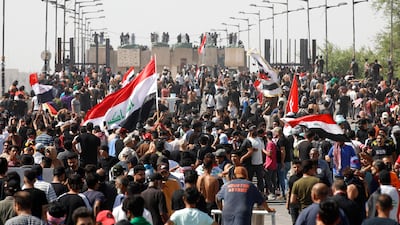
Protesters wave the Iraqi national flag as they attend a protest in Tahrir Square, Baghdad. AFP -
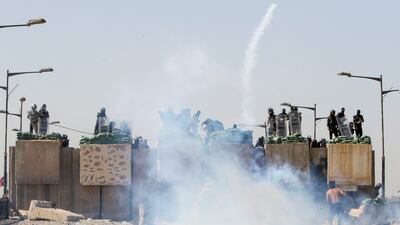
Anti-riot police, standing on barricades, disperse protesters with tear gas, in Baghdad. Reuters -
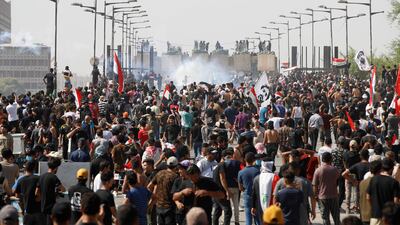
Tear gas rises as demonstrators gather in Tahrir Square in the centre of Baghdad. AFP -
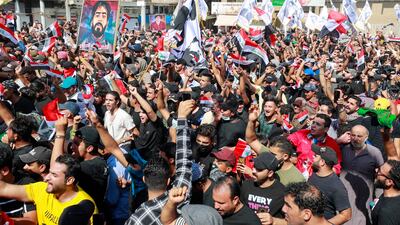
People were marking three years since anti-government protests swept through major cities in central and southern Iraq. AFP -
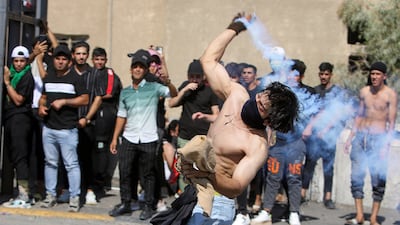
A protester hurls a tear gas canister. Reuters -
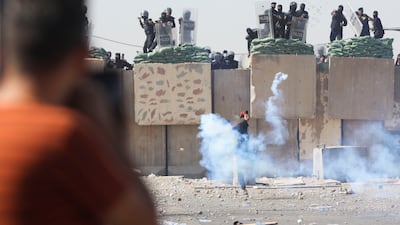
Anti-riot police clash with protesters. Reuters -
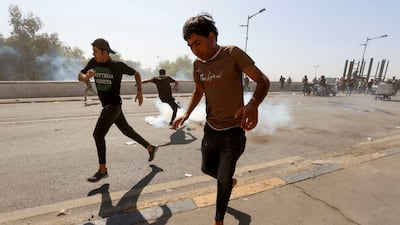
Fleeing from tear gas. Reuters -

A protester affected by tear gas is carried away. Reuters


But after the powerful anti-Iran Shiite cleric Moqtada Al Sadr, who emerged as a clear winner and sought to sideline Iran-backed parties, was frustrated in efforts to form a government and then withdrew from politics, his rivals were able to form the next administration.
After a year of political wrangling, the legislative body confirmed the new government led by Prime Minister Mohammed Shia Al Sudani nominated by the Co-ordination Framework, which is made up of influential Shiite militias and political parties close to Iran.
protester
Smoke grenade
Mr Al Mirjan, 25, lived a normal life before the October protests that broke out in major cities in central and southern Iraq. He was a taxi driver and played tambourine in a band.
The youth-led protests demanded more jobs, better services, an end to endemic corruption, an overhaul of the political system and an end to Iranian influence in Iraq.
“I was living a relatively good life, but I joined the protests to get a homeland where we all can live with dignity and have all our rights protected,” he said.
But near the end of October he was hit in the face by a smoke grenade fired by security forces. Officers fired on crowds using shot, live ammunition and large, military-grade smoke grenades causing tens of thousands of injuries.
“At the beginning, I didn’t realise what happened to me, I just fell to the ground and sudden numbness developed in all my body and I couldn’t move it,” he said.
“I was hearing my friends calling: ‘Haider, Haider, Haider’, but couldn’t move or stand up,” he said. “At that point, I started feeling smoke coming out from my mouth, ears and eyes.”
The grenade destroyed his upper and lower jaw and all his teeth. It also hit the facial nerve, known as the seventh cranial nerve, which carries nerve fibres that control facial movement and expression.

Six days later, he woke from a coma in a Baghdad hospital.
He travelled to India for treatment after receiving funds from volunteers. Five months later, he returned to Iraq and continued protesting.
Ultimately, however, he fled the country in October last year after receiving threats from Shiite militias, joining thousands of migrants who illegally crossed the borders into European countries before reaching Germany. Two months later, his family sold the house and left for Turkey.
Germany granted him political asylum and he now awaits plastic surgery in Berlin to help heal the scars and repair the damage.
Protest revival
Efforts are under way to revive the protests against Mr Al Sudani’s government soon, Mr Al Mirjan said.
“This government is rejected because it is subservient to Iran, therefore it will not serve the country and the people,” he said.
“There will be a leader for the protests and we will not go out with flowers and flags as we did before, this time we will face them with weapons if they face us with weapons,” he said.
The leaderless, youth-led protests were met with a heavy-handed crackdown from security forces and Iran-backed militias.
About 600 protesters and members of security forces were killed in the violence, while tens of thousands were wounded.
Dozens of activists reported intimidation and there were numerous kidnappings and assassinations.
Activists accused Iran-backed militias of being behind the assassinations while the government and the militias blamed “third parties”, without specifying who they were.
In early 2020, the protests ended because of the crackdowns and the coronavirus pandemic. The protests forced prime minister Adel Abdul Mahdi’s government to resign and brought in Mustafa Al Kadhimi to address the anger and organise elections.
Since then, sporadic small gatherings have taken place in provinces mostly focused around the southern city of Nasiriyah. Many activists rely on social media to deliver messages or to hold discussions.
In a sign protesters say shows Mr Al Sudani is not interested in their concerns, one of his first acts was to sack several officials in his office and other senior roles in the government who were appointed by his predecessor after October 2021.
In his first press conference after a Cabinet session on Tuesday, he cited the previous government's interim status.
"According to the Supreme Court, an interim government does not have the right [to make such senior appointments]," he said.
He did not identify the dismissed officials, but among them is the intelligence chief Raid Jouhi, who also served as Mr Al Khadimi's office manager.
Before that, he dismissed some employees in his media office. New officials linked to political parties within the Co-ordination Framework are expected to replace them as well as senior posts such as deputy ministers and general directors, according to politicians.
He also appeared to back away from a plan to hold snap elections "within a year", noting that parliament must be involved in such a move. Iraq's parliament must dissolve itself before a new vote can be held, he said.
“Iraq is back to pre-Tishreen,” political writer Mousa Jawad wrote on Twitter, using the Arabic word for October.
“From darkness to Darkness,” Mr Jawad said.

