Mohammed Shia Al Sudani, who will head the new Iraqi government as prime minster. AP

Iraq’s parliament approves new government headed by Mohammed Shia Al Sudani


Sinan Mahmoud
  • English
  • Arabic

Iraq’s parliament approved a new government headed by Mohammed Shia Al Sudani as prime minster on Thursday, ending more than a year of political deadlock during which the country teetered on the verge of collapse.

The stalemate over the formation of a new government that followed October national elections last year was the longest in Iraq since the 2003 US-led invasion that toppled Saddam Hussein.

The stalemate turned bloody when clashes broke out earlier this year between Shiite militias in Baghdad's Green Zone, the heart of government that contains the parliament buildings and foreign embassies. Dozens of people were killed or wounded.

Mr Al Sudani, a long-time Shiite politician and former minister, had 21 ministries of his Cabinet confirmed, leaving two unfilled, pending agreement among political rivals on the candidates.

In his government agenda submitted earlier to parliament, Mr Al Sudani said he was forming “a coalition government based on the national partnership principle”, referring to an informal power-sharing arrangement — the Muhasasa in Arabic — established in 2003.

Under the agreement, Shiites are entitled to 12 ministries, Sunnis six, Kurds four and the rest distributed among other religious and ethnic groups.

The two unfilled posts are the minister of environment and the minister of construction and housing, to which Kurds are entitled.

Disagreement over government posts continued as preparations were under way for Thursday's session, forcing a postponement twice before being held at 7.30pm.

Members of parliament attend a session with the new government in Baghdad, Iraq. AP

Mr Al Sudani chose deputy commander of Joint Operations Lt Gen Abdul Amir Al Shammari, a Shiite, as the interior minister and former military officer and MP Thabit Al Baldawi as defence minister.

He kept Kurdish politician Fuad Hussein as foreign minister for a second term and named the head of state-run South Gas Company Hayan Abdul Ghani Abdul Zahra as oil minister.

For the Finance Ministry, he chose long-time deputy finance minster Taif Sami Mohammed.

The Health Ministry went to former minister Salih Al Hasnawi, and the Electricity Ministry to Ziyad Ali Fadhil, who held several senior posts in the ministry.

Mr Al Sudani has set out ambitious plans to introduce economic and financial reforms, improve public services, fight endemic corruption and reduce unemployment and poverty.

He has also promised to amend the elections law within three months and to hold early national elections within a year.

The politician was the nominee of the Co-ordination Framework, the largest political group in parliament and compromising Shiite militias, which controls 138 out of 329 seats.

The UN mission in Iraq welcomed the confirmation of the new government, saying that it “faces many serious challenges that require decisive action”.

Among the challenges, the UN said, the government has to work on “ending impunity and making perpetrators accountable; and reining in non-state armed actors while asserting the state’s authority".

“A strong resolve, across the spectrum, to provide concrete solutions will prove vital,” it added, calling for the swift completion of the Cabinet.

Descended from a well-known tribe in the southern province of Maysan, Mr Al Sudani, 52, started his political career after 2003 as a member of the Shiite Dawa Party.

From 2004 to 2009, he served as member of the provincial council in his home town and as provincial governor for a year.

He ran for election with the State of Law Coalition led by former prime minister Nouri Al Maliki and has won three terms in parliament since 2014.

Among other posts, he served as minister of human rights from 2010 to 2014 and minister of labour and social affairs from 2014 to 2018.

Iraqi anti-government demonstrators — in pictures

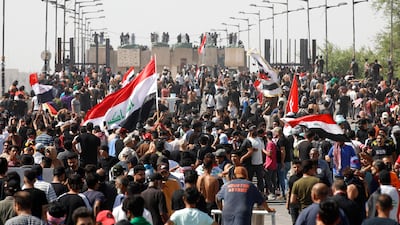
  • Protesters wave the Iraqi national flag as they attend a protest in Tahrir Square, Baghdad. AFP
    Protesters wave the Iraqi national flag as they attend a protest in Tahrir Square, Baghdad. AFP
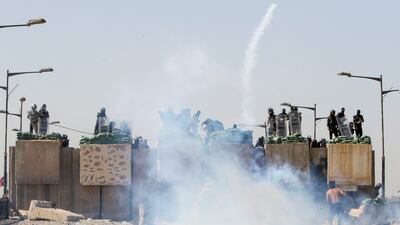
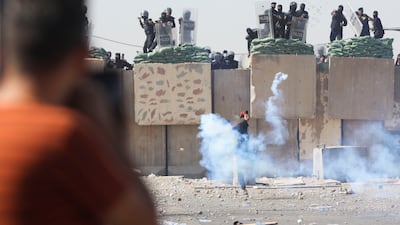
  • Anti-riot police, standing on barricades, disperse protesters with tear gas, in Baghdad. Reuters
    Anti-riot police, standing on barricades, disperse protesters with tear gas, in Baghdad. Reuters
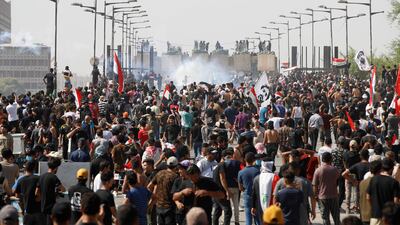
  • Tear gas rises as demonstrators gather in Tahrir Square in the centre of Baghdad. AFP
    Tear gas rises as demonstrators gather in Tahrir Square in the centre of Baghdad. AFP
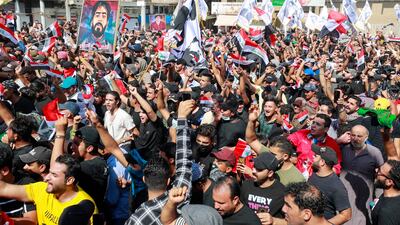
  • People were marking three years since anti-government protests swept through major cities in central and southern Iraq. AFP
    People were marking three years since anti-government protests swept through major cities in central and southern Iraq. AFP
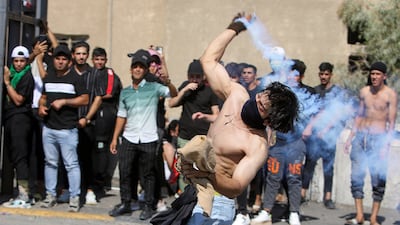
  • A protester hurls a tear gas canister. Reuters
    A protester hurls a tear gas canister. Reuters
  • Anti-riot police clash with protesters. Reuters
    Anti-riot police clash with protesters. Reuters
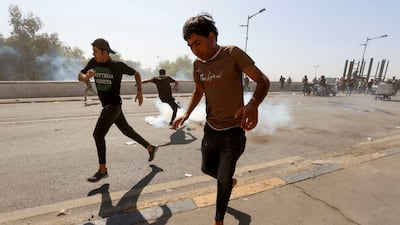
  • Fleeing from tear gas. Reuters
    Fleeing from tear gas. Reuters
  • A protester affected by tear gas is carried away. Reuters
    A protester affected by tear gas is carried away. Reuters

He worked in an acting role for several ministries during Mr Al Maliki’s two terms in office from 2006 to 2014.

Mr Al Sudani begins his tenure facing a series of challenges, including the climate crisis, high unemployment, widespread corruption and dilapidated public services.

Frustration over the failure of previous governments to deal with the country’s chronic woes has sparked protests against the political elite who have been in power since 2003.

The largest protests since 2003 broke out in October 2019 in the central and southern parts of the country, leading to the resignation of the government and the approval of a new law that led to early elections, but these achievements came with a heavy price.

The leaderless, youth-led protests were met with a heavy-handed crackdown from security forces and Iran-backed militias.

About 600 protesters and members of security forces were killed in the violence, while tens of thousands were wounded.

Dozens of activists reported intimidation. There were also a number of kidnappings and assassinations.

Activists accused Iran-backed militias of being behind the assassinations while the government and the militias blamed “third parties”, without specifying who they were.

In early 2020, the protests ended due to the crackdowns and the coronavirus pandemic. Dozens of independent candidates who took part in the protests managed to win seats in parliament following the October 2021 elections.

For the first time since 2003, the Sadrist movement, a political group backed by influential Shiite cleric Moqtada Al Sadr, will be absent from the process of forming a new government.

Mr Al Sadr's political bloc emerged as the biggest in parliament after the elections, winning 73 of the 329 seats.

However, he asked his MPs to resign in June after failing to form a majority government with Sunni and Kurdish politicians. The resignation was in protest against what Mr Al Sadr called illegal attempts, mostly by the Co-ordination Framework, to block the formation of a government.

The resignations put the Co-ordination Framework in prime position to form a government, allowing it to name as prime minister Mr Al Sudani, who has been firmly rejected by Mr Al Sadr due to his ties to the cleric's bitter rival Mr Al Maliki.


FIGHT INFO

Men’s 60kg Round 1:

Ahmad Shuja Jamal (AFG) beat Krisada Takhiankliang (THA) - points 
Hyan Aljmyah (SYR) beat Akram Alyminee (YEM) - retired Round 1
Ibrahim Bilal (UAE) beat Bhanu Pratap Pandit (IND) - TKO Round 1

Men’s 71kg Round 1:
Seyed Kaveh Soleyman (IRI) beat Abedel Rahman (JOR) - RSC round 3.
Amine Al Moatassime (UAE) walk over Ritiz Puri (NEP)

RIVER%20SPIRIT
%3Cp%3E%3Cstrong%3EAuthor%3A%20%3C%2Fstrong%3ELeila%20Aboulela%C2%A0%3C%2Fp%3E%0A%3Cp%3E%3Cstrong%3EPublisher%3A%3C%2Fstrong%3E%20Saqi%20Books%3C%2Fp%3E%0A%3Cp%3E%3Cstrong%3EPages%3A%3C%2Fstrong%3E%20320%3C%2Fp%3E%0A%3Cp%3E%3Cstrong%3EAvailable%3A%3C%2Fstrong%3E%20Now%3C%2Fp%3E%0A

6.30pm: Al Maktoum Challenge Round-3 Group 1 (PA) | US$95,000 | (Dirt) 2,000m
7.05pm: Meydan Classic Listed (TB) ) | $175,000) | (Turf) 1,600m
7.40pm: Handicap (TB) ) | $135,000 ) | (D) 1,600m
8.15pm: Nad Al Sheba Trophy Group 3 (TB) ) | $300,000) | (T) 2,810m
8.50pm: Curlin Handicap Listed (TB)) | $160,000) | (D) 2,000m
9.25pm: Handicap (TB)) | $175,000) | (T) 1,400m
10pm: Handicap (TB) ) | $135,000 ) | (T) 2,000m

COMPANY%20PROFILE
%3Cp%3E%3Cstrong%3ECompany%20name%3C%2Fstrong%3E%3A%20ASI%20(formerly%20DigestAI)%3C%2Fp%3E%0A%3Cp%3E%3Cstrong%3EStarted%3A%3C%2Fstrong%3E%202017%3C%2Fp%3E%0A%3Cp%3E%3Cstrong%3EFounders%3A%3C%2Fstrong%3E%20Quddus%20Pativada%3C%2Fp%3E%0A%3Cp%3E%3Cstrong%3EBased%3A%3C%2Fstrong%3E%20Dubai%2C%20UAE%3C%2Fp%3E%0A%3Cp%3E%3Cstrong%3EIndustry%3A%3C%2Fstrong%3E%20Artificial%20intelligence%2C%20education%20technology%3C%2Fp%3E%0A%3Cp%3E%3Cstrong%3EFunding%3A%3C%2Fstrong%3E%20%243%20million-plus%3C%2Fp%3E%0A%3Cp%3E%3Cstrong%3EInvestors%3A%3C%2Fstrong%3E%20GSV%20Ventures%2C%20Character%2C%20Mark%20Cuban%3C%2Fp%3E%0A
If you go

The flights Etihad (www.etihad.com) and Spice Jet (www.spicejet.com) fly direct from Abu Dhabi and Dubai to Pune respectively from Dh1,000 return including taxes. Pune airport is 90 minutes away by road. 

The hotels A stay at Atmantan Wellness Resort (www.atmantan.com) costs from Rs24,000 (Dh1,235) per night, including taxes, consultations, meals and a treatment package.
 

Key facilities
  • Olympic-size swimming pool with a split bulkhead for multi-use configurations, including water polo and 50m/25m training lanes
  • Premier League-standard football pitch
  • 400m Olympic running track
  • NBA-spec basketball court with auditorium
  • 600-seat auditorium
  • Spaces for historical and cultural exploration
  • An elevated football field that doubles as a helipad
  • Specialist robotics and science laboratories
  • AR and VR-enabled learning centres
  • Disruption Lab and Research Centre for developing entrepreneurial skills
PROFILE OF HALAN

Started: November 2017

Founders: Mounir Nakhla, Ahmed Mohsen and Mohamed Aboulnaga

Based: Cairo, Egypt

Sector: transport and logistics

Size: 150 employees

Investment: approximately $8 million

Investors include: Singapore’s Battery Road Digital Holdings, Egypt’s Algebra Ventures, Uber co-founder and former CTO Oscar Salazar

Ten tax points to be aware of in 2026

1. Domestic VAT refund amendments: request your refund within five years

If a business does not apply for the refund on time, they lose their credit.

2. E-invoicing in the UAE

Businesses should continue preparing for the implementation of e-invoicing in the UAE, with 2026 a preparation and transition period ahead of phased mandatory adoption. 

3. More tax audits

Tax authorities are increasingly using data already available across multiple filings to identify audit risks. 

4. More beneficial VAT and excise tax penalty regime

Tax disputes are expected to become more frequent and more structured, with clearer administrative objection and appeal processes. The UAE has adopted a new penalty regime for VAT and excise disputes, which now mirrors the penalty regime for corporate tax.

5. Greater emphasis on statutory audit

There is a greater need for the accuracy of financial statements. The International Financial Reporting Standards standards need to be strictly adhered to and, as a result, the quality of the audits will need to increase.

6. Further transfer pricing enforcement

Transfer pricing enforcement, which refers to the practice of establishing prices for internal transactions between related entities, is expected to broaden in scope. The UAE will shortly open the possibility to negotiate advance pricing agreements, or essentially rulings for transfer pricing purposes. 

7. Limited time periods for audits

Recent amendments also introduce a default five-year limitation period for tax audits and assessments, subject to specific statutory exceptions. While the standard audit and assessment period is five years, this may be extended to up to 15 years in cases involving fraud or tax evasion. 

8. Pillar 2 implementation 

Many multinational groups will begin to feel the practical effect of the Domestic Minimum Top-Up Tax (DMTT), the UAE's implementation of the OECD’s global minimum tax under Pillar 2. While the rules apply for financial years starting on or after January 1, 2025, it is 2026 that marks the transition to an operational phase.

9. Reduced compliance obligations for imported goods and services

Businesses that apply the reverse-charge mechanism for VAT purposes in the UAE may benefit from reduced compliance obligations. 

10. Substance and CbC reporting focus

Tax authorities are expected to continue strengthening the enforcement of economic substance and Country-by-Country (CbC) reporting frameworks. In the UAE, these regimes are increasingly being used as risk-assessment tools, providing tax authorities with a comprehensive view of multinational groups’ global footprints and enabling them to assess whether profits are aligned with real economic activity. 

Contributed by Thomas Vanhee and Hend Rashwan, Aurifer

The Sand Castle

Director: Matty Brown

Stars: Nadine Labaki, Ziad Bakri, Zain Al Rafeea, Riman Al Rafeea

Rating: 2.5/5

Naga
%3Cp%3E%3Cstrong%3EDirector%3A%C2%A0%3C%2Fstrong%3EMeshal%20Al%20Jaser%3C%2Fp%3E%0A%3Cp%3E%3Cstrong%3EStarring%3A%C2%A0%3C%2Fstrong%3EAdwa%20Bader%2C%20Yazeed%20Almajyul%2C%20Khalid%20Bin%20Shaddad%3C%2Fp%3E%0A%3Cp%3E%3Cstrong%3ERating%3A%20%3C%2Fstrong%3E4%2F5%3C%2Fp%3E%0A
Fitness problems in men's tennis

Andy Murray - hip

Novak Djokovic - elbow

Roger Federer - back

Stan Wawrinka - knee

Kei Nishikori - wrist

Marin Cilic - adductor

The specs

Engine: 2-litre 4-cylinder and 3.6-litre 6-cylinder

Power: 220 and 280 horsepower

Torque: 350 and 360Nm

Transmission: eight-speed automatic

Price: from Dh136,521 VAT and Dh166,464 VAT 

On sale: now

The Birkin bag is made by Hermès. 
It is named after actress and singer Jane Birkin
Noone from Hermès will go on record to say how much a new Birkin costs, how long one would have to wait to get one, and how many bags are actually made each year.

What sanctions would be reimposed?

Under ‘snapback’, measures imposed on Iran by the UN Security Council in six resolutions would be restored, including:

  • An arms embargo
  • A ban on uranium enrichment and reprocessing
  • A ban on launches and other activities with ballistic missiles capable of delivering nuclear weapons, as well as ballistic missile technology transfer and technical assistance
  • A targeted global asset freeze and travel ban on Iranian individuals and entities
  • Authorisation for countries to inspect Iran Air Cargo and Islamic Republic of Iran Shipping Lines cargoes for banned goods
GAC GS8 Specs

Engine: 2.0-litre 4cyl turbo

Power: 248hp at 5,200rpm

Torque: 400Nm at 1,750-4,000rpm

Transmission: 8-speed auto

Fuel consumption: 9.1L/100km

On sale: Now

Price: From Dh149,900

The specs
  • Engine: 3.9-litre twin-turbo V8
  • Power: 640hp
  • Torque: 760nm
  • On sale: 2026
  • Price: Not announced yet
Key fixtures from January 5-7

Watford v Bristol City

Liverpool v Everton

Brighton v Crystal Palace

Bournemouth v AFC Fylde or Wigan

Coventry v Stoke City

Nottingham Forest v Arsenal

Manchester United v Derby

Forest Green or Exeter v West Brom

Tottenham v AFC Wimbledon

Fleetwood or Hereford v Leicester City

Manchester City v Burnley

Shrewsbury v West Ham United

Wolves v Swansea City

Newcastle United v Luton Town

Fulham v Southampton

Norwich City v Chelsea

UAE currency: the story behind the money in your pockets
Updated: October 28, 2022, 5:03 AM