


Political tensions were heightened in Iraq on Wednesday, after deadly clashes erupted between two rival blocs and as an aide of influential cleric Moqtada Al Sadr warned Iran-backed groups against holding a parliamentary session.
Calm was restored in the capital and the south of the country after 30 people died and hundreds were injured during fighting on Monday night.
The violence broke out after Mr Al Sadr said he would retire from politics, which sparked clashes between his supporters and their Iran-backed rivals.
The turmoil has gripped a country that was already caught in political deadlock, with no functioning government and no common ground between the various political blocs to form a new Cabinet, nearly 11 months after a nationwide election was held.
Mr Al Sadr’s top aide, Salih Mohammed Al Iraqi, gave a warning that there should be no new attempt by rivals to form a government — despite the fact that the Iran-linked parties of the Co-ordination Framework now have the largest bloc in parliament, giving them the best chance to elect a president, who can then permit them to select a prime minister.
He called on Iran to “restrain its cattle in Iraq”, saying there would be "no place for regrets”.
Mr Al Iraqi was referring to the Co-ordination Framework, which consists of officials with close ties to neighbouring Iran. Since the US-led invasion of 2003, much of Iraq's politics have been heavily influenced by neighbouring countries.
Tehran is often said to have the most influence on state institutions and is accused by critics of intimidating or covertly funding Iraqi leaders.
Mr Al Sadr has in the past spoken out against both Iranian and western influence in Baghdad.
Since last October, Iraq has been in a state of paralysis following a nationwide election that involved Mr Al Sadr's bloc winning the most seats in Parliament but falling short of a majority.
But his party could not agree with the second-largest bloc, the Co-ordination Framework, on who to nominate for the three top posts in government: the president, prime minister and Speaker of Parliament.
The power struggle over forming the next government sparked the worst fighting for years this week.
Mr Al Sadr on Tuesday called his supporters to immediately withdraw from the protests inside Baghdad's fortified Green Zone, which they did.
-
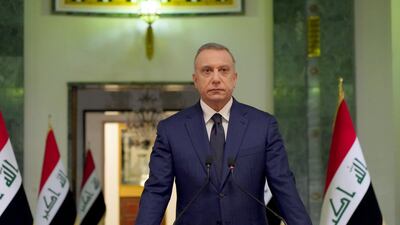
Iraqi Prime Minister Mustafa Al Kadhimi has threatened to resign if the political stand-off in the country is not resolved. Photo: Iraqi Prime Minister's Media Office -

An aerial view of Yafa Street in Baghdad after Shiite cleric Moqtada Al Sadr called on his supporters to withdraw from the Iraqi capital's heavily fortified Green Zone. AP -

Plumes of smoke rise after small fires were lit near the Tomb of the Unknown Soldier and Parliament in Baghdad. AP -
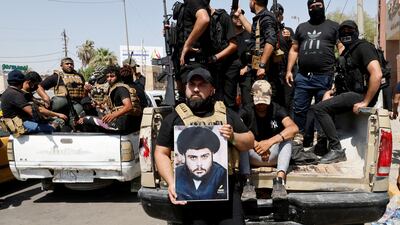
Mr Al Sadr's followers heed his call to withdraw from the Green Zone after violent clashes in Baghdad. Reuters -
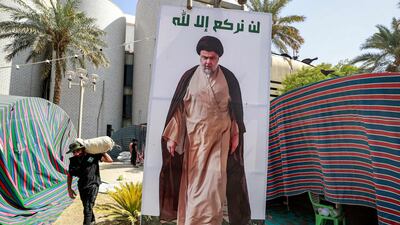
A supporter of Mr Al Sadr helps to dismantle the encampment in Baghdad's high-security Green Zone. AFP -
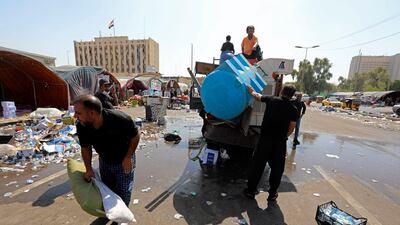
Supporters of Mr Al Sadr pack up belongings as they prepare to leave the Green Zone. AP -
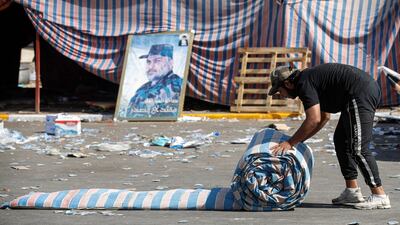
A supporter of Mr Al Sadr rolls up a mattress as their encampment in the Green Zone is dismantled. AFP -
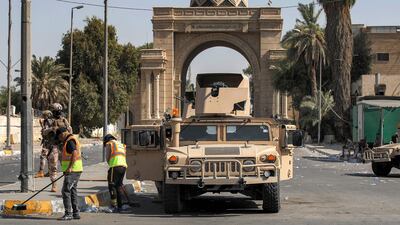
Municipality workers clean up while Iraqi army soldiers guard the entrance to the Green Zone. AFP -
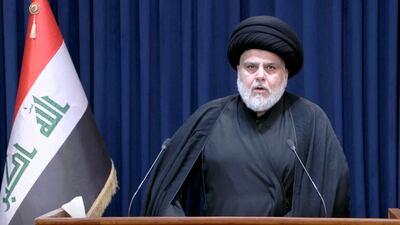
Mr Al Sadr addresses a news conference in Najaf, Iraq. Reuters -

Iraqi Shiite gunmen clash with government forces in the Green Zone of central Baghdad. EPA -
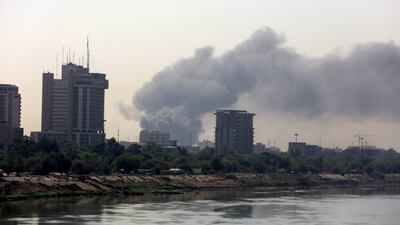
Smoke rises from a building in Baghdad. EPA -
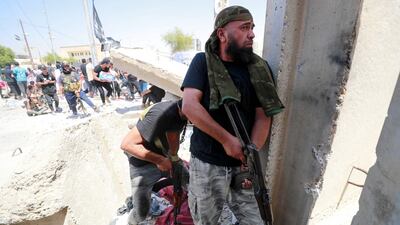
Armed members of Saraya Al Salam, the military wing affiliated with Shiite cleric Moqtada Al Sadr. AFP -
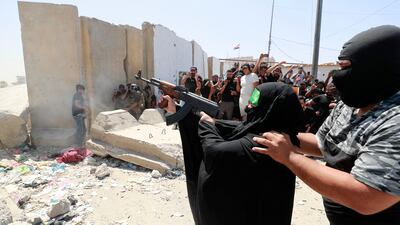
An armed member of Saraya Al Salam. AFP -
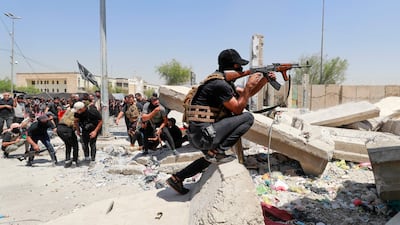
A member of Saraya Al Salam takes aim. AFP -
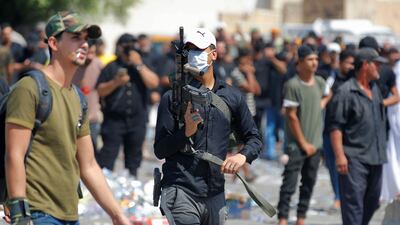
Armed members of the Peace Brigades militia in Baghdad's Green Zone. AFP -
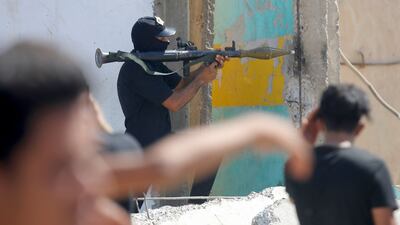
They are affiliated with Shiite cleric Moqtada Al Sadr. AFP -
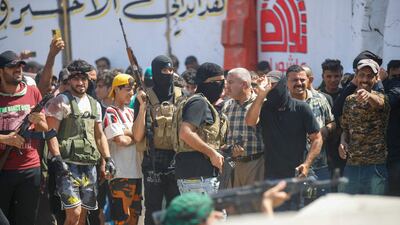
Peace Brigades members clash with security forces in the Iraqi capital. AFP -
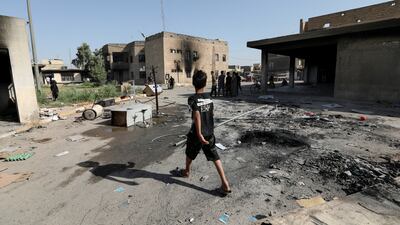
The office of rival Shiite party the Badr Organisation, which was burnt by Sadrists. Reuters -
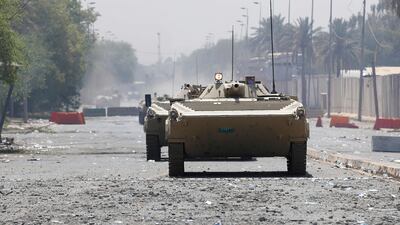
Iraqi security armoured vehicles during clashes with the Peace Brigades in the Green Zone. AFP -
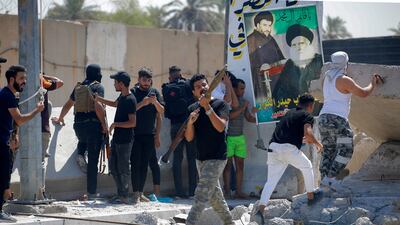
Peace Brigades members carry weapons in the fortified zone. AFP -
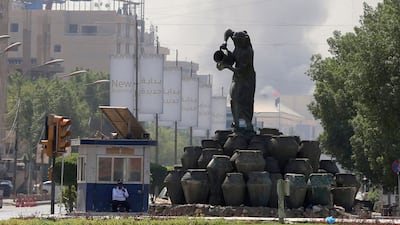
Smoke over Baghdad during an army-imposed curfew, a day after 23 Al Sadr supporters were shot dead. AFP -
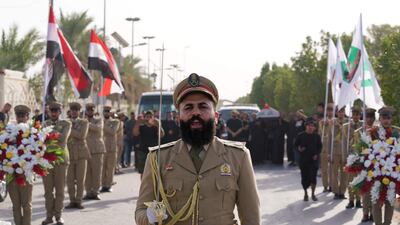
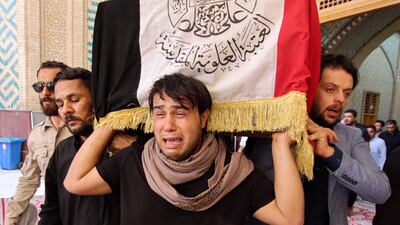
A Peace Brigades member leads a mass funeral in Najaf for Al Sadr supporters killed in the clashes in Baghdad's Green Zone. AFP -
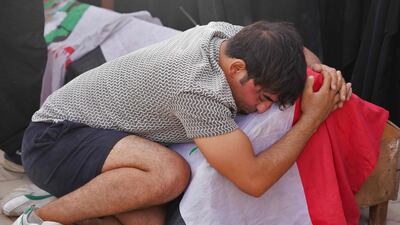
Tears during the mass funeral. AFP -

Mourners pray in front of the coffins of Al Sadr supporters. Reuters -
A coffin is carried at the funeral. AFP -
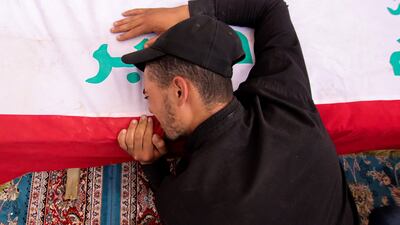
The ceremony took place at a cemetery in Najaf, central Iraq. AFP


Mr Al Sadr's speech "immediately cleared the way for parliament to resume its business and political actors to restart government formation negotiations," said Abbas Kadhim, director of the Iraqi Initiative at the Atlantic Council.
"What happens next depends on the direction that Sadr’s rivals will take," he said.
The tussle has deepened the gap in Iraq's Shiite community, especially as it has dominated the country's politics since 2003.
For weeks, Mr Al Sadr has been pressing for fresh elections and the dissolution of Parliament, a move that his rivals, the Shiite Co-ordination Framework, have opposed.
Many experts believe that if the Framework can unilaterally form a government and exclude the Sadrists then another round of violence will be seen on the streets.
"I was not surprised by the position of the Framework when they announced their proceeding with the convening of Parliament to form their government while the blood of the executed, from peaceful demonstrators and the bullets of their militias has not dried out," Mr Al Iraqi said on Twitter.
He accused the Framework and its militias of killing and attacking supporters of the Sadrist movement, who were holding a sit-in at the parliament building.
However, during his speech, Mr Al Sadr thanked the Iran-backed militias, known as the Hashed Al Shaabi, or Popular Mobilisation Forces, for their collective security. He said he does not believe they were responsible for the death of protesters.
It is widely believed that Mr Al Iraqi is Mr Al Sadr's "proxy" and his statement shows the concern that they have had regarding the Framework's push to form a government without them, said Sajad Jiyad, an Iraqi political analyst.
“Sadr will not sit by and watch and will do his utmost to prevent that,” said Mr Jiyad, who is based in Baghdad and a fellow at the Century Foundation.
"To be clear, this is not Sadr speaking directly, rather through his ‘minister’, who is his nephew Ali, more hardline than Moqtada himself," Mr Jiyad said.
The populist cleric has found himself "boxed into a corner, the Co-ordination Framework need to realise the danger and find a way to compromise with him," he said.
Mr Al Sadr commands a thousands-strong militia and has millions of loyal supporters across the country. His opponents, longtime allies of Tehran, control dozens of paramilitary groups that heavily armed and trained by Iranian forces.
"There are uncontrolled militias, yes, but that does not mean the Sadrist Movement should also be uncontrolled," Mr Al Sadr said in his address calling off the protests on Tuesday.
For weeks, Mr Al Sadr's supporters had been staging a sit-in outside Iraq's parliament, after storming the legislature's interior on July 30, demanding thtat fresh elections be held.
The Coordination Framework wants a new head of government to be appointed before any new polls.
Shortly after calm was restored to the Iraqi capital on Tuesday, the Framework called on "parliament and other state institutions to return to exercising their constitutional functions".

