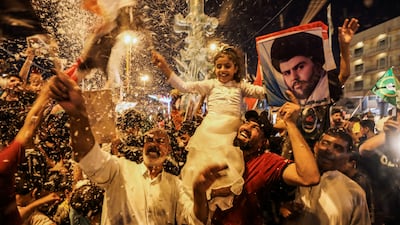
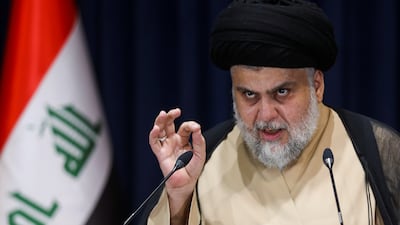
Iraqi populist Shiite cleric Moqtada Al Sadr accused his Iran-aligned political rivals of abusing the judiciary for their own interests on Wednesday, amid wrangling over the formation of a new government.
Although Mr Al Sadr’s political group emerged in the strongest position after October's elections, gaining 73 seats out of 328 in the country's national assembly, he failed to form a government with his allies, prompting him to order his MPs to resign.
Meanwhile on Thursday, the deeply divided parliament held an extraordinary session and swore in new lawmakers to replace resigned Sadrist lawmakers.
Only 64 new lawmakers took the constitutional oath to the parliament, while nine others did not attend the session, the office of the Parliament Speaker said.
The office did not provide details on how many seats other parties gained after the mass resignation, but was likely to strengthen the position of Mr Al Sadr's Iran-backed rivals.
The resignation of Sadrists has complicated the political stalemate in the country, casting further doubt on the process of forming a government eight months after the national elections.
Mr Al Sadr did not identify any specific political party on Wednesday, but said “Iran’s arms are practising political violations against the Iraqi judiciary for their own interests”.
“They are also trying to exert pressure on other political blocs, whether independents or non-Shiite blocs,” he said.
“Some blocs are afraid of increasing illegal pressure on them, such as violence or issuing judicial decisions or spreading rumours."
He also dismissed as “groundless and a lie” reports that he ordered his bloc to resign from parliament owing to pressure from Iran.
Mr Al Sadr is one of Iraq's most powerful figures, with a national following. He became a prominent leader after the 2003 fall of Saddam Hussein following the US-led invasion.
Mr Al Sadr wanted to move away from a political system introduced by the US that is based on sectarian apportionment. The system considers the political influence and perceived entitlements of each sect during government formation, rather than policy agendas.
For that goal, he wanted to form a majority government only with winners from Sunni and Kurdish parties — respecting the will of voters, rather than negotiating backroom deals.
That has upset his rivals in the Co-ordination Framework, an umbrella group of Iran-backed militias and parties that suffered major losses in the elections.
The group wants him to help to form a wider Shiite bloc to negotiate the formation of a government and the division of posts along sectarian lines.
Since the resignation, the Co-ordination Framework has tried to forge a deal with Mr Al Sadr’s allies, the Kurdistan Democratic Party (KDP) and the Sunni Sovereignty Alliance, but has failed to make headway.
Members of the KDP and the alliance have come under attack and received threats from armed groups. Analysts have blamed the incidents on Iran-backed militias, something Mr Al Sadr alluded to on Wednesday.

Ten tax points to be aware of in 2026
1. Domestic VAT refund amendments: request your refund within five years
If a business does not apply for the refund on time, they lose their credit.
2. E-invoicing in the UAE
Businesses should continue preparing for the implementation of e-invoicing in the UAE, with 2026 a preparation and transition period ahead of phased mandatory adoption.
3. More tax audits
Tax authorities are increasingly using data already available across multiple filings to identify audit risks.
4. More beneficial VAT and excise tax penalty regime
Tax disputes are expected to become more frequent and more structured, with clearer administrative objection and appeal processes. The UAE has adopted a new penalty regime for VAT and excise disputes, which now mirrors the penalty regime for corporate tax.
5. Greater emphasis on statutory audit
There is a greater need for the accuracy of financial statements. The International Financial Reporting Standards standards need to be strictly adhered to and, as a result, the quality of the audits will need to increase.
6. Further transfer pricing enforcement
Transfer pricing enforcement, which refers to the practice of establishing prices for internal transactions between related entities, is expected to broaden in scope. The UAE will shortly open the possibility to negotiate advance pricing agreements, or essentially rulings for transfer pricing purposes.
7. Limited time periods for audits
Recent amendments also introduce a default five-year limitation period for tax audits and assessments, subject to specific statutory exceptions. While the standard audit and assessment period is five years, this may be extended to up to 15 years in cases involving fraud or tax evasion.
8. Pillar 2 implementation
Many multinational groups will begin to feel the practical effect of the Domestic Minimum Top-Up Tax (DMTT), the UAE's implementation of the OECD’s global minimum tax under Pillar 2. While the rules apply for financial years starting on or after January 1, 2025, it is 2026 that marks the transition to an operational phase.
9. Reduced compliance obligations for imported goods and services
Businesses that apply the reverse-charge mechanism for VAT purposes in the UAE may benefit from reduced compliance obligations.
10. Substance and CbC reporting focus
Tax authorities are expected to continue strengthening the enforcement of economic substance and Country-by-Country (CbC) reporting frameworks. In the UAE, these regimes are increasingly being used as risk-assessment tools, providing tax authorities with a comprehensive view of multinational groups’ global footprints and enabling them to assess whether profits are aligned with real economic activity.
Contributed by Thomas Vanhee and Hend Rashwan, Aurifer
About%20My%20Father
%3Cp%3E%3Cstrong%3EDirector%3A%20%3C%2Fstrong%3ELaura%20Terruso%3C%2Fp%3E%0A%3Cp%3E%3Cstrong%3EStars%3A%20%3C%2Fstrong%3ERobert%20De%20Niro%2C%20Sebastian%20Maniscalco%2C%20Kim%20Cattrall%3C%2Fp%3E%0A%3Cp%3E%3Cstrong%3ERating%3A%3C%2Fstrong%3E%202%2F5%26nbsp%3B%3C%2Fp%3E%0A
The cost of Covid testing around the world
Egypt
Dh514 for citizens; Dh865 for tourists
Information can be found through VFS Global.
Jordan
Dh212
Centres include the Speciality Hospital, which now offers drive-through testing.
Cambodia
Dh478
Travel tests are managed by the Ministry of Health and National Institute of Public Health.
Zanzibar
AED 295
Zanzibar Public Health Emergency Operations Centre, located within the Lumumba Secondary School compound.
Abu Dhabi
Dh85
Abu Dhabi’s Seha has test centres throughout the UAE.
UK
From Dh400
Heathrow Airport now offers drive through and clinic-based testing, starting from Dh400 and up to Dh500 for the PCR test.
The%20specs
%3Cp%3E%3Cstrong%3EEngine%3A%3C%2Fstrong%3E%20Dual%20synchronous%20electric%20motors%0D%3Cbr%3E%3Cstrong%3EPower%3A%20%3C%2Fstrong%3E660hp%0D%3Cbr%3E%3Cstrong%3ETorque%3A%20%3C%2Fstrong%3E1%2C100Nm%0D%3Cbr%3E%3Cstrong%3ETransmission%3A%20%3C%2Fstrong%3ESingle-speed%20automatic%0D%3Cbr%3E%3Cstrong%3ETouring%20range%3A%20%3C%2Fstrong%3E488km-560km%0D%3Cbr%3E%3Cstrong%3EPrice%3A%20%3C%2Fstrong%3EFrom%20Dh850%2C000%20(estimate)%0D%3Cbr%3E%3Cstrong%3EOn%20sale%3A%20%3C%2Fstrong%3EOctober%3C%2Fp%3E%0A
Company%20Profile
%3Cp%3E%3Cstrong%3EName%3A%3C%2Fstrong%3E%20Neo%20Mobility%3Cbr%3E%3Cstrong%3EStarted%3A%3C%2Fstrong%3E%20February%202023%3Cbr%3E%3Cstrong%3ECo-founders%3A%3C%2Fstrong%3E%20Abhishek%20Shah%20and%20Anish%20Garg%3Cbr%3E%3Cstrong%3EBased%3A%3C%2Fstrong%3E%20Dubai%3Cbr%3E%3Cstrong%3EIndustry%3A%3C%2Fstrong%3E%20Logistics%3Cbr%3E%3Cstrong%3EFunding%3A%3C%2Fstrong%3E%20%2410%20million%3Cbr%3E%3Cstrong%3EInvestors%3A%3C%2Fstrong%3E%20Delta%20Corp%2C%20Pyse%20Sustainability%20Fund%2C%20angel%20investors%3C%2Fp%3E%0A
It Was Just an Accident
Director: Jafar Panahi
Stars: Vahid Mobasseri, Mariam Afshari, Ebrahim Azizi, Hadis Pakbaten, Majid Panahi, Mohamad Ali Elyasmehr
Rating: 4/5