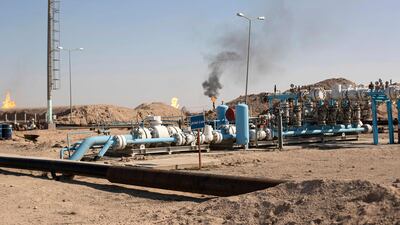
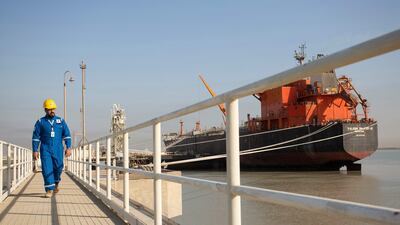
Rumaylah oil field near Basra. Iraq has yet it pay Iran money it owes for importing gas. AFP

Iraq's oil revenue hits new high as summer electricity crisis looms


  • English
  • Arabic

Iraq has failed to pay $1.6 billion owed to neighbouring Iran for gas imports, which is needed to guarantee further supplies and prevent worsening power cuts, Baghdad authorities said on Wednesday.

Payment of the debt was a vital requirement to ensure energy supplies were available for Iraq's power plants during the intense heat of the summer months, when electricity demand surges as people seek to keep cool.

The failure to pay comes as Iraq’s oil revenue imports reached another record high. Iraq's revenue reached $11.436 billion in May and has surpassed $10bn every month since March.

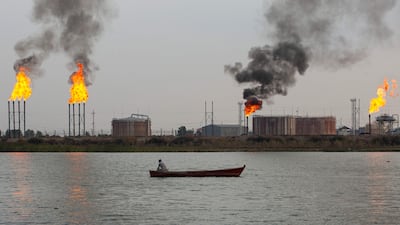
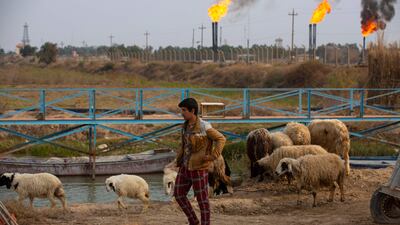
  • Flare stacks above Umm Qasr port near Iraq's southern city of Basra. In the oilfields of southern Iraq, billions of cubic feet of gas literally go up in smoke, burnt off on flare stacks for want of the infrastructure to capture and process it. All photos: AFP
    Flare stacks above Umm Qasr port near Iraq's southern city of Basra. In the oilfields of southern Iraq, billions of cubic feet of gas literally go up in smoke, burnt off on flare stacks for want of the infrastructure to capture and process it. All photos: AFP
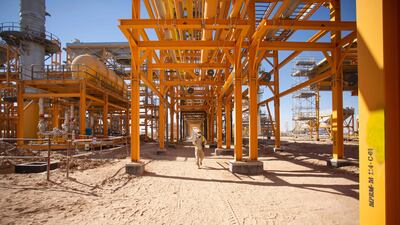
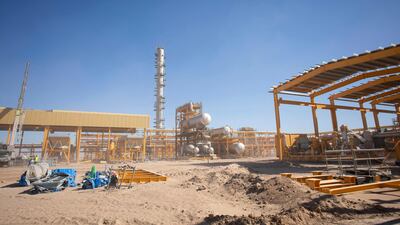
  • A gas separation plant under construction near Iraq's southern port city of Basra.
    A gas separation plant under construction near Iraq's southern port city of Basra.
  • The Nahr bin Omar oil field and facility near Basra. The flares produce vast amounts of carbon dioxide and other greenhouse gases, contributing to global warming without any economic or social benefit.
    The Nahr bin Omar oil field and facility near Basra. The flares produce vast amounts of carbon dioxide and other greenhouse gases, contributing to global warming without any economic or social benefit.
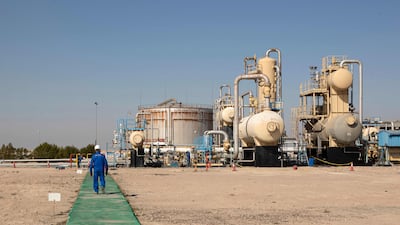
  • A processing facility in Artawi, near Basra.
    A processing facility in Artawi, near Basra.
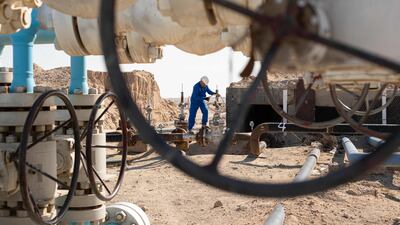
  • Part of the processing facility in Artawi.
    Part of the processing facility in Artawi.
  • Flare stacks burn off excess gas at the facility in Artawi.
    Flare stacks burn off excess gas at the facility in Artawi.
  • A gas separation plant under construction near Basra.
    A gas separation plant under construction near Basra.
  • Flare stacks at the Nahr bin Omar oil field near Basra.
    Flare stacks at the Nahr bin Omar oil field near Basra.
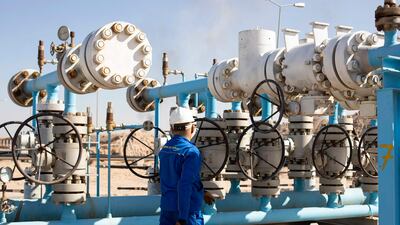
  • A technician at the processing facility in Artawi.
    A technician at the processing facility in Artawi.
  • Umm Qasr port near Basra, in southern Iraq.
    Umm Qasr port near Basra, in southern Iraq.

The last time oil revenue in Iraq was as high was in April 2012, when it reached almost $8.8bn.

“Iran had demanded the payment by Iraq of its financial obligations for the payment of the gas,” Iraq's Electricity Ministry said in a statement.

However, “the delay in the adoption of the budget”, as well as parliamentary blockages stalling a bill that aimed to guarantee debt payments in the electricity sector, led to “delays”.

Supplies have already been reduced by five million cubic metres of gas per day, limiting the operation of the power stations and “reducing the hours of electricity supply”, the ministry said.

Iran gas supply issues

Iran currently provides a third of Iraq's gas and electricity needs but supplies are regularly cut or reduced, aggravating daily load-shedding.

Iraq has struggled to pay Iran on time, first because of spending on security during the war against ISIS between 2014 and 2017 — which followed a slump in oil prices — and later due to the Covid-19 pandemic, which caused an unprecedented collapse in oil prices.

Iran also struggles to meet domestic demand, particularly during Tehran's cold winters and at the height of summer, when high temperatures scorch the south of the country.

Iraq's Electricity Ministry highlighted the “efforts of parliament and the government” to allow the ministry to “find compromise solutions with Iran in order to pay the arrears and guarantee the supply of gas”.

The debt, which was due to have been paid by the start of June, dates back to 2020.

Payment stalled amid sanctions against Iran by the US, which mean that Baghdad could not pay directly for energy imports in cash.

Instead, it must be used in a complicated process to buy goods from the agriculture or pharmaceutical sectors.

Last year, when temperatures in Iraq soared to 52°C in the shade, swathes of the country suffered blackouts, sparking several sporadic protests and prompting the electricity minister to resign.

Iraq is already sweltering, with temperatures climbing to 48°C on Thursday, the meteorological service says.

Ranked as one of the world's five most vulnerable nations to the effects of climate change, Iraq has been hit by a series of sandstorms in recent months, sending thousands of people to hospital with respiratory problems.


Mina Cup winners

Under 12 – Minerva Academy

Under 14 – Unam Pumas

Under 16 – Fursan Hispania

Under 18 – Madenat

WRESTLING HIGHLIGHTS
APPLE IPAD MINI (A17 PRO)

Display: 21cm Liquid Retina Display, 2266 x 1488, 326ppi, 500 nits

Chip: Apple A17 Pro, 6-core CPU, 5-core GPU, 16-core Neural Engine

Storage: 128/256/512GB

Main camera: 12MP wide, f/1.8, digital zoom up to 5x, Smart HDR 4

Front camera: 12MP ultra-wide, f/2.4, Smart HDR 4, full-HD @ 25/30/60fps

Biometrics: Touch ID, Face ID

Colours: Blue, purple, space grey, starlight

In the box: iPad mini, USB-C cable, 20W USB-C power adapter

Price: From Dh2,099

PROFILE OF HALAN

Started: November 2017

Founders: Mounir Nakhla, Ahmed Mohsen and Mohamed Aboulnaga

Based: Cairo, Egypt

Sector: transport and logistics

Size: 150 employees

Investment: approximately $8 million

Investors include: Singapore’s Battery Road Digital Holdings, Egypt’s Algebra Ventures, Uber co-founder and former CTO Oscar Salazar

Milestones on the road to union

1970

October 26: Bahrain withdraws from a proposal to create a federation of nine with the seven Trucial States and Qatar. 

December: Ahmed Al Suwaidi visits New York to discuss potential UN membership.

1971

March 1:  Alex Douglas Hume, Conservative foreign secretary confirms that Britain will leave the Gulf and “strongly supports” the creation of a Union of Arab Emirates.

July 12: Historic meeting at which Sheikh Zayed and Sheikh Rashid make a binding agreement to create what will become the UAE.

July 18: It is announced that the UAE will be formed from six emirates, with a proposed constitution signed. RAK is not yet part of the agreement.

August 6:  The fifth anniversary of Sheikh Zayed becoming Ruler of Abu Dhabi, with official celebrations deferred until later in the year.

August 15: Bahrain becomes independent.

September 3: Qatar becomes independent.

November 23-25: Meeting with Sheikh Zayed and Sheikh Rashid and senior British officials to fix December 2 as date of creation of the UAE.

November 29:  At 5.30pm Iranian forces seize the Greater and Lesser Tunbs by force.

November 30: Despite  a power sharing agreement, Tehran takes full control of Abu Musa. 

November 31: UK officials visit all six participating Emirates to formally end the Trucial States treaties

December 2: 11am, Dubai. New Supreme Council formally elects Sheikh Zayed as President. Treaty of Friendship signed with the UK. 11.30am. Flag raising ceremony at Union House and Al Manhal Palace in Abu Dhabi witnessed by Sheikh Khalifa, then Crown Prince of Abu Dhabi.

December 6: Arab League formally admits the UAE. The first British Ambassador presents his credentials to Sheikh Zayed.

December 9: UAE joins the United Nations.

Honeymoonish
%3Cp%3E%3Cstrong%3EDirector%3A%3C%2Fstrong%3E%20Elie%20El%20Samaan%3C%2Fp%3E%0A%3Cp%3E%3Cstrong%3EStarring%3A%20%3C%2Fstrong%3ENour%20Al%20Ghandour%2C%20Mahmoud%20Boushahri%3C%2Fp%3E%0A%3Cp%3E%3Cstrong%3ERating%3A%3C%2Fstrong%3E%203%2F5%3C%2Fp%3E%0A
BULKWHIZ PROFILE

Date started: February 2017

Founders: Amira Rashad (CEO), Yusuf Saber (CTO), Mahmoud Sayedahmed (adviser), Reda Bouraoui (adviser)

Based: Dubai, UAE

Sector: E-commerce 

Size: 50 employees

Funding: approximately $6m

Investors: Beco Capital, Enabling Future and Wain in the UAE; China's MSA Capital; 500 Startups; Faith Capital and Savour Ventures in Kuwait

Hotel Silence
Auður Ava Ólafsdóttir
Pushkin Press

Liverpool's all-time goalscorers

Ian Rush 346
Roger Hunt 285
Mohamed Salah 250
Gordon Hodgson 241
Billy Liddell 228

GAC GS8 Specs

Engine: 2.0-litre 4cyl turbo

Power: 248hp at 5,200rpm

Torque: 400Nm at 1,750-4,000rpm

Transmission: 8-speed auto

Fuel consumption: 9.1L/100km

On sale: Now

Price: From Dh149,900

Who's who in Yemen conflict

Houthis: Iran-backed rebels who occupy Sanaa and run unrecognised government

Yemeni government: Exiled government in Aden led by eight-member Presidential Leadership Council

Southern Transitional Council: Faction in Yemeni government that seeks autonomy for the south

Habrish 'rebels': Tribal-backed forces feuding with STC over control of oil in government territory

Updated: June 01, 2022, 2:28 PM