UN special representative to Iraq, the Dutch diplomat Jeanine Hennis-Plasschaert, has urged the formation of a new Iraqi government to avoid unrest. AP

UN warns Iraq to form government before 'streets boil over'


Sinan Mahmoud
  • English
  • Arabic

The UN envoy to Iraq on Tuesday chastised the country's political elite over the failure to form a new government in more than seven months since national elections were held.

Dutch diplomat Jeanine Hennis-Plasschaert also warned that the continuing political impasse could spark civil unrest in the country that is still suffering from consequences of decades of war, rampant corruption, fragile security and environmental challenges.

"The streets are about to boil over in Iraq," she told reporters after briefing the UN Security Council, adding that Iraq and the region cannot afford to go back to October 2019, when deadly street protests rocked the country.

The formation of a new government in Iraq is a protracted process. The various political factions are usually mired in negotiations and horse-trading for months.

The "notorious aspects of Iraqi political life are repeating themselves in a seemingly incessant loop of zero-sum politics," Ms Hennis-Plasschaert said in her briefing.

Iraq's political elite have yet to solve a long list of domestic challenges, ranging from post-war reconstruction, climate change and security, to disagreements over how to manage the country's natural resources.

With the country's politicians "content with stale power battles," Ms Hennis-Plasschaert said Iraqis "are waiting for a political class that will roll up its sleeves to make headway on Iraq’s long list of outstanding domestic priorities".

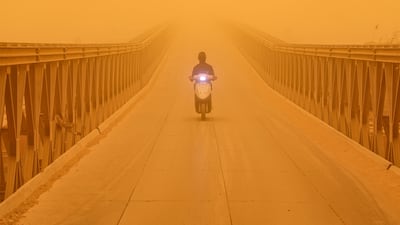
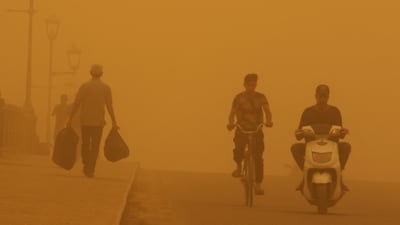
  • A motorist drives a scooter along a bridge in the city of Nasiriyah, Iraq, during a heavy dust storm. AFP
    A motorist drives a scooter along a bridge in the city of Nasiriyah, Iraq, during a heavy dust storm. AFP
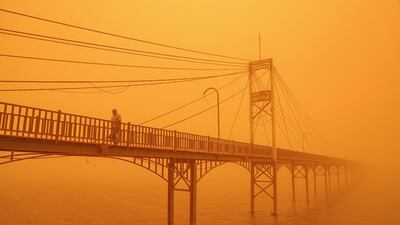
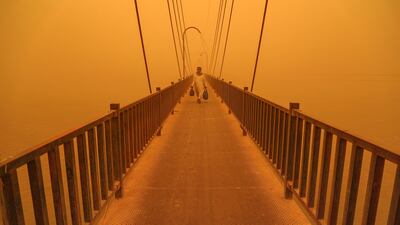
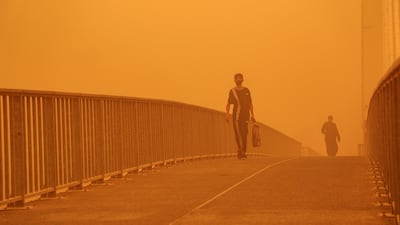
  • A man crosses the River Euphrates in Nasiriyah, where the dust storm had reduced visibility severely. AFP
    A man crosses the River Euphrates in Nasiriyah, where the dust storm had reduced visibility severely. AFP
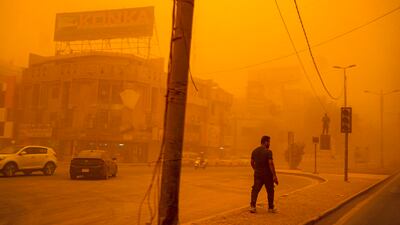
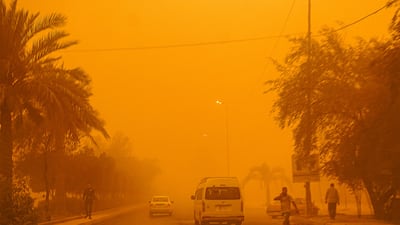
  • Heavy dust in the air in Iraq's capital Baghdad. AFP
    Heavy dust in the air in Iraq's capital Baghdad. AFP
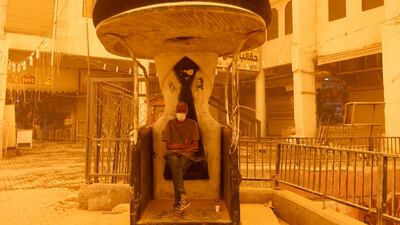
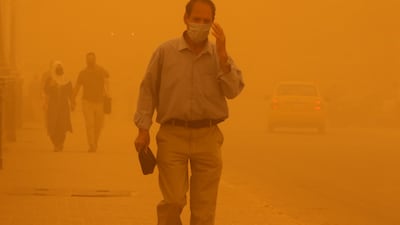
  • A man wears a mask as he rests in a traffic policeman's booth during the storm in Baghdad. Reuters
    A man wears a mask as he rests in a traffic policeman's booth during the storm in Baghdad. Reuters
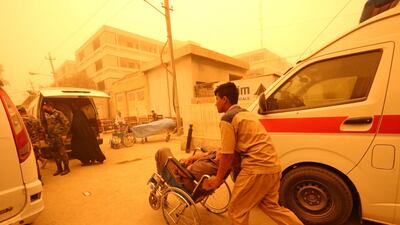
  • A patient suffering from breathing problems arrives for care at Sheikh Zayed Hospital in Baghdad. AFP
    A patient suffering from breathing problems arrives for care at Sheikh Zayed Hospital in Baghdad. AFP
  • Baghdad's streets were quieter than usual as the dust storm raged. AP
    Baghdad's streets were quieter than usual as the dust storm raged. AP
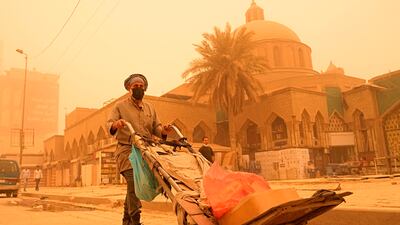
  • A man wearing a protective mask pushes a cart during the dust storm in Baghdad. AP
    A man wearing a protective mask pushes a cart during the dust storm in Baghdad. AP
  • This man found it hard to see from one side of the bridge to the other as he crossed over the Euphrates. AFP
    This man found it hard to see from one side of the bridge to the other as he crossed over the Euphrates. AFP
  • Dust or sand storms are not unusual in the region but many have hit Baghdad and its surrounding areas in the past few weeks. Reuters
    Dust or sand storms are not unusual in the region but many have hit Baghdad and its surrounding areas in the past few weeks. Reuters
  • Cars drive by a mosque in Baghdad, barely visible due to the storm. Reuters
    Cars drive by a mosque in Baghdad, barely visible due to the storm. Reuters
  • People cross a bridge during a sandstorm in Baghdad. Reuters
    People cross a bridge during a sandstorm in Baghdad. Reuters
  • The storms tend to turn the sky an orange colour. AFP
    The storms tend to turn the sky an orange colour. AFP
  • Dust fills the air in Baghdad. AFP
    Dust fills the air in Baghdad. AFP

But more than seven months after the country held early elections, "multiple deadlines for the formation of a government have been missed", she said. Ms Hennis-Plasschaert added that political leaders agree to hold negotiations and dialogues, "but the necessary willingness to compromise? It is painfully absent".

"Visit any market and Iraqis will tell you: the national interest is, yet again, taking a back seat to short-sighted considerations of control over resources and power play," she said.

Iraqis, she said, also want “an end to pervasive corruption; factionalism and the pillaging of state institutions; a diversification of the economy; an end to impunity; the reining in of armed groups; and “predictable governance instead of constant crisis management".

Enmity between Shiite populist cleric Moqtada Al Sadr, whose Sadrist Bloc emerged as the clear winner with 73 seats in the 329-seat parliament, and some of his Iran-backed Shiite rivals is the main obstacle to forming the new government.

Influential Shiite cleric Moqtada Al Sadr is trying to form a majority government. Reuters

Mr Al Sadr wants to form a majority government only with the winners among Sunni and Kurdish political parties. This has irritated his rivals from the Iran-backed Co-ordination Framework, who have been delayed forming the government to force Mr Al Sadr to give them a voice.

Ms Hennis-Plasschaert was also sharply critical of the missile and rocket attacks by Turkey and Iran, describing them as “disturbing, disruptive and dangerous”.

She also drew attention to armed groups operating beyond the control of the government, who have been recklessly firing rockets, including at an oil refinery in Erbil, the capital of the Kurdistan region, two weeks ago.

"Significant domestic vulnerabilities are being compounded by the ongoing effects of the pandemic and global geopolitical tensions," she said.

"A sincere, collective and urgent will to resolve political differences must now prevail for the country to move forward and to meet the needs of its citizens."

More than seven months after legislative elections, Iraqi institutions are at a standstill over lawmakers' inability to elect a president. It is the president's job to select the largest block in parliament to form a government.

In the interim, the outgoing president, Barham Salih, who had run for re-election, and Prime Minister Mustafa Al Kadhimi have been taking care of the day-to-running of the country.


Have you been targeted?

Tuan Phan of SimplyFI.org lists five signs you have been mis-sold to:

1. Your pension fund has been placed inside an offshore insurance wrapper with a hefty upfront commission.

2. The money has been transferred into a structured note. These products have high upfront, recurring commission and should never be in a pension account.

3. You have also been sold investment funds with an upfront initial charge of around 5 per cent. ETFs, for example, have no upfront charges.

4. The adviser charges a 1 per cent charge for managing your assets. They are being paid for doing nothing. They have already claimed massive amounts in hidden upfront commission.

5. Total annual management cost for your pension account is 2 per cent or more, including platform, underlying fund and advice charges.

Defence review at a glance

• Increase defence spending to 2.5% of GDP by 2027 but given “turbulent times it may be necessary to go faster”

• Prioritise a shift towards working with AI and autonomous systems

• Invest in the resilience of military space systems.

• Number of active reserves should be increased by 20%

• More F-35 fighter jets required in the next decade

• New “hybrid Navy” with AUKUS submarines and autonomous vessels

UAE currency: the story behind the money in your pockets
Ten tax points to be aware of in 2026

1. Domestic VAT refund amendments: request your refund within five years

If a business does not apply for the refund on time, they lose their credit.

2. E-invoicing in the UAE

Businesses should continue preparing for the implementation of e-invoicing in the UAE, with 2026 a preparation and transition period ahead of phased mandatory adoption. 

3. More tax audits

Tax authorities are increasingly using data already available across multiple filings to identify audit risks. 

4. More beneficial VAT and excise tax penalty regime

Tax disputes are expected to become more frequent and more structured, with clearer administrative objection and appeal processes. The UAE has adopted a new penalty regime for VAT and excise disputes, which now mirrors the penalty regime for corporate tax.

5. Greater emphasis on statutory audit

There is a greater need for the accuracy of financial statements. The International Financial Reporting Standards standards need to be strictly adhered to and, as a result, the quality of the audits will need to increase.

6. Further transfer pricing enforcement

Transfer pricing enforcement, which refers to the practice of establishing prices for internal transactions between related entities, is expected to broaden in scope. The UAE will shortly open the possibility to negotiate advance pricing agreements, or essentially rulings for transfer pricing purposes. 

7. Limited time periods for audits

Recent amendments also introduce a default five-year limitation period for tax audits and assessments, subject to specific statutory exceptions. While the standard audit and assessment period is five years, this may be extended to up to 15 years in cases involving fraud or tax evasion. 

8. Pillar 2 implementation 

Many multinational groups will begin to feel the practical effect of the Domestic Minimum Top-Up Tax (DMTT), the UAE's implementation of the OECD’s global minimum tax under Pillar 2. While the rules apply for financial years starting on or after January 1, 2025, it is 2026 that marks the transition to an operational phase.

9. Reduced compliance obligations for imported goods and services

Businesses that apply the reverse-charge mechanism for VAT purposes in the UAE may benefit from reduced compliance obligations. 

10. Substance and CbC reporting focus

Tax authorities are expected to continue strengthening the enforcement of economic substance and Country-by-Country (CbC) reporting frameworks. In the UAE, these regimes are increasingly being used as risk-assessment tools, providing tax authorities with a comprehensive view of multinational groups’ global footprints and enabling them to assess whether profits are aligned with real economic activity. 

Contributed by Thomas Vanhee and Hend Rashwan, Aurifer

The Way It Was: My Life with Frank Sinatra by Eliot Weisman and Jennifer Valoppi
Hachette Books

Key facilities
  • Olympic-size swimming pool with a split bulkhead for multi-use configurations, including water polo and 50m/25m training lanes
  • Premier League-standard football pitch
  • 400m Olympic running track
  • NBA-spec basketball court with auditorium
  • 600-seat auditorium
  • Spaces for historical and cultural exploration
  • An elevated football field that doubles as a helipad
  • Specialist robotics and science laboratories
  • AR and VR-enabled learning centres
  • Disruption Lab and Research Centre for developing entrepreneurial skills
What vitamins do we know are beneficial for living in the UAE

Vitamin D: Highly relevant in the UAE due to limited sun exposure; supports bone health, immunity and mood.Vitamin B12: Important for nerve health and energy production, especially for vegetarians, vegans and individuals with absorption issues.Iron: Useful only when deficiency or anaemia is confirmed; helps reduce fatigue and support immunity.Omega-3 (EPA/DHA): Supports heart health and reduces inflammation, especially for those who consume little fish.

Key changes

Commission caps

For life insurance products with a savings component, Peter Hodgins of Clyde & Co said different caps apply to the saving and protection elements:

• For the saving component, a cap of 4.5 per cent of the annualised premium per year (which may not exceed 90 per cent of the annualised premium over the policy term). 

• On the protection component, there is a cap  of 10 per cent of the annualised premium per year (which may not exceed 160 per cent of the annualised premium over the policy term).

• Indemnity commission, the amount of commission that can be advanced to a product salesperson, can be 50 per cent of the annualised premium for the first year or 50 per cent of the total commissions on the policy calculated. 

• The remaining commission after deduction of the indemnity commission is paid equally over the premium payment term.

• For pure protection products, which only offer a life insurance component, the maximum commission will be 10 per cent of the annualised premium multiplied by the length of the policy in years.

Disclosure

Customers must now be provided with a full illustration of the product they are buying to ensure they understand the potential returns on savings products as well as the effects of any charges. There is also a “free-look” period of 30 days, where insurers must provide a full refund if the buyer wishes to cancel the policy.

“The illustration should provide for at least two scenarios to illustrate the performance of the product,” said Mr Hodgins. “All illustrations are required to be signed by the customer.”

Another illustration must outline surrender charges to ensure they understand the costs of exiting a fixed-term product early.

Illustrations must also be kept updatedand insurers must provide information on the top five investment funds available annually, including at least five years' performance data.

“This may be segregated based on the risk appetite of the customer (in which case, the top five funds for each segment must be provided),” said Mr Hodgins.

Product providers must also disclose the ratio of protection benefit to savings benefits. If a protection benefit ratio is less than 10 per cent "the product must carry a warning stating that it has limited or no protection benefit" Mr Hodgins added.

Generation Start-up: Awok company profile

Started: 2013

Founder: Ulugbek Yuldashev

Sector: e-commerce

Size: 600 plus

Stage: still in talks with VCs

Principal Investors: self-financed by founder

On Instagram: @WithHopeUAE

Although social media can be harmful to our mental health, paradoxically, one of the antidotes comes with the many social-media accounts devoted to normalising mental-health struggles. With Hope UAE is one of them.
The group, which has about 3,600 followers, was started three years ago by five Emirati women to address the stigma surrounding the subject. Via Instagram, the group recently began featuring personal accounts by Emiratis. The posts are written under the hashtag #mymindmatters, along with a black-and-white photo of the subject holding the group’s signature red balloon.
“Depression is ugly,” says one of the users, Amani. “It paints everything around me and everything in me.”
Saaed, meanwhile, faces the daunting task of caring for four family members with psychological disorders. “I’ve had no support and no resources here to help me,” he says. “It has been, and still is, a one-man battle against the demons of fractured minds.”
In addition to With Hope UAE’s frank social-media presence, the group holds talks and workshops in Dubai. “Change takes time,” Reem Al Ali, vice chairman and a founding member of With Hope UAE, told The National earlier this year. “It won’t happen overnight, and it will take persistent and passionate people to bring about this change.”

'Texas Chainsaw Massacre'

Rating: 1 out of 4

Running time: 81 minutes

Director: David Blue Garcia

Starring: Sarah Yarkin, Elsie Fisher, Mark Burnham

Updated: May 18, 2022, 12:19 PM